Category Archives: Careers

The A.I. Tug of War in Fundraising—And How to Find Your Footing

Let me ask you something: How many times has a piece of technology promised to change everything… and then promptly driven you absolutely crazy?

You know the scenarios. It can do all the things, but only after you’ve configured everything yourself. “Integration” turned out to mean something very different from what you imagined. The upgrade wiped out every custom setting you spent hours building. And whenever you try to do something just slightly outside the norm, the software fights you like a toddler at bedtime.

I could go on. We have all been there.

And yet—here’s the tension—technology genuinely has made our lives easier. Microsoft Word may not make complex formatting a walk in the park, but it has transformed how we create documents. And because it plays nicely with the rest of the MS Office suite, whole categories of headaches have simply disappeared.

Welcome to the tug of war.

The Two Ends of the Rope

When it comes to A.I. in fundraising, this same push and pull is playing out in real time. On one end of the rope are the people who believe A.I. is too messy, too risky, and too unreliable to touch. On the other end are the people who believe A.I. has ushered in such a leap in accuracy that we can use machine-generated information as-is, no human review required.

New technologies that arrive with enormous hype—and A.I. certainly arrived with enormous hype—have a way of polarizing us. But is there something useful to be found in the middle of that rope?

Spoiler alert: There is.

Yes, A.I. Has Been Around. But This Feels Different.

A.I. has been woven into our digital experience for years. Recommendation engines. Spam filters. Autocomplete. But when OpenAI released ChatGPT in 2022, it felt less like a product launch and more like a digital eruption. Things are moving fast. New and genuinely exciting capabilities are emerging. And yes, things are getting broken along the way.

For many in our field, the speed of that change feels dangerous. Whatever you do, don’t ask A.I.

But much like the anxiety that greeted Google’s debut—remember when people worried that nobody would learn anything anymore?—there is real and practical value here, if you know how to use it.

One of the most useful features of a generative A.I. chatbot is that you can ask it to show its work. Where did that information come from? What sources support that conclusion? What transactions were used to build that summary? That transparency is actually a significant feature, not a quirk.

Where A.I. Is Changing the Game for Prospect Research

At Aspire Research Group, one of the most dramatic shifts A.I. has made in our day-to-day work is in writing bios. Even setting aside the time required to gather information, writing a few well-crafted paragraphs about a prospect has always been time-intensive. Using DonorAtlas, we now have well-written bios and the underlying sources for verification—almost instantly. We can deliver a significantly stronger product at the low end, in far less time.

Until, of course, A.I. fails us. And it does fail us.

People in the arts, for example, seem to get misrepresented by A.I. with striking frequency. What is their “job,” exactly? They don’t fit the pattern that it expects. In those cases, we take over the steering wheel and drive that one ourselves.

This is not a reason to abandon A.I. It’s a reason to understand it.

Algorithms Are Only as Good as the Data Behind Them

Remember when Netflix’s recommendations felt almost eerily accurate—until they didn’t? If you shared an account with someone whose taste was wildly different from yours, the algorithm got confused. It was doing its best with messy inputs.

The same principle applies to your fundraising database. If your data is a hot mess, A.I. is going to struggle to give you reliable scores or meaningful analysis. But here’s the thing: it might still give you better results than statistical modeling did. And if better-than-before scores get gift officers out the door and into conversations with donors faster, that’s not nothing. Something is better than nothing.

But that raises the next question—and it’s an important one.

If A.I. Is Better Than What Came Before, Why Not Just Trust It?

If A.I. analysis outperforms statistical modeling, why shouldn’t we lean on it entirely? Why not let it drive portfolio assignments, staffing decisions, campaign planning?

I recently interviewed Vered Siegel on the Prospect Research #ChatBytes podcast, and she said something that I keep coming back to:

“One of the biggest shifts generative AI has introduced in our industry is that information is no longer the scarce resource. Judgment is now the scarce resource. We can generate lists and summaries and signals faster than ever, but that doesn’t automatically make our decisions better. One key aspect of being a strategic partner right now means helping the room slow down just enough to ask the right questions.”

Read that again. Judgment is now the scarce resource.

Finding the Balance

The key to leveraging A.I. well is knowing where human judgment needs to enter the picture—and deciding what level of risk is acceptable for you and your organization.

I’m not suggesting that every single name assigned to a portfolio requires a human review. Not anymore. But what if a feedback loop was built into the prospect assignment process? What if gift officers had a routine way to tell your analytics team when things are working—and when they’re not. That loop is human judgment at scale.

Here’s what breaks down when human judgment is undervalued or eliminated altogether: efficiencies go down. Not up. The risk of an error that could damage donor trust or cause your organization harm goes up. The promise of A.I. is efficiency, but that promise only delivers when the humans in the process are engaged at the right moments.

Get the balance right, and productivity goes up. New opportunities surface. Gift officers work with better information. Researchers spend their energy where it actually matters.

Get it wrong—either by refusing to use A.I. at all or by outsourcing your judgment to it entirely—and you’re just holding a rope with nobody on your end.

This Is Your Moment to Lead

Here’s what I want you to take away from all of this: the disruption that A.I. is causing in our field is real. But it’s also creating space for researchers and prospect management professionals to step into a more strategic role.

A.I. can generate the bio. It can surface the signal. It can produce the list. But it cannot decide which signals matter for your organization’s specific mission and relationships. It cannot make the judgment call about when a score doesn’t pass the smell test. It cannot be the strategic partner in the room who helps leadership slow down and ask the right questions.

Only you can do that.

The question—as always—is whether you’re ready to step up and do it.

Additional Resources

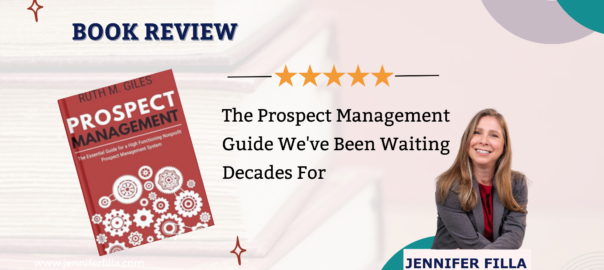
Book Review: The Prospect Management Guide We’ve Been Waiting Decades For

Prospect Management: The Essential Guide by Ruth Giles

Here’s a question for everyone in fundraising research and prospect management: How have we been implementing moves management and prospect management for decades without a comprehensive, practical guide to actually building these programs?

We’ve all been winging it with bits and pieces—a conference session here, a colleague’s advice there, maybe some tribal knowledge passed down from our predecessors. But a solid, soup-to-nuts guide on creating, implementing, and maintaining a robust prospect management program?

That didn’t exist.

Until now.

Enter Ruthie Giles (And Her 200+ Page Solution)

If you’ve been to any prospect development conference in the past decade, you know Ruthie. She’s the speaker who makes prospect management feel less like database drudgery and more like strategic chess. Fun, brilliant, and overflowing with practical wisdom.

She’s taken all of that knowledge—plus decades of experience building and fixing prospect management programs—and distilled it into Prospect Management: The Essential Guide for a High Functioning Nonprofit Prospect Management System (published 2025).


Prospect Management BookProspect Management: The Essential Guide for a High Functioning Nonprofit Prospect Management System by Ruth Giles is available now. Get your copy and start building the prospect management program your organization deserves.

Buy It Now


The Structure: From Skeptics to System

The book is organized into three brilliantly logical sections:

Section 1: Preparing Your Case for Prospect Management
Section 2: From Planning to Implementation
Section 3: Post-Implementation

Excited yet? You should be.

Why This Book Matters Now (Hint: It’s Not Just About Process)

AI is the latest—and fastest—iteration of information technology pushing our field to new speed limits. If you want to stay relevant (let alone advance in your career), you need to persuasively influence decision-makers to make smart investments in prospect development.

Which is exactly why Section 1 includes an entire chapter on change management.

Because here’s the truth: The best prospect management system in the world is useless if you can’t get buy-in to implement it.

The Chapter That Changed How I Think About Portfolio Meetings

Ruthie doesn’t hold back on step-by-step instruction. Every piece of building a prospect management program is here including the frameworks, the templates, and the hard-won insights.

But my absolute favorite chapter (the one with two bookmarks and a coffee stain) is Chapter 14: The Giles Method – A Multi-Meeting Approach.

Finally. Clarity.

Finally, words for what I’d been fumbling to articulate for years.

Ruthie breaks down the three very different objectives of prospect management meetings and shows you how to create three separate meeting types to accommodate them:

  • Data Optimization
  • Portfolio Strategy
  • Prospect Strategy

I’m not giving you the details. Because every practitioner should have this book within arm’s reach—on your bookshelf, in your e-reader, maybe both.

Who Needs This Book

New to prospect management? This is your roadmap. Everything you need to build a program from scratch without reinventing wheels that Ruthie already perfected.

Been practicing for years? This book provides the depth of perspective and theoretical framework our field has been desperately lacking. Ruthie has that rare gift of seeing the structure beneath the practice—which means you can take her solid framework and build something bespoke for your organization.

A prospect management program that actually hums.

The Bottom Line

We’ve been waiting decades for this book. Now it’s here, and it’s everything we needed it to be: comprehensive, practical, and written by someone who’s actually done this work.

Whether you’re making the case for prospect management to skeptical leadership, building your first program, or optimizing a system that’s gone stale, this book belongs on your desk.

Right next to your coffee. You’ll be referencing it that often.

Additional Resources

Blinker Alert: Research is Changing Lanes

If you want to support fundraising major gifts work, but you don’t want to be the person asking for gifts, you couldn’t get a better job than prospect research. Whether you become a generalist or a specialist, there is no end to the interesting variety of tasks and information you are exposed to. But blinker alert! Research is changing lanes. Is everyone ready?

I had the privilege of attending the Apra Great Plains conference recently and I was incredibly impressed with the innovative work their members have been implementing with great success. And it has to do with shifting lanes.

If you want to understand the variety of work, it’s easy to break it down into work types: prospect research, prospect management, and fundraising analytics. Although one person can fulfill all of these roles in one position, in larger and more complex organizations the work often evolves into these three specialized areas.

But it wasn’t area of specialty or advanced specialty skills that seemed to be driving the success of Apra Great Plains members. It appeared to be a lane shift into a new role – that of prospect strategy partner.

Trending: Lane Shifts

In the right hand (slow) lane, you have research performing administrative tasks. This is where research is directed to perform certain tasks that mostly involve gathering, presenting, and pulling reports on information.

Shift one lane to the left, and research steps into accountability coach. In this role research is gathering, presenting, and pulling reports on information – but also translating that information into actionable items. For example, profiles that recommend a prospect cultivation or solicitation approach and providing active portfolio management that identifies problems and opportunities instead of rote, line-by-line data entry checks.

Shift another lane to the left – into the fast lane – and research becomes the prospect strategy partner. This is what I witnessed a lot of at Apra Great Plains.

As a prospect strategy partner, research is doing things like:

  • Expressing the current state of work in terms of outcomes – not counting tasks.
  • Collaborating with leadership and major gifts and making decisions based on carefully tracked, accurate data.
  • Providing services, not products, which build client relationships so that you understand current needs and successes, instead of waiting to be told.
  • Persisting and refining for years to discover additional “truths” as more data accumulates and relationships deepen.

What can you do to put your blinker on and signal that you want to shift lanes?

Begin by asking lots of questions, of yourself and the larger team.

  • If I deliver what you are asking for, what will you do with it?
  • Where can I have the most impact?
  • Can I have a quick meeting with you to find out what’s on the horizon this quarter?
  • I know I am not your boss, but I see by your metrics that you are struggling. How can I help you?
  • It was exciting to hear how you want the team to do XYZ. How can I help support these changes?

Becoming a partner means taking responsibility for your role, even if no-one is asking you to step up. Instead of blaming others for the department missing its fundraising goals, you take responsibility. Did you really identify the best prospects? How could you more actively help development officers manage their portfolios?

Becoming a prospect strategy partner is all about solving problems. You are the consultant assessing what is happening now, crafting a plan to reach where you want to go, and persuading others to take action.

If you want to use your blinker and signal to change lanes to become a strategy partner, join your local/favorite Apra Chapter or become a Research Assets Member at the Prospect Research Institute with access to 30+ upcoming and past workshops as well as monthly group coaching calls where you bring your questions and connect with your peers, and me, Jen Filla.

And start asking more questions!

Additional Resources

7 Resources That Keep My Fundraising Loaded!

Keeping my skills current and keeping up with the field of fundraising and prospect research is critical to my role as a prospect research consultant. Slowly I have been shaping my favorite reading list, trying to get it to represent what I need to know most – because I don’t have the time to browse aimlessly!

I run a small, virtual business and that means, like many of you, my head is piled high with hats! I manage to juggle all the hats pretty evenly, catching each one and passing it along … until something new gets thrown into the mix. Then I start playing catch-up. One hat falls down and I let it stay there until I can get used to the new hat in the mix. Once I adjust to the new rhythm I can grab the lost hat and keep going. In this case, I dropped my blog writing while I adjusted to some new skill building.

Now that I am back on track and blog writing is in the mix, I thought it might make a lot of sense to share with you my favorite sources for prospect-research-biased fundraising news and clues. Since readers are of a mixed variety, I’ve kept the really technical research reading out of the mix. I hope you will chime in and comment in whatever platform you find this article. What am I missing? I’m always looking for the best, must-have reading favorites!

1-Chronicle of Philanthropy

Not having been in a traditional “office” for years, I had neglected to subscribe. As soon as I did, I realized once again the Chronicle’s charms. First, they send me paper. Love that. So I can catch up on the weekends or over lunch on the balcony. The Chronicle prints a great mix of information and I get good clues about changes and trends. The October 18th edition, especially the articles on the Missouri Arts center and The Y, really had me thinking about fattening the middle $1,000 to $5,000 donor pool and how that translates into approaching the data.

2-AFP’s Advancing Philanthropy and APRA’s Connections

These are my two all-time favorite associations and I love, love, yes love, their magazines. Okay, so AFP is moving digital and APRA is already there. I have a printer. And paper. Every issue of these magazines goes beyond the how-to and gives me something real that changes my thinking or expands my ideas.

3-Advancing the Nonprofit Sector

This blog is written by a number of different fundraising consultants. I like it because it reminds me that the fundraising world is bigger than prospect research and it helps me stay in tune with the practical needs front-line fundraisers face daily. I like that it covers local Florida topics too.

4-CoolData

Kevin MacDonald does an amazing job of making me want to read his blog. Not only is he having a conversation with me, but he uses lots of pictures and graphics to demonstrate what he is talking about. Okay, so it’s pretty technical stuff. But it is the kind of conversation that every fundraiser needs at least a cursory understanding of. The power of data analytics is as earth-moving as the power unleashed when our donor index cards turned into relational databases or the horse was replaced by the tractor. It is the kind of conversation that is deciding our future. And if I’m going to participate, or just eavesdrop, I’d prefer to do it with Kevin. And his cool guest bloggers like Peter Wylie too.

5-The Agitator

No, it’s not a washing machine cycle! This is another blog where I get practical, but a little more in-your-face, fundraising cents. What I really like is that it talks intelligently about direct response fundraising, which might just be the black sheep of the fundraising family. Yes, everyone loves major gifts, but getting broad support is more than money. It’s the community giving credibility to your mission and how you are performing. And if you do it well, it means you treat all of your donors well. That’s special in my book. Which brings us back to that great article in The Chronicle of Philanthropy about the Missouri Arts Center…

6-Well Planned Web

I have followed a lot of different marketing and social media and other technology blogs, but this one has been the most relevant to me. It’s not too technical. I get a good feel for a topic. It makes me feel smart and current instead of dumb and behind the curve. Most of us have to operate in a constantly evolving online world. At some point we all wind up being impacted by or responsible for at least a piece of our organization’s online face. The Well Planned Web will make you feel good about it.

7-Hootsuite

When data analytics guru, Audrey Geoffrey at the University of Florida Foundation first showed me this website at an APRA-FL board retreat I thought it looked like the most confusing, most complicated website that I would never use. I just couldn’t understand why I would want to keep track of things that way. Now I am a convert. I love being able to customize the way I view and participate in social media. I can narrow my focus to the topics and people who provide me with exactly the content I need to see.

I hope you found a gem among my 7 favorite resources, but I really hope you will share yours too!