Tag Archives: major gifts

The 3 Topics That Shaped Our Year (And Will Level Up Yours)

December always does this—it makes us want to sprint toward January with fresh plans and big goals. But first, let’s take a breath and see what caught your attention in 2025. 

When I look back at the blog posts that resonated most with readers this year, they weren’t the ones promising quick fixes or silver bullet solutions. They were the ones that challenged assumptions, expanded roles, and helped researchers and fundraisers think differently about the work we do. 

So before we dive headfirst into the new year, let’s revisit the three posts that hit home for professionals like you—the ones that sparked conversations, shifted perspectives, and maybe even changed how you approach your work. 

If you missed these the first time around, consider this your second chance. If you read them already, well, sometimes the best insights are worth revisiting. 

1. Top 5 Capacity Rating Insights for Research Professionals

Let’s start with everyone’s favorite anxiety-inducing topic: capacity ratings. This post cut through the noise and named the uncomfortable reality: No matter what rating you choose, you will be wrong. And that’s okay. 

Why did this post resonate? Because it gave you permission to be human while doing technical work. It acknowledged that capacity ratings are directional, not definitive. And it reminded us that our job isn’t perfection—it’s providing the best assessment possible with available data, managing expectations, and building confidence for bold asks. 

If you’re still treating capacity ratings like a math problem with one correct answer, go read this post. Then have a conversation with your gift officers about methodology, limitations, and what you actually know versus what you’re estimating. You’ll all sleep better. 

2. Blinker Alert: Research is Changing Lanes

This might have been the most provocative post of the year. Not because it was controversial, but because it named something many of us were feeling but couldn’t quite articulate. 

Here’s why this post mattered: It gave language to the career evolution many researchers are pursuing. And it provided a roadmap for getting there, starting with five simple but powerful questions you can ask right now to signal your lane change. 

The researchers who read this post and took action? They’re the ones having different conversations with their gift officers. They’re the ones being invited into strategy meetings. They’re the ones building careers, not just holding jobs. 

If you’ve been feeling like your role should be more strategic but you’re not sure how to make that shift, this is your manual. Read it. Then start asking those questions. 

3. Public Company Insider. So What?

Maybe nobody in your fundraising office would actually say “So what?” out loud. But let’s be honest—when you tell a gift officer their prospect is a public company insider, you can see it in their eyes. They’re thinking: And that means… what, exactly? 

Why did this post land? Because it took a technical concept and translated it into fundraising relevance. It answered the “so what” question before anyone had to ask it. 

For researchers working in major gifts, this post was a masterclass in communicating value. For gift officers who skimmed past SEC filings in profiles, it was a wake-up call about what they might be missing. 

The Common Thread 

Three very different posts. Three distinct topics. But one consistent theme: Moving beyond the transactional to become genuinely strategic. 

Whether you’re wrestling with capacity ratings, considering your career trajectory, or trying to communicate the significance of insider wealth, the challenge is the same. It’s not about gathering more data. It’s about translating information into insight, insight into action, and action into results. 

The researchers and fundraisers who thrive aren’t the ones with access to the best databases or the fanciest screening tools. They’re the ones asking better questions. The ones challenging their own assumptions. The ones building relationships based on trust and proven value rather than just task completion. 

They’re the ones reading posts like these and thinking: How can I apply this tomorrow? 

 Take Action for 2026 

  1. Bookmark the Aspire Research Links Directory free webpage for instant access to resources the Aspire team uses every day 
  1. Register for the Back Stage Tour of the Prospect Research Institute to learn about 2026 hot topics 
  1. Order the updated Search Tips for Fundraisers booklet for yourself or your favorite colleague 

Blinker Alert: Research is Changing Lanes

If you want to support fundraising major gifts work, but you don’t want to be the person asking for gifts, you couldn’t get a better job than prospect research. Whether you become a generalist or a specialist, there is no end to the interesting variety of tasks and information you are exposed to. But blinker alert! Research is changing lanes. Is everyone ready?

I had the privilege of attending the Apra Great Plains conference recently and I was incredibly impressed with the innovative work their members have been implementing with great success. And it has to do with shifting lanes.

If you want to understand the variety of work, it’s easy to break it down into work types: prospect research, prospect management, and fundraising analytics. Although one person can fulfill all of these roles in one position, in larger and more complex organizations the work often evolves into these three specialized areas.

But it wasn’t area of specialty or advanced specialty skills that seemed to be driving the success of Apra Great Plains members. It appeared to be a lane shift into a new role – that of prospect strategy partner.

Trending: Lane Shifts

In the right hand (slow) lane, you have research performing administrative tasks. This is where research is directed to perform certain tasks that mostly involve gathering, presenting, and pulling reports on information.

Shift one lane to the left, and research steps into accountability coach. In this role research is gathering, presenting, and pulling reports on information – but also translating that information into actionable items. For example, profiles that recommend a prospect cultivation or solicitation approach and providing active portfolio management that identifies problems and opportunities instead of rote, line-by-line data entry checks.

Shift another lane to the left – into the fast lane – and research becomes the prospect strategy partner. This is what I witnessed a lot of at Apra Great Plains.

As a prospect strategy partner, research is doing things like:

  • Expressing the current state of work in terms of outcomes – not counting tasks.
  • Collaborating with leadership and major gifts and making decisions based on carefully tracked, accurate data.
  • Providing services, not products, which build client relationships so that you understand current needs and successes, instead of waiting to be told.
  • Persisting and refining for years to discover additional “truths” as more data accumulates and relationships deepen.

What can you do to put your blinker on and signal that you want to shift lanes?

Begin by asking lots of questions, of yourself and the larger team.

  • If I deliver what you are asking for, what will you do with it?
  • Where can I have the most impact?
  • Can I have a quick meeting with you to find out what’s on the horizon this quarter?
  • I know I am not your boss, but I see by your metrics that you are struggling. How can I help you?
  • It was exciting to hear how you want the team to do XYZ. How can I help support these changes?

Becoming a partner means taking responsibility for your role, even if no-one is asking you to step up. Instead of blaming others for the department missing its fundraising goals, you take responsibility. Did you really identify the best prospects? How could you more actively help development officers manage their portfolios?

Becoming a prospect strategy partner is all about solving problems. You are the consultant assessing what is happening now, crafting a plan to reach where you want to go, and persuading others to take action.

If you want to use your blinker and signal to change lanes to become a strategy partner, join your local/favorite Apra Chapter or become a Research Assets Member at the Prospect Research Institute with access to 30+ upcoming and past workshops as well as monthly group coaching calls where you bring your questions and connect with your peers, and me, Jen Filla.

And start asking more questions!

Additional Resources

A Screening By Any Other Name Would Read As Rich

Apologies to Shakespeare, but when it comes to the communication between major gift officers and prospect researchers, “What’s in a name?” is an important question worth paying attention to!

“What’s in a name? That which we call a rose by any other name would smell as sweet…” -William Shakespeare in Romeo and Juliet

I didn’t realize how important words are until I became a consultant and needed to clarify what services we offer our customers. If I fail in that communication, the consequence is either no work or an unhappy customer.

As it happens, wealth screenings are one of the most frequently misunderstood tools – and words – we use for major gift prospect identification at Aspire.

Notice how I defined that?

A wealth screening is a tool for major gift prospect identification.

However, all too frequently Aspire Research Group’s potential customers and current clients define it more like: Wealth screenings provide accurately matched profiles on prospects.

Why is there such a discrepancy in the definitions?

As much as I am indebted to the big vendors for flooding the nonprofit market with advertising and education on using wealth screenings, they have also perpetuated the myth of accurate electronic data matching and scoring. It makes for healthy sales revenue!

As a business owner I respect that simple marketing messages make sales. But as a prospect research professional it drives me nuts because you can have the very best, most amazing data-matching algorithms and scores and ratings and all things analytics – but it will not be enough!

It will not be enough because ultimately we are dealing with humans, not data.

Do any of these kinds of scenarios sound familiar?

  • Visits with donors that are recorded in the database as actions with text, but no specific coding to know they were qualified or disqualified.
  • Donors with common names, such as Robert Smith, but is it the billionaire or not?
  • Researchers wanting to preserve data and not deleting things like gift opportunities on records when there was never a single two-way exchange.
  • A great structure for coding prospect management in the database – that has old or just completely wrong information.
  • Contact reports that indicate the prospect is ready for a solicitation, but no gift opportunity or prospect status was ever entered or updated, and in the hundreds of names in portfolio the prospect was unwittingly dropped like a hot potato.
  • The data integrity team won’t allow development officers to update contact information on the record and now actively engaged prospects lack the basics such as current addresses or working telephone numbers.

I could go on and on. It’s all so human!

So, what now? Are wealth screenings worthless?

Heck no! Wealth screenings are an important and economical tool for major gift prospect identification. They are designed to help you segment and prioritize large groups of records and they perform better and better as the matching algorithms and accessible data improve.

The auto-matched profiles available with most wealth screenings are also really good. It’s just that they are not anywhere near 100% accurate. They were never meant to be! Matching algorithms keep getting better, but they can’t be perfect. They are good enough to get a great segment to focus on.

Because once you have a top major gift prospect segment, research can prioritize that much smaller list with quick research to confirm the information, and can deliver prospects to the development officer that have current, actionable data.

A screening by any other name would read as rich.

It doesn’t matter if you define a screening as an electronically matched algorithm or a researcher quickly scanning sources to confirm the algorithm’s findings — or both. Bottom line is that screenings help identify new major gift prospects.

One way to avoid confusion over the choices of words used is to describe the desired outcome.  If you are a development officer and want to identify new major gift prospects, say that. If you say “I need a wealth screening” but a different technique would work better, you may not get the best outcome.

As Elisa Shoenberger describes in Top 5 Misconceptions of Prospect Identification, prospect identification is “using the knowledge of an organization, its best prospects, as well as an understanding of wealth and philanthropy to determine which prospects are the best ones.”

This goes for prospect research professionals, too! When someone wants new prospects identified, it’s not always wise to assume a wealth screening will be the best technique. Instead of focusing on a tool or technique, start asking questions about what they will do with the names, or how many names do they need, or other questions to widen the conversation.

And once everyone knows what is desired, then the discussion can progress to the tools and techniques that would best deliver the outcome of identifying major gift prospects.

Are you tasked with doing the work of major gift prospect identification? Check out the Prospect Research Institute’s workshop, Profiles vs. Screenings, where we dive into the difference and research for the desired outcome!

Profiles v Screening 14 Nov 2024 workshop

If you say ‘no’ enough, you will probably get fired

I have been known to say: “If you say ‘no’ enough, you will probably get fired.” But what if you are a solo researcher and the development team comes at you with a tidal wave of requests? How can you create healthy work boundaries and avoid drowning?

Following are three ideas to help you stay in the moment while also giving yourself time to figure out how to get ahead of the problem.

1. Don’t fight the current.

Many solo researchers start off as database managers or development coordinators with the capability of doing much more. Some researchers come into the first research role created – with or without prior experience.

As you build a positive reputation it can lead to a strong current of research requests that feel random, disjointed, and extremely time consuming. What starts out as flattering can become overwhelming!

Do you have to start saying ‘no’? Sometimes you do.

But before you go there, give the following or some variation a try:

  • “If I could get you what you want, what will you do with it?”

When you ask this kind of question you are floating with the current instead of trying to swim against it. It reduces the tension of having to commit to a ‘yes’ or a ‘no’ and allows you to discover things such as:

  • They want to send out emails, not call each person individually – so you really don’t have to spend a lot of time qualifying the list. Can you pull an internal list with records that have emails? Can you purchase an external list of prospects?
  • They just want to know what other places the prospect has given to (or something else specific) – so you really don’t need to do a full profile.
  • They are planning ahead (woo hoo!) and don’t really need the work for months – so you can plan ahead too!

But what if it is yet another request for you to find prospects in the community and there is no clear strategy behind the request? Because we all know this happens A LOT.

For now, keep floating with the current and say something like: “That sounds interesting, but I’d really like to think it through some more. Is that okay?” And then…

2. Step back and take time to evaluate.

I’m going to continue with the prospecting example because it really is a common issue. Development officers have a very difficult job. They need to build relationships with humans and put money into the bank. These are two very different and sometimes conflicting goals.

Under pressure to bring money in, a development officer needs to get good at prospecting. Yes, they need to build relationships, but if they do it with people who are solid prospects, they can be more efficient and bring in more money.

If a researcher is being asked to prospect – especially outside the database – the assumption is that there is not enough value inside the organization’s base of donors. Or there may be a fear that the major gift pipeline is going to be running dry soon.

When you get asked to find prospects outside of the database, and you’ve gone through the “what will you do with it” and you need to answer, consider saying ‘maybe.’

If you tell someone ‘maybe’ then you have time to spend thinking through the bigger picture of prospecting at your organization. You can run some exploratory reports to find out things such as:

  • Of the major gift prospects identified, are they being contacted? If not, asking why not is valid and there could be a good reason why not, which will help you do better prospecting.
  • Has the donor base been rated for wealth and philanthropy or a predictive score for major gifts? If so, what is the unassigned potential of high affinity, high wealth prospects?
  • What are all the prospect ID tactics that are underway now or happened in recent past? Were they successful?

Now you can schedule time to discuss the request and explore the bigger picture of how you can help the development officer focus on the best prospects to raise more money. You can re-state the need, review what makes a best prospect, and offer ideas on how to find those best prospects. Ideally, each step of the conversation is a two-way learning experience.

And in the end maybe you just have to do the prospecting request as asked. Either way, you will have learned a lot about prospecting, that development officer, and your organization’s constituency.

And if you are still being overwhelmed…

3. Talk ‘big picture’ with your manager.

Now that you have stepped back and evaluated the prospecting strategies and tactics as a whole and whether they have worked or not, you are ready to have a conversation with your manager. You need your manager to help manage the team’s expectations about what you can do, which means you need to get your manager on board with the best path forward.

Looking at the bigger picture usually makes for a better conversation with leadership. Do your best to stay out of the details of how you do the work and focus on the outcomes. In this kind of conversation, you start by walking the through the same steps as above:

  • What are the fundraising goals?
  • What does a best prospect look like for those goals?
  • What are the ways prospecting has happened and how has that worked?

And then you get to ask…

  • Should I be doing all of them? How should I prioritize requests?

Hopefully, this two-way conversation helps your manager advocate more effectively for you with the team.

Either way, be sure you are writing up each research project with the goal, tactics, delivery, and results. You can present these reports at staff meetings when you update the team on what you’re doing. It could help the development team hold themselves accountable for acting on your work.

Accept the things we cannot change.

Sometimes the development team or the fundraising culture at your organization just isn’t ready for your research prowess. If development officers simply don’t contact the prospects, then it doesn’t matter how many prospecting projects you perform, or profiles you create, or any of the research you are providing.

It might be time to say ‘no’ judiciously, or ask your manager to give you direction on how to prioritize requests.

Regardless of your situation, if you haven’t already, it is definitely time to consider what you want for your career and make sure you plan your next steps.


How connected is your major gifts team to its donors – really?

Do you really know how well your major gifts teams is performing? Maybe they are raising millions of dollars every year and hitting the targets set for them — but are those the right targets? Evaluating donor engagement could help you answer those questions.

If you are one of those organizations that fundraises your budget every year and has grown to command a major gifts team, you have my deepest admiration! Scaling a nonprofit organization is not an easy task. Neither is growing and scaling a major gifts team.

At Aspire, we work with fundraising leaders who are tasked with taking their major gifts team up to the next level of performance. It can be surprisingly difficult for even an experienced major gifts officer, trained at a larger institution, to make headway with a legacy major gifts team.

Donor Engagement as a Framework

Having major gift officers assign their prospects a donor engagement level is one way to find out what’s happening on your team and in their portfolios.

It has been a common practice to focus on portfolios through the lens of the gift cycle — identification, qualification, cultivation, solicitation, and stewardship. And this works very well for gift proposals, but human relationships don’t fit very well into those process-oriented terms. Donor engagement is different.

Many major gift officers intuitively view their portfolio through the lens of donor engagement – discovery, early cultivation, and deep cultivation.

It also fits the rule of three, which means when major gift officers show up to work, they only have to remember three categories of donors in their portfolios. This can help them manage their time and prioritize the right people.

Honest Discussion Leads to Real Change

When you ask each major gift officer to assign a donor engagement level to every person in their portfolio, surprising conversations may arise and lead you to what’s really happening.

For example, you might learn that someone on your team is struggling to find contact information, leaving them with only snail mail letters to communicate. You may also discover that some team members don’t know how to build a deep relationship with a major donor, which is why they have stagnant, lower gift sizes.

To create fertile ground for these kinds of discussions, it’s important to clearly define the donor engagement levels. It’s also important for each major gift solicitation to be recorded and tracked as a proposal or gift opportunity on the donor record.

Major gift officers also need routine portfolio reviews. This is time-consuming, but it’s where all the stories start pouring out. And when you combine portfolio reviews with monthly team meetings, now you have a platform for coaching and developing process and policies.

Which Comes First – The Process or the Outcomes?

If you are like most fundraising leadership, you need more dollars raised and now. Using donor engagement as a framework isn’t for every organization, but it can help you assess the reality of your team’s performance while you are working to identify and assign new prospects.

And there is an added bonus with this framework. It is within the full and complete control of each major gift officer to categorize their relationships with the donors in their portfolios – as it should be. When major gift officers have ratings of all sorts assigned to their donors it can feel like their relationships and the information they have gathered are ignored.

With a donor engagement framework, it’s about the relationship first, ratings second.

I want to be a major gift officer! Say very few researchers ever. But should they?

What would happen if researchers adopted the technique of method acting for one week out of every year? What if the researcher “became” a major gift fundraiser? Could this be the kind of training that could differentiate between superstar researchers and all the rest?

Are you familiar with method acting? It’s where the actor stays in the role of the character, even off camera. Jack Nicholson — he starred as Jack Torrance in the Shining, Col. Jessup in A Few Good Men, and too many more to list — was reported to have modestly said, “There’s probably no one who understands method acting better academically than I do, or actually uses it more in his work.”

And I have heard of organizations where the researcher tags along for some donor visits or makes thank you calls to donors. As part of the development department, it’s not unheard of for a researcher to help staff major donor events. I have. All of these interactions shift the researcher out of his or her research mindset and into a donor-facing mindset.

Because whatever research you’re doing – profiles, data mining, prospect lists, verifying a screening – could benefit from one last review by you, but in the mindset or role of major gift officer. When I say “one last review” I mean that there needs to be distance of some kind between performing the work and reviewing the work.

Just as writers will put down their work for a few days or a few weeks, picking it up again with “fresh eyes,” so researchers can put down their work and pick it up again with “major gift officer eyes.”

Reviewing Research through “Major Gift Officer Eyes”

Anyone who routinely reviews donor prospects with talented major gift officers can’t help but to start thinking like one. Imagine that you both have the profiles up on your computers and the major gift officer starts commenting and asking questions in each of the five building blocks of the profile, like this:

  1. Institutional Information: Is this the same couple that met while on one of our sponsored donor trips? (Yes, it was, and by golly that level of high affinity changes everything about approaching them for a campaign gift!)
  2. Biographical Information: I clicked through to her Twitter account and did you see that in her profile line she describes herself as a “disability advocate, wife, and mother?” I wonder if they have a disabled child! (Obviously, you didn’t read it because you put “none found” under children and didn’t find any connection to your cause beyond her first gift to your organization.)
  3. Community Involvement: They gave a million dollars to Sunshine Charity? Really? I wonder what that was about. They’ve only ever given us $1,000 and everything else found shows giving under $5,000. (After tracking down the annual report it turns out it was a typo from the vendor and you need to re-examine the screening capacity rating.)
  4. Occupation: His wife is Janita Billingswart? Do you think she’s the celebrity attorney? A name like that, surely… (But you didn’t search her name because the deep relationship has been with the spouse and you were in a hurry.)
  5. Wealth and Assets: Can you tell me more about the family limited partnership you mention here? Doesn’t that mean they have a lot of money? (You check it out when you’re off the call and realize it does indicate significant wealth and now you notice it was formed the same year that they sold their first company.)

You might not be able to practice method acting and live the life of your major gift officers to understand them, but you can live their work life vicariously by engaging in frequent conversations about their prospects. It takes dedicated effort, but so does method acting. And you will learn LOADS about doing research better.

Getting Good Without Shock Therapy

It was rumored that Jack Nicholson underwent shock therapy in preparation for his role in One Flew Over the Cuckoo’s Nest. I don’t recommend diving deep into every single research project or you might just go crazy!

Here’s how I described to a client, and an amazing major gift fundraiser, what he could expect from our profiles so he could know when to question us about the work and when he should run off on his own with his questions:

  • Our Snap Bios are a quick look, a snapshot, and it is unlikely that we would jump out of our usual process to follow a lead or ask a deeper question about the prospects.
  • Our Tactical Briefings are confirming philanthropy and wealth and while we are spending more time and digging deeper, we’re unlikely to wander off following a hunch unless there is an anomaly — unless something looks strange or we want to be sure we are accurate.
  • Our Strategic Assessments are the deep dive, following all those questions, untangling ambiguity, and laboriously seeking information not directly related to the prospect, but directly related to the prospect’s philanthropic or wealth story.

Of course, the fewer hours it takes us, the lower the cost, but the less information, too. Sometimes we do get dazzled by a prospect, spend more time, and the inspiration unlocks key information. We love our work and that’s inevitable!

Anything You Do, You Could Do Better

The prospect research field is full of people who are fulfilled in their work because it demands constant learning across, well, everything! We can have confidence in knowing that we don’t know a lot, and this opens us up to learn from everyone, everywhere.

So, even though the examples I’ve given in this article relate to prospect profiles, you could do better in every aspect of your work. Maybe your major gift officer loves Excel and enjoys filtering and sorting a long list of potential prospects for an upcoming trip, but is that the best way to provide the information? Could the process be improved?

If you don’t look at your work product through “major gift officer eyes” you may never know. I’m curious. Aren’t you?

Do you “get it” when it comes to wealth? Probably not.

Let’s test your wealth instinct and find out if you “get it” or not.

Pretend that your boss comes to you and says: As you know, leadership is taking the company public next year. You can choose how you want to receive your $100,000 annual compensation from the three options below:

  1. $25,000 in cash and $75,000 worth of the company’s new stock
  2. $75,000 in cash and $25,000 worth of the company’s new stock
  3. $80,000 in cash and $0 worth of the company’s new stock

Which one do you choose?

This choice is difficult for you and me!

If the only wealth you have is cash in your bank accounts, maybe some retirement funds like a 401(k), and you are renting or own the home you live in (probably with a mortgage), your options are very limited. Could you survive on $25,000 cash for a year? You are considering the options based on your disposable income.

If you have a dual-income household, a second home, or some reasonably liquid investments that you could cash-in, all three choices might become plausible options. You have disposable income plus additional investment wealth.

I know you know that the $75,000 worth of stock could take off and double or triple in value-or even more. You want that stock!

Now, what if suddenly your parents passed away and you inherited the house they owned for 50 years, which sells for $800,000. Would that make it easier to accept $25,000 in cash with $75,000 in stock?

Of course it would!

And this is the shift in thinking that you need to make when you are researching and cultivating major gift prospects.

You do not want a cash gift.

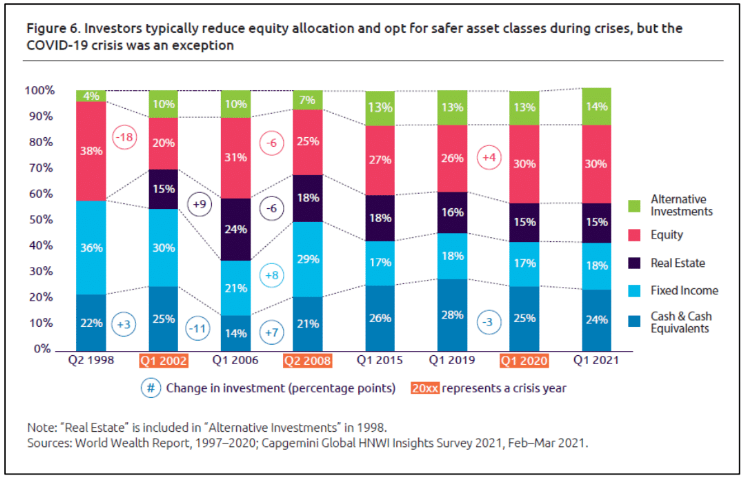
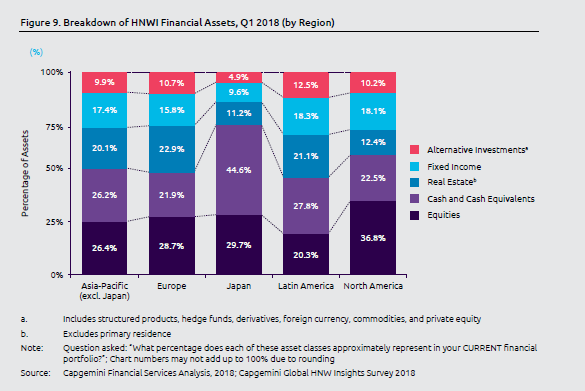
Check out the asset allocation chart below. This chart is telling you many things, but among them is that in the first quarter of 2021, the high-net-worth individuals (HNWIs) surveyed were holding 24% of all of their wealth in cash and cash equivalents. A cash equivalent is something like a certificate of deposit (CD) or money market account–things that you can very easily turn into cash.

When you ask your donor prospect for a gift, do you want her to think:

“Gosh, they want me to give $50,000 out of my $250,000 cash. That feels a bit steep. The kids private school tuition went up a lot this year.”

Or would you rather ask for a gift of appreciated stock and have her think:

“If I give $50,000 of appreciated stock out of my $750,000 investment account, I can take a charitable gift tax deduction for the full amount and offset the capital gains taxes. I’ve always wanted to have this kind of impact on this cause.”

But you shouldn’t just believe me.

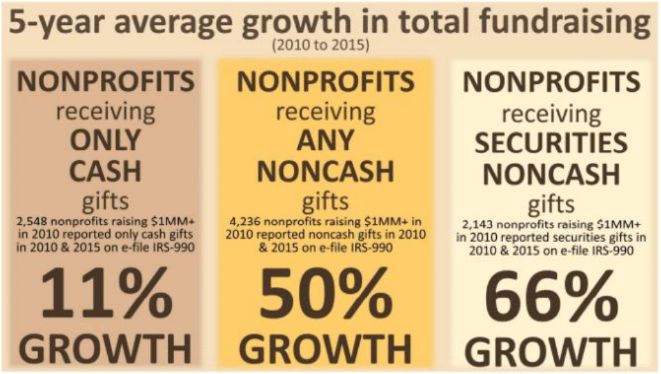
What do I know? Instead, you should believe Dr. Russell James who took the time to review a million nonprofit tax returns filed between 2010 and 2015. Numbers don’t lie. Dr. James discovered that nonprofits that received asset gifts raised more money. Check out the figure below for a snapshot of his findings.

Source: Cash is Not King in Fundraising: Results from 1 Million Nonprofit Tax Returns, Professor Russell James III, J.D., Ph.D., CFP®

Note: If you want to find whether your organization has a history of accepting asset gifts, you can check Schedule Min its public IRS Form 990.

Evaluating your donor prospects for wealth

If you want to grow your fundraising in major gifts, a key strategy is to ask for non-cash gifts. Understanding the asset allocation model from Capgemini featured above allows us to quantify this shift in thinking. We can now estimate the relative size of the cash vs. non-cash wealth held by our donor prospect.

Once you have estimated the value of the cash and non-cash wealth of your prospect, you can better understand how your prospect might view your ask amount relative to those values.

Below is an example of what this allocation looks like if we use the Capgemini asset allocation percentages on someone research has determined has an estimated net worth of $5 million.

Assets Value
Cash and Cash Equivalents $850,000
Non-Cash $4,150,000
Total $5,000,000

Imagine for a moment that you want to ask the prospect for $250,000. How does that stack up against each of the two categories, cash or non-cash?

Lean-in to the psychology of giving

Why would you want to fight against human nature and continue asking very wealthy donors for cash gifts when you could switch to asking for non-cash and raise more money overall? Lots of reasons. Maybe you feel much more comfortable asking for cash gifts.

I’m suggesting that it’s time to get comfortable with being uncomfortable.

To help you get more comfortable, check out this collection of work by Dr. James for more insights into the psychology of giving and techniques and tactics you can use in your work:

http://www.protopage.com/prospectresearch#Planned_Giving_(Dr._James)

Not asking for Millions? Why should you care about HNWIs?

NOT ASKING FOR MILLIONS? WHY SHOULD YOU CARE ABOUT HNWIS?I get it. Your organization is not going to ask for millions even if the prospect could give millions, so why should you spend your limited emotional energy trying to understand HNWIs (high net worth individuals) and global wealth trends? The clear majority of nonprofit organizations in the U.S., around 80%, have operating budgets of $1 million or less.

Nevertheless, there are three very good reasons why you should care.

1-Mission

I’ve been a consultant for over a decade and no matter what the mission, every organization is sure that fundraisers with a different mission – children, animals, environment – have it easier. That somehow someone else’s mission is easier to raise money for. The truth is that every mission has passionate donors, but it takes careful, skilled fundraisers to understand the donor base and position the messaging and gift opportunities to match.

Sure, you might not have the budget or opportunities to attract million dollar gifts now, but isn’t your mission worthy of receiving million dollar gifts? Aren’t you working together with leadership to grow your organization’s impact?

If you don’t know anything about HNWIs how could you possibly position your organization’s messaging and gift opportunities to grow into million dollar giving?

2-Career Growth

Especially if you are working for a small nonprofit on a thin budget, you need to be in command of your career training. With rampant content marketing your free learning choices can be a bit overwhelming. You’re reading this blog post so I know you care about sharpening and growing your skills. The next step is to find and manage learning sources that are related, but outside the boundaries of fundraising.

Local and global economics, including HNWIs should be on your list. Following are three really good (and very readable) resources with a hot tip from each:

Capgemini World Wealth Report

Besides having a fun-to-navigate website that lets you dig in to the data, you can download the report to take advantage of the table of contents and the executive summary. But it’s the attractive charts on pages 17-19 that I want to highlight for you here.

Figure9-CapgeminiWWR-2018

For the HNWIs that participated in this study in North America, 12.4% of their wealth is held in real estate. This percentage is excluding the primary residence, which is helpful because individuals who own multiple properties are more likely to be HNW. We don’t want to use our “back of the envelope” calculations on just anyone – only those that have investable assets of at least $1 million.

So, if you have someone who has multiple properties you can now perform some eye-opening “back of the envelope” calculations:

Real Estate ÷ 0.124 = Estimated Net Worth
Estimated Net Worth x 0.05 = Low Gift Capacity
Estimated Net Worth x 0.10 = High Gift Capacity

The New York Times – How to Get the Wealthy to Donate

Did you miss this article on “How to Get the Wealthy to Donate?” Did you hear about the underlying scientific research anywhere else? If not, you may find yourself frustrated and unhappy with the results of your conversations with HNWIs. It is squarely on your shoulders to understand and relate to donor prospects – in situ!

In this consumer-friendly world of content marketing, you don’t have to have a subscription to benefit from great resources like The New York Times. You can usually find a free e-newsletter or mobile app that will tease you with headlines. My favorite way of keeping up with multiple resources like this is to create a Twitter stream in Hootsuite of various topic lists I create from Twitter accounts that I follow.

Indiana University Lilly Family School of Philanthropy – Current Research

At Indiana University’s School of Philanthropy, the list of research projects creates a wonderful feeling of abundance! From Giving USA to the Study of High Net Worth Philanthropy to Women Give you can’t go astray.

“Nonprofit boards that include a higher percentage of women tend to have board members who participate more in fundraising and advocacy. Members of these boards also tend to be more involved in the board’s work, new research shows.” –Indiana University

The next time you attend a strategic planning session or any other leadership meeting, you now have scientific research at your fingertips to help your organization continue to grow and expand its reach.

3-Success = Preparation x Opportunity

Notice how I changed the formula adage slightly from “Preparation plus Opportunity” to “Preparation multiplied by Opportunity”? I wanted to emphasize how rare and transformative Opportunity is in this world. According to the Urban Institute, as of December 2016, there were more than 1.2 million public charities and private foundations in the United States. That is a lot of noise! How will donors and prospects hear you?

When opportunity does come, will you recognize it?
Are you prepared to seize it?

If you wanted to compete and win at the Olympics, would you wait until you passed initial qualifying tests before hiring a coach? No way! You would have had a coach from when you were a mere tot expressing interest. Don’t wait to get a fundraising mentor or coach. Regularly consume information about communicating with all kinds of people, including HNWIs.

Sales training abounds and one of my favorite resources is Sandler Sales. They have great white papers, articles, and newsletters. Do you have any kind of commute to the office? Visit www.sandler.com or search on iTunes to find their “How To Succeed” podcast, which is about 15 minutes per episode.

One of their recent episodes was how to make “touch calls.” This translates easily to fundraising! After all, we want to retain our donors and becoming more systematic about it is part of the preparation that leads to success. In the episode there is a reference to the DiSC profile and how each client personality is likely to respond to your call, which you might decide to investigate further.

You can create a personalized coaching team by pulling together key resources, like a podcast, and having the discipline to schedule time every day to learn.

Why am I focusing on Wealth instead of Philanthropy?

It is easy to argue that if you needed to focus on only one thing, it should be philanthropy first. After all, a person can have great wealth and refuse to part with a penny. Hands down, if you are in a smaller nonprofit, focusing on philanthropy first is a winning strategy. I’m not suggesting otherwise.

What I am suggesting is that it is important to focus on philanthropy with wealth. Your organization needs dollars and is worthy of money to pay the electric bill, hire competent staff, and deliver programs that are making our world a better place.

It’s important for all of us to assess our feelings about money and any bias we may have about wealth accumulation so that we don’t neglect our education and skill building around philanthropy with wealth.

Additional Resources

Warning! Wealth Screenings Create a Skills Gap

MindTheGapSMReally good wealth screenings are changing the way we fundraise and they’re bumping campaign results ever higher. That’s definitely good. Yet wealth screenings are putting research decisions into the hands of non-researchers. Like you. Is this a good thing or bad thing? It’s up to you to decide!

I’ve been having more conversations with nonprofits about training prospect researchers. And they haven’t been the typical “I want to set up shop” conversations. The director of development doesn’t want me to help them choose a research subscription or craft a profile template.

She wants me to teach the researcher things like recognizing when prospects have wealth types in common (recognize patterns) or to focus more on the information that will help the gift officer to create a cultivation strategy (fundraising analysis).

Notice I said I’m talking to the director of development (or advancement) – not the director of research. Non-researchers are being pushed into taking the lead on research decisions. And I blame wealth screenings. (Technically, it’s more than screening for wealth. Vendors now give meaningful ratings and data analytics too.)

What exactly is changing?

Imagine you are the director of development for a smallish university, hospital or human services organization (and maybe you are). Your fundraising goals keep getting higher every year and you’ve brought some 7-figure gifts through the door. Your database manager has transitioned into your full-time prospect researcher.

As you gear up for the biggest-ever campaign you are faced with some challenges:

  • Your researcher has been churning out profiles for eight hours a day for months. She’s become a profile zombie!
  • Yes, your researcher can find information, but she doesn’t seem to really understand how prospect cultivation and solicitation works, which makes her work less helpful. She’s disconnected from the actual fundraising.
  • You’ve been prioritizing with wealth screenings and ratings, but now that information is a jumbled mess in the database. You don’t know how to fix it and your researcher is busy doing profiles.

Why are the wealth screening vendors to blame?

Because now that raw data has become more tightly matched, you have enough confidence in it to prioritize your donor prospects and get out on your discovery visits.

You don’t need a prospect researcher to do much.  Until you do.

The path to prospect research used to be a bit wider and longer. In the new, shortened time-frame your prospect researcher isn’t always ready to do more when you are.

So, you, the development director are tasked with managing prospect research in a way you never anticipated. How can you bridge the gap between your researcher’s current skill set and where she needs to be?  Grab your manager’s hat and explore some capacity building opportunities!

MOTIVATE by connecting your researcher with outcomes

Slow down the profile mill ever so slightly – just enough to establish a system to track completed research in your database. Maybe it’s a contact or action item. Whatever field you use, make sure you can pull reports that will demonstrate things like which researched prospects made a gift and were visited.

If you really want to have a little fun, track the researcher’s capacity rating in its own field so you can compare that against the screening rating and against the ask and gift amounts.

We all want to feel like our work creates something. Knowing that her work led to a really big gift is going to be motivating!

But tracking your research efforts is just a first step. Make sure there is opportunity for regular communication between the gift officer and the researcher. You want your researcher to hear how the gift officer sees wealth on those visits. You know what I’m talking about. The “he belongs to this club” or “she had to drop at least a thousand dollars on that handbag”.

Get the gift officer and researcher in a conversation about wealth and a lot of great education will happen both ways. Including more motivation. More teamwork.

INVOLVE the researcher in creating solutions

Work with your researcher to identify ways to solve problems like too many profiles and not enough new prospect identification and qualification.

  • Are gift officers getting too much information too soon? Maybe there should be guidelines about what actions need to happen before a comprehensive profile can be requested.
  • Is your researcher spending too much time digging deeper than needed? Have him track how long it takes to do profiles over a few weeks and reflect on the results. By watching the clock can he get more focused?

You may need to take a lot of the lead in the beginning, but loosen the leash as much as you possibly can. Prospect researchers are notoriously good at learning new things and problem-solving. Give them some room and many can become really good managers.

CREATE some structure around research

As your researcher is getting re-energized and challenged to solve problems, you need to recognize where to create structure to keep everyone and everything moving in sync. You are no doubt under a lot of pressure to make miracles happen in wickedly short time-frames. Keep your eye out for imbalance and act quickly.

  • Is the researcher spending an hour talking shop with a gift officer? Direct her to create a more formal research request process and channel those wonderful conversations into an established prospect review meeting.
  • Is your researcher creating a fully functional but too complex prospect management system? Continue to let her create it, but challenge her to make it simpler. (Playing a little dumb is a perfectly acceptable way to get someone to stretch a little. You have my permission!)

BIG fundraising doesn’t happen without prospect research

It’s a fact of fundraising that you need to harness the power of prospect research to raise the kind of money your mission needs and deserves. And yet, new tools like wealth screenings can allow a skill gap to creep up on you just when you need it the LEAST.

You don’t have to become a prospect research guru to make good decisions about it. And you don’t always have to fire and hire. Strengthen your managerial skills and use them to stretch and grow the prospect researcher and other staff that have an aptitude for prospect research.

Motivate. Involve. Create. And you and your organization will find yourself doing some really BIG fundraising!

And if you need a little outside help to train your staff, evaluate your procedures or create some, Aspire Research Group and the Prospect Research Institute are only a phone call away at 727 202 3405. And we have email too!

Other Articles You Might Like

The Friends of a $55 million Donor

by Jakki Aviles

David Alan Tepper, founder of Appaloosa Management L.P., has recently announced that, through the David Tepper Charitable Foundation, he will be making a $3 million gift to Feeding America, one of the nation’s largest organizations that fight hunger.

Tepper’s philanthropy did not start with hunger-relief organizations. A gift he is probably best known for is his record $55 million gift to Carnegie Mellon’s business school. Tepper attended the school to receive his MBA, but certainly did not come up with the idea for the gift completely on his own. He was prompted by a friend and former professor, Kenneth Dunn, to donate. Tepper was convinced, but was also driven by naming capabilities– the school is now named the David A. Tepper School of Business.

Friends, however, seem to be the main source of motivation behind Tepper’s generous gifts. According to the Clark-Garwood Patch, Tepper was introduced to the hunger-relief area of philanthropy by a friend, Kathleen DiChiara, who is the founder and president of the Community FoodBank of New Jersey. She asked Tepper for his help in a campaign and he, in turn, got together $2 million between himself and others in his company.

According to an article in PR Newswire, the FoodBank is part of a larger network: Feeding America. Through being introduced to the hunger movement in his home state by Ms. DiChiara, Tepper was made aware of a larger cause that was in need of gifts. Feeding America tapped into a valuable source in Mr. Tepper. He is motivated by the causes his friends encourage, and was already donating to Feeding America’s hunger movement on the local level.

Perhaps the most interesting and valuable aspect of a donor like Tepper is his enormous wealth. The David Tepper Charitable Foundation first became interested in hunger in 2006. In a rather short amount of time, the Foundation moved from a local charity to donations to the national charity. As Tepper’s giving progression has shown, he is capable of giving to all sorts of hunger charities and does not need to be dedicated to just one. His wealth allows him to give on a level that many only dream about.

Tepper’s wealth and wide-range of interests should be a major clue-in for fundraisers looking for donors. As he has demonstrated, his engagement in charities like Feeding America is relatively new, and highly influenced by a friend dedicated to the project. As a fundraiser you need to be careful not to overlook the social networks within your reach. Although Tepper may not have come up with the idea to give to hunger based on his own inner passion for the cause, he is still giving– in large amounts. Who’s to say he could not be influenced to put his money into another great cause?

Are there any David Teppers lurking in your donors’ social sphere? Would you know if there were? Predictive modeling, wealth screenings and donor ratings all focus on the names you have in your database. The social reach of your board members and existing major gift donors might not reveal a David Tepper.

At Aspire Research Group we have helped organizations use prospect research to find their David Tepper in two ways:
(1)  Researching an individual identified as wealthy and/or interested in the mission – Sometimes a fundraiser will read about a David Tepper in their community (you are reading local and philanthropy news sources, right?!) Through in-depth research, Aspire Research Group focuses on business, volunteering, giving and social relationships. Using this information the fundraiser can begin to connect the dots back to her organization, with Aspire Research Group providing quick follow-up answers as part of the profile service.

(2) Exploring the relationships of someone known to the organization – Especially with major gift donors, a fundraiser will come to Aspire Research Group looking to find ways to leverage the donor’s business and social spheres of influence. Being informed before sitting down with the donor helps to keep the meeting focused and productive.

If you want Aspire Research Group to help you find your very own David Tepper, give us a call at 800-494-4132 or email jen at aspireresearchgroup dot com.