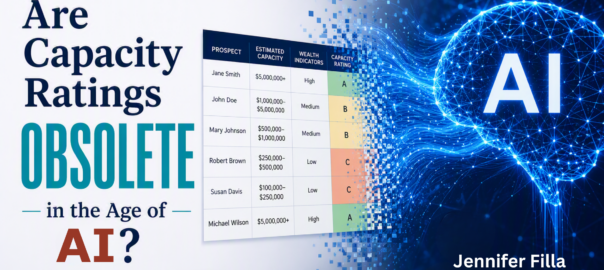
The short answer: not yet. Capacity ratings built from public records wealth screenings still do their job, helping organizations prioritize prospects. But they’re facing real pressure from newer, AI-generated wealth ratings that weigh many kinds of wealth signals — not just hard assets.
From Magic to Ho Hum
Capacity ratings arrived in the late 1990s, when real estate records, SEC filings, and other public data started going digital. Suddenly it was possible to match those wealth markers to individual names — at scale. It felt like magic.
Before digital records, researchers had to dig up wealth markers one name at a time. What used to take a team of researchers months, wealth screenings could do in hours.
The early versions were rough — counting multiple assessments on the same property as multiple properties, for instance. But the technology matured, and today wealth screenings and the capacity ratings they generate have surfaced countless prospects who otherwise would have gone unnoticed.
But calculating capacity from asset values alone has always had a ceiling. And that ceiling has gotten a lot more confining as wealth has exploded among the ultra-wealthy.
From Assets to Signals
The term “capacity rating” grew up alongside wealth screenings, but any wealth rating can do the same job: filtering prospects by wealth. Windfall entered the fundraising research market with AI-generated “precise net worth” values. More recently, DonorAtlas, built entirely on AI, pulls a wide range of wealth signals from the internet, translates them into Estimated Net Worth, and shows its reasoning along the way.
Does AI’s ability to crunch huge datasets and weigh all kinds of wealth signals make its ratings more accurate?
Yes — and the higher the net worth, the bigger the gap. This is exactly where wealth-screening capacity ratings hit a wall. They can land someone in the top range and still badly underestimate the ultra-wealthy, because how many houses is one person really going to buy? The ultra-wealthy carry more signals that aren’t hard assets at all — but point to far greater wealth.
What Happens Next for Capacity Ratings?
Capacity ratings have never been just one thing. Like prospect profiles, they come in a lot of variations. And they were never meant to stand alone — a capacity rating is one filter, one criterion, for mining major gift prospects who also show other signs of caring about your organization, aligning with your mission, or otherwise being engaged with you.
Capacity ratings from wealth screenings remain a trusted, proven technique for organizations in campaign or building out a major gift program. And prices have dropped over the decades, putting wealth screenings and capacity ratings within reach of a much longer tail of nonprofit organizations across the US.
AI is certainly disrupting the status quo. But the most likely outcome isn’t replacement — it’s convergence. Public records will get folded into AI approaches and evolve into new, better, more accurate wealth ratings.
How can you get help if the pressure to raise major gifts is outpacing your capacity ratings?
From private team trainings to RPM (Research and Prospect Management) Assessments, Aspire has been helping organizations articulate their goals and focus on their strengths to create a roadmap to their desired destination.
And capacity ratings are one of the hot issues right now!
Your Vice President of Development wants the wealthiest prospects in portfolio yesterday. You need to work consistently, methodically, and accurately. Those two positions can feel out of sync — and that tension is real.
It doesn’t have to be that way. When Aspire performs an RPM Assessment, organizations typically begin developing consensus and start working toward a shared destination before we even deliver the final results!
Curious if Aspire can help your team? Schedule a discovery call today: https://aspireresearchgroup.com/contact-form







 There was a cry for help on the PRSPCT-L list-serv: “I’m a new researcher and my boss wants me to provide net worth on a prospect. He says it was the previous practice to do this and I can get what I need to calculate it from Dun & Bradstreet.” What would your response be?