Let me ask you something: When was the last time a wealth screening rating automatically translated into an engaged prospect?
If you’re laughing right now, we’re on the same page. We all know the drill—trust but verify, capacity doesn’t equal inclination, wealth doesn’t equal relationship. But here’s what keeps me up at night: If wealth screenings have such obvious limitations, why are so many research shops still treating them as the primary engine for major gift prospect identification?
Spoiler alert: They shouldn’t be.
The Statistic That Changes Everything
According to a CASE study of principal gifts to U.S. colleges and universities, half of these transformational gifts came from non-alumni. Read that again. Half.
We’re not talking about modest annual fund gifts here. We’re talking principal gifts—the naming opportunities, the program-changing investments, the gifts that get announced with press releases and champagne.
And half of them came from people who weren’t in the alumni database waiting to be wealth-screened.
Now, the study didn’t break down how many were parents versus community members. But that ambiguity makes the statistic even more powerful. These prospects exist in multiple spheres around your organization, and they’re making gifts that matter.
So the question isn’t whether we should be prospecting outside the database. We already know the answer is yes.
The real question is: How do we build a prospect identification process that actually works?
Let’s Start at the Very Beginning
Here’s what we know to be true: Relationships drive gifts. Not wealth. Not capacity. Not even inclination, really. Relationships.
And relationships exist in concentric circles radiating out from your organization’s core. The closer someone is to your mission, the more likely they are to give significantly. This isn’t revolutionary—it’s fundraising 101.
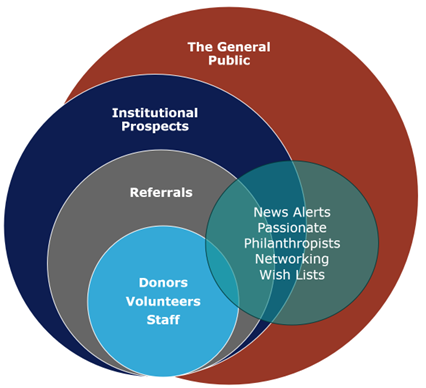
But here’s where it gets interesting. Once you and your development team really internalize this principle, you can start mapping out all the ways major gift prospects actually enter your pipeline. And I promise you, many of them aren’t entering via your annual wealth screening.
Think about it:
- The grateful patient whose care team mentions a giving opportunity during recovery
- The board member who brings a business colleague to your gala
- The parent who gets involved with the advisory committee
- The foundation executive who hears your CEO speak at a conference
- The corporate partner whose VP falls in love with your program
These aren’t hypothetical scenarios. These are the everyday ways that million-dollar prospects walk through your door. And most organizations have no systematic way of capturing, vetting, and reporting on these individuals.
Your development team is probably already doing this work—identifying prospects through organic relationship-building, event attendance, and word-of-mouth referrals. The problem is, they’re doing it in isolation. Without your input. Without a process. Without documentation.
And that means opportunities are being missed, expectations aren’t managed, and you’re probably spending way too much time researching people with zero connection to your organization while high-potential prospects languish in the “someone should probably look into this person” pile.
Why Documentation Is Your Secret Weapon
I can already hear some of you groaning. Documentation? Really? You want me to document our prospect ID process when I can barely keep up with the profile requests I have now?
Yes. I do. And here’s why.
Documentation isn’t bureaucracy—it’s strategy in writing. Once you put your prospect identification framework on paper, something magical happens:
- Leadership suddenly has opinions. And that’s exactly what you want. Because leadership has the authority to make decisions about how prospect identification actually works at your organization. Once they’re engaged, you have a powerful ally who can say “no, we’re not going to ask the researcher to find us 50 wealthy strangers with no connection to our mission” or “yes, we’re going to prioritize event attendees and board referrals over cold prospecting.”
- You can make the case for what actually works. When you’re writing the documentation, you get to remind everyone that relationships drive fundraising. You get to frame prospect identification through that lens. And you get to set expectations—when leadership commands you to prospect outside the relationship sphere, you can point to your documented framework and say “absolutely, but our engagement ratio is going to be around 5% instead of 30%.”
- Everyone agrees on what counts as prospect identification. This might be the biggest win of all. Once you document that event attendees require research vetting, that board referrals follow a specific qualification process, that news article mentions get the same treatment as wealth screening hits—suddenly all of these activities fall under the same umbrella. Which means they can be tracked, measured, and resourced appropriately.
But What If Your Culture Is Broken?
I can hear you. Some of you are thinking: “This is great in theory, Jen, but you don’t understand my organization. The culture here is completely entrenched. I spend all my time researching deep profiles on people who will never be contacted. I’m not even allowed to talk directly with leadership. Documentation isn’t going to fix that.”
I’m here to tell you something that might sound harsh at first, but I promise it comes from a place of deep respect for what you do: You can do your best work anywhere.
No, really. Stay with me.
You can write your documentation and share it with team members who will talk to you. You’ll learn so much from those conversations, especially if you’re willing to listen to the frontline fundraisers who are actually in the trenches. They know which prospects have potential and which are pipe dreams. They know what information helps them and what just clutters their inbox. They’ll tell you the truth—if you ask and if you listen.
You can begin socializing your framework by giving your services marketing names that describe your actual process. This is where you get to be creative. Deliver a list of no-connection prospects under the service name “Cold Outreach Research-Wish List” and suddenly everyone understands what they’re getting.
Call your event attendee research “Hot Lead Vetting” and watch how much more enthusiastic people are about those prospects. Words are powerful. Use them strategically.
You can introduce innovations wherever you have authority to do so. For example, when you deliver a new prospect, include a brief “relationship statement” or “reasoning note” explaining why they’re a good prospect. This does two things: It educates your development team about what makes a quality prospect, and it invites feedback that helps you refine your process over time.
Here’s the bottom line: If you don’t practice your best work now—in whatever imperfect environment you’re currently in—you won’t be prepared when that golden job opportunity finally manifests itself.
The researcher who gets hired into that dream role isn’t the one who spent three years complaining about their dysfunctional shop. It’s the one who built innovative processes, documented their framework, and can articulate in an interview exactly how they would set up prospect identification at a new organization.
Practice your best work now so you’re ready for what comes next.
AI Is Here, and It’s Time to Step Up and Lead
Let’s talk about the elephant in the room: artificial intelligence.
AI has already begun disrupting our work. For some of you, that’s terrifying. For others, it’s exciting. But here’s what I know for sure—AI is poised to help you unleash your inner leader, whether you’re ready or not.
Think about everything we just discussed:
- Writing that prospect identification framework? AI can help you draft it.
- Coming up with creative service names that catch people’s attention? AI is brilliant at brainstorming.
- Communicating differently with different personalities on your development team? AI can help you adapt your tone and approach.
- Building a major gift prospect ID process that hums? AI can help you design it, refine it, and evolve it.
But here’s the thing AI can’t do: AI can’t be a leader. It can’t build relationships with your development team. It can’t advocate for resources. It can’t make the strategic decision about whether to prioritize board referrals or cold prospects. It can’t look a gift officer in the eye and say “I know you want me to research this person, but I think we’d get better results if we focused here instead.”
Only you can do that.
AI is a tool—an incredibly powerful one—but it’s still just a tool. The prospect researchers who will thrive in this new landscape aren’t the ones with the best technical skills or the fanciest databases. They’re the ones who step up and lead.
The ones who build frameworks, communicate strategy, and help their organizations make smart decisions about where to invest their prospecting energy.
This is your moment. The disruption that AI brings creates space for you to redefine your role. You can be the researcher who just finds information, or you can be the strategist who shapes how prospect identification works at your organization.
Which one do you want to be?
The Prospect ID Process That Hums
So what does a major gift prospect ID process that actually hums look like?
- It’s documented, so everyone knows how it works and what to expect.
- It’s relationship-focused, starting with your organization’s closest connections and working outward strategically.
- It’s collaborative, with researchers and development officers working together to identify, vet, and qualify prospects through multiple channels.
- It’s adaptive, using AI and other tools to increase efficiency without losing the human judgment that makes research valuable.
- It’s communicated clearly, with service names and frameworks that help your development team understand what they’re getting and why.
And most importantly, it’s led by you—the prospect researcher who understands that wealth screenings are just one tool in a much larger toolkit, and who has the confidence to advocate for a better way forward.
The question is: Are you ready to build it?
Additional Resources
Wish you had access to more resources on prospecting? You do! The Prospect Research Institute has lots of resources to help you with prospecting:
- Join Jen Filla for a free Backstage Tour of the Institute on 1/9/2026 at 12pm ET where you’ll learn about upcoming workshops such as: Strategic Prospect Identification – Smart Verification Framework – Solo Researcher Survival Kit
- Connect with other prospect research professionals tackling these same challenges in the FREE Forums at the Prospect Research Institute.
- Buy the Approach to Prospecting book or the course. This teaches you how to build a score card, which you can use for internal or external prospecting.
- Check out our prospecting category on Prospect Research#ChatBytes the Institute’s podcast.