Tag Archives: prospect development

Donor Referrals and Introductions: Cracking the Relationship Mapping Code

A real-world test of DonorAtlas’s relationship mapping features — and what it means for researchers who never had time for this work before.

Traditionally, relationship mapping has been a long and tedious process reserved for high-stakes prospects. Could that be changing with advances in generative AI? I sure hope so.

I want to be clear upfront: I am a subscriber to DonorAtlas and I genuinely believe in what they’re building. I don’t get paid to say that — I just think it’s doing something the field has needed for a long time. And when I tested their new relationship mapping feature, I wanted to share what I found honestly, including what works, what doesn’t yet, and why I’m excited anyway.

There is so much hype around generative AI. I don’t want to fuel the binge on over-promising and under-delivering. But who isn’t at least curious about the possibility that relationship mapping could get easier and less expensive — and maybe start being used earlier in the prospecting process?

Why this matters right now

We are all under pressure to identify and move prospects who can make major and transformational gifts. The K-Shaped Economy shows no signs of abating, which means more giving will come from wealthier donors making larger gifts. If you’re not familiar with the term, the K-Shaped Economy describes an environment where the wealthy are experiencing growth in asset values while the less affluent are feeling the squeeze of higher prices and a tight job market.

What this means practically: engaging ultra-high-net-worth (UHNW) individuals requires an introduction. Even when an UHNW individual is already a donor to your organization, you might not have enough of a relationship to get them to respond to outreach. You need a door-opener. And that means you need to know who your existing donors and trustees know.

That’s exactly what relationship mapping is supposed to solve. The problem is that it’s historically been slow, expensive, and therefore rationed — reserved for only the most critical prospects.

What I tested: prospecting from a top donor’s connections

To try out DonorAtlas’s relationship mapping capabilities, I chose a well-known Tampa Bay philanthropist, Penny Vinik, and asked: who does she know that might be a new major gift prospect for a nonprofit she already supports?

Penny and her husband Jeffrey have given generously to the Tampa Museum of Art, which is currently in a publicly announced capital campaign. I asked DonorAtlas to show me her connections. At first, I was getting individuals already connected to the museum in some way — as donors or current or past trustees. That gave me 78 names, which was too many to evaluate meaningfully.

So I tried filtering out Florida connections entirely. That narrowed the list to 10 names. Much more manageable!

And that’s when I found an interesting lead: someone who had previously served with Penny on a Tampa private school board. The museum has extensive educational programming. This person has a high-profile business in Tampa Bay. Could they be a great prospect? Maybe! The point isn’t that DonorAtlas handed me a definitive answer — it’s that it helped me surface a name worth scrutinizing, quickly.

This exercise was about developing an initial list for scrutiny, not producing a finished prospect list. And it worked reasonably well. Relationship mapping is a new feature for DonorAtlas, and I’m expecting it to be refined and improved with user feedback — they have been extremely responsive to input, which is a delight.

The problem it also solves that I didn’t expect

One of the persistent challenges at Aspire has been developing a quick preliminary list for clients to review before we invest time in deeper research. When we go old-school — listing names of previous board members, for example — a name by itself isn’t enough. Development staff need context to assess whether a name is worth bringing to their top donor or trustee. But researching each name fully before the first review is inefficient.

DonorAtlas solves this problem in an interesting way. When you develop an early list, you automatically have full profiles for each name. That’s actually too much information for a first pass! But you can export only the specific data fields you want — a bio, a wealth indicator, a philanthropic summary — making it easy to present a meaningful list for initial review without overwhelming anyone.

And here’s the feature that changes everything for prospecting work: the ability to save a network of individuals and then filter any new list by connections to that saved network. So we can surface names and immediately know who in our existing network is connected to them. That is a giant improvement.

Why DonorAtlas is different for this work

DonorAtlas isn’t the first technology to help researchers mine for relationships. But it is specifically designed for fundraising — and that design intent shows. It makes it easy to prospect for new names based on philanthropy and wealth, filter for connections to a defined network, and quickly view profiles without leaving search results. Founded in 2024 and built entirely on generative AI, they keep adding features and — this matters — they actually listen to users.

Is it perfect? Not yet. But that’s not the point. The point is that relationship mapping, which used to feel like a luxury reserved for a handful of prospects per year, is starting to feel like something that could happen routinely. Earlier in the process. More systematically.

For researchers who have always known that relationships drive gifts — not wealth ratings, not capacity scores, not screenings — that’s a very exciting direction!

Have you experimented with relationship mapping tools in your research practice? I’d love to hear what you’re finding.

Additional Resources

The A.I. Tug of War in Fundraising—And How to Find Your Footing

Let me ask you something: How many times has a piece of technology promised to change everything… and then promptly driven you absolutely crazy?

You know the scenarios. It can do all the things, but only after you’ve configured everything yourself. “Integration” turned out to mean something very different from what you imagined. The upgrade wiped out every custom setting you spent hours building. And whenever you try to do something just slightly outside the norm, the software fights you like a toddler at bedtime.

I could go on. We have all been there.

And yet—here’s the tension—technology genuinely has made our lives easier. Microsoft Word may not make complex formatting a walk in the park, but it has transformed how we create documents. And because it plays nicely with the rest of the MS Office suite, whole categories of headaches have simply disappeared.

Welcome to the tug of war.

The Two Ends of the Rope

When it comes to A.I. in fundraising, this same push and pull is playing out in real time. On one end of the rope are the people who believe A.I. is too messy, too risky, and too unreliable to touch. On the other end are the people who believe A.I. has ushered in such a leap in accuracy that we can use machine-generated information as-is, no human review required.

New technologies that arrive with enormous hype—and A.I. certainly arrived with enormous hype—have a way of polarizing us. But is there something useful to be found in the middle of that rope?

Spoiler alert: There is.

Yes, A.I. Has Been Around. But This Feels Different.

A.I. has been woven into our digital experience for years. Recommendation engines. Spam filters. Autocomplete. But when OpenAI released ChatGPT in 2022, it felt less like a product launch and more like a digital eruption. Things are moving fast. New and genuinely exciting capabilities are emerging. And yes, things are getting broken along the way.

For many in our field, the speed of that change feels dangerous. Whatever you do, don’t ask A.I.

But much like the anxiety that greeted Google’s debut—remember when people worried that nobody would learn anything anymore?—there is real and practical value here, if you know how to use it.

One of the most useful features of a generative A.I. chatbot is that you can ask it to show its work. Where did that information come from? What sources support that conclusion? What transactions were used to build that summary? That transparency is actually a significant feature, not a quirk.

Where A.I. Is Changing the Game for Prospect Research

At Aspire Research Group, one of the most dramatic shifts A.I. has made in our day-to-day work is in writing bios. Even setting aside the time required to gather information, writing a few well-crafted paragraphs about a prospect has always been time-intensive. Using DonorAtlas, we now have well-written bios and the underlying sources for verification—almost instantly. We can deliver a significantly stronger product at the low end, in far less time.

Until, of course, A.I. fails us. And it does fail us.

People in the arts, for example, seem to get misrepresented by A.I. with striking frequency. What is their “job,” exactly? They don’t fit the pattern that it expects. In those cases, we take over the steering wheel and drive that one ourselves.

This is not a reason to abandon A.I. It’s a reason to understand it.

Algorithms Are Only as Good as the Data Behind Them

Remember when Netflix’s recommendations felt almost eerily accurate—until they didn’t? If you shared an account with someone whose taste was wildly different from yours, the algorithm got confused. It was doing its best with messy inputs.

The same principle applies to your fundraising database. If your data is a hot mess, A.I. is going to struggle to give you reliable scores or meaningful analysis. But here’s the thing: it might still give you better results than statistical modeling did. And if better-than-before scores get gift officers out the door and into conversations with donors faster, that’s not nothing. Something is better than nothing.

But that raises the next question—and it’s an important one.

If A.I. Is Better Than What Came Before, Why Not Just Trust It?

If A.I. analysis outperforms statistical modeling, why shouldn’t we lean on it entirely? Why not let it drive portfolio assignments, staffing decisions, campaign planning?

I recently interviewed Vered Siegel on the Prospect Research #ChatBytes podcast, and she said something that I keep coming back to:

“One of the biggest shifts generative AI has introduced in our industry is that information is no longer the scarce resource. Judgment is now the scarce resource. We can generate lists and summaries and signals faster than ever, but that doesn’t automatically make our decisions better. One key aspect of being a strategic partner right now means helping the room slow down just enough to ask the right questions.”

Read that again. Judgment is now the scarce resource.

Finding the Balance

The key to leveraging A.I. well is knowing where human judgment needs to enter the picture—and deciding what level of risk is acceptable for you and your organization.

I’m not suggesting that every single name assigned to a portfolio requires a human review. Not anymore. But what if a feedback loop was built into the prospect assignment process? What if gift officers had a routine way to tell your analytics team when things are working—and when they’re not. That loop is human judgment at scale.

Here’s what breaks down when human judgment is undervalued or eliminated altogether: efficiencies go down. Not up. The risk of an error that could damage donor trust or cause your organization harm goes up. The promise of A.I. is efficiency, but that promise only delivers when the humans in the process are engaged at the right moments.

Get the balance right, and productivity goes up. New opportunities surface. Gift officers work with better information. Researchers spend their energy where it actually matters.

Get it wrong—either by refusing to use A.I. at all or by outsourcing your judgment to it entirely—and you’re just holding a rope with nobody on your end.

This Is Your Moment to Lead

Here’s what I want you to take away from all of this: the disruption that A.I. is causing in our field is real. But it’s also creating space for researchers and prospect management professionals to step into a more strategic role.

A.I. can generate the bio. It can surface the signal. It can produce the list. But it cannot decide which signals matter for your organization’s specific mission and relationships. It cannot make the judgment call about when a score doesn’t pass the smell test. It cannot be the strategic partner in the room who helps leadership slow down and ask the right questions.

Only you can do that.

The question—as always—is whether you’re ready to step up and do it.

Additional Resources

Book Review: The Prospect Management Guide We’ve Been Waiting Decades For

Prospect Management: The Essential Guide by Ruth Giles

Here’s a question for everyone in fundraising research and prospect management: How have we been implementing moves management and prospect management for decades without a comprehensive, practical guide to actually building these programs?

We’ve all been winging it with bits and pieces—a conference session here, a colleague’s advice there, maybe some tribal knowledge passed down from our predecessors. But a solid, soup-to-nuts guide on creating, implementing, and maintaining a robust prospect management program?

That didn’t exist.

Until now.

Enter Ruthie Giles (And Her 200+ Page Solution)

If you’ve been to any prospect development conference in the past decade, you know Ruthie. She’s the speaker who makes prospect management feel less like database drudgery and more like strategic chess. Fun, brilliant, and overflowing with practical wisdom.

She’s taken all of that knowledge—plus decades of experience building and fixing prospect management programs—and distilled it into Prospect Management: The Essential Guide for a High Functioning Nonprofit Prospect Management System (published 2025).


Prospect Management BookProspect Management: The Essential Guide for a High Functioning Nonprofit Prospect Management System by Ruth Giles is available now. Get your copy and start building the prospect management program your organization deserves.

Buy It Now


The Structure: From Skeptics to System

The book is organized into three brilliantly logical sections:

Section 1: Preparing Your Case for Prospect Management
Section 2: From Planning to Implementation
Section 3: Post-Implementation

Excited yet? You should be.

Why This Book Matters Now (Hint: It’s Not Just About Process)

AI is the latest—and fastest—iteration of information technology pushing our field to new speed limits. If you want to stay relevant (let alone advance in your career), you need to persuasively influence decision-makers to make smart investments in prospect development.

Which is exactly why Section 1 includes an entire chapter on change management.

Because here’s the truth: The best prospect management system in the world is useless if you can’t get buy-in to implement it.

The Chapter That Changed How I Think About Portfolio Meetings

Ruthie doesn’t hold back on step-by-step instruction. Every piece of building a prospect management program is here including the frameworks, the templates, and the hard-won insights.

But my absolute favorite chapter (the one with two bookmarks and a coffee stain) is Chapter 14: The Giles Method – A Multi-Meeting Approach.

Finally. Clarity.

Finally, words for what I’d been fumbling to articulate for years.

Ruthie breaks down the three very different objectives of prospect management meetings and shows you how to create three separate meeting types to accommodate them:

  • Data Optimization
  • Portfolio Strategy
  • Prospect Strategy

I’m not giving you the details. Because every practitioner should have this book within arm’s reach—on your bookshelf, in your e-reader, maybe both.

Who Needs This Book

New to prospect management? This is your roadmap. Everything you need to build a program from scratch without reinventing wheels that Ruthie already perfected.

Been practicing for years? This book provides the depth of perspective and theoretical framework our field has been desperately lacking. Ruthie has that rare gift of seeing the structure beneath the practice—which means you can take her solid framework and build something bespoke for your organization.

A prospect management program that actually hums.

The Bottom Line

We’ve been waiting decades for this book. Now it’s here, and it’s everything we needed it to be: comprehensive, practical, and written by someone who’s actually done this work.

Whether you’re making the case for prospect management to skeptical leadership, building your first program, or optimizing a system that’s gone stale, this book belongs on your desk.

Right next to your coffee. You’ll be referencing it that often.

Additional Resources

Beyond Episodic Wealth Screenings: Major Gift Prospect Identification That Hums

Let me ask you something: When was the last time a wealth screening rating automatically translated into an engaged prospect?

If you’re laughing right now, we’re on the same page. We all know the drill—trust but verify, capacity doesn’t equal inclination, wealth doesn’t equal relationship. But here’s what keeps me up at night: If wealth screenings have such obvious limitations, why are so many research shops still treating them as the primary engine for major gift prospect identification?

Spoiler alert: They shouldn’t be.

The Statistic That Changes Everything

 According to a CASE study of principal gifts to U.S. colleges and universities, half of these transformational gifts came from non-alumni. Read that again. Half.

We’re not talking about modest annual fund gifts here. We’re talking principal gifts—the naming opportunities, the program-changing investments, the gifts that get announced with press releases and champagne.

And half of them came from people who weren’t in the alumni database waiting to be wealth-screened.

Now, the study didn’t break down how many were parents versus community members. But that ambiguity makes the statistic even more powerful. These prospects exist in multiple spheres around your organization, and they’re making gifts that matter.

So the question isn’t whether we should be prospecting outside the database. We already know the answer is yes.

The real question is: How do we build a prospect identification process that actually works?

Let’s Start at the Very Beginning

Here’s what we know to be true: Relationships drive gifts. Not wealth. Not capacity. Not even inclination, really. Relationships.

And relationships exist in concentric circles radiating out from your organization’s core. The closer someone is to your mission, the more likely they are to give significantly. This isn’t revolutionary—it’s fundraising 101.
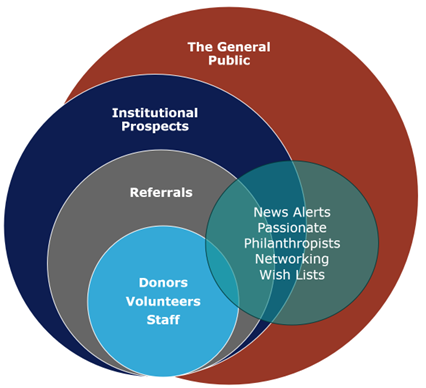
But here’s where it gets interesting. Once you and your development team really internalize this principle, you can start mapping out all the ways major gift prospects actually enter your pipeline. And I promise you, many of them aren’t entering via your annual wealth screening.

Think about it:

  • The grateful patient whose care team mentions a giving opportunity during recovery
  • The board member who brings a business colleague to your gala
  • The parent who gets involved with the advisory committee
  • The foundation executive who hears your CEO speak at a conference
  • The corporate partner whose VP falls in love with your program

These aren’t hypothetical scenarios. These are the everyday ways that million-dollar prospects walk through your door. And most organizations have no systematic way of capturing, vetting, and reporting on these individuals.

Your development team is probably already doing this work—identifying prospects through organic relationship-building, event attendance, and word-of-mouth referrals. The problem is, they’re doing it in isolation. Without your input. Without a process. Without documentation.

And that means opportunities are being missed, expectations aren’t managed, and you’re probably spending way too much time researching people with zero connection to your organization while high-potential prospects languish in the “someone should probably look into this person” pile.

Why Documentation Is Your Secret Weapon

I can already hear some of you groaning. Documentation? Really? You want me to document our prospect ID process when I can barely keep up with the profile requests I have now?

Yes. I do. And here’s why.

Documentation isn’t bureaucracy—it’s strategy in writing. Once you put your prospect identification framework on paper, something magical happens:

  • Leadership suddenly has opinions. And that’s exactly what you want. Because leadership has the authority to make decisions about how prospect identification actually works at your organization. Once they’re engaged, you have a powerful ally who can say “no, we’re not going to ask the researcher to find us 50 wealthy strangers with no connection to our mission” or “yes, we’re going to prioritize event attendees and board referrals over cold prospecting.”
  • You can make the case for what actually works. When you’re writing the documentation, you get to remind everyone that relationships drive fundraising. You get to frame prospect identification through that lens. And you get to set expectations—when leadership commands you to prospect outside the relationship sphere, you can point to your documented framework and say “absolutely, but our engagement ratio is going to be around 5% instead of 30%.”
  • Everyone agrees on what counts as prospect identification. This might be the biggest win of all. Once you document that event attendees require research vetting, that board referrals follow a specific qualification process, that news article mentions get the same treatment as wealth screening hits—suddenly all of these activities fall under the same umbrella. Which means they can be tracked, measured, and resourced appropriately.

But What If Your Culture Is Broken?

 I can hear you. Some of you are thinking: “This is great in theory, Jen, but you don’t understand my organization. The culture here is completely entrenched. I spend all my time researching deep profiles on people who will never be contacted. I’m not even allowed to talk directly with leadership. Documentation isn’t going to fix that.”

I’m here to tell you something that might sound harsh at first, but I promise it comes from a place of deep respect for what you do: You can do your best work anywhere.

No, really. Stay with me.

You can write your documentation and share it with team members who will talk to you. You’ll learn so much from those conversations, especially if you’re willing to listen to the frontline fundraisers who are actually in the trenches. They know which prospects have potential and which are pipe dreams. They know what information helps them and what just clutters their inbox. They’ll tell you the truth—if you ask and if you listen.

You can begin socializing your framework by giving your services marketing names that describe your actual process. This is where you get to be creative. Deliver a list of no-connection prospects under the service name “Cold Outreach Research-Wish List” and suddenly everyone understands what they’re getting.

Call your event attendee research “Hot Lead Vetting” and watch how much more enthusiastic people are about those prospects. Words are powerful. Use them strategically.

You can introduce innovations wherever you have authority to do so. For example, when you deliver a new prospect, include a brief “relationship statement” or “reasoning note” explaining why they’re a good prospect. This does two things: It educates your development team about what makes a quality prospect, and it invites feedback that helps you refine your process over time.

Here’s the bottom line: If you don’t practice your best work now—in whatever imperfect environment you’re currently in—you won’t be prepared when that golden job opportunity finally manifests itself.

The researcher who gets hired into that dream role isn’t the one who spent three years complaining about their dysfunctional shop. It’s the one who built innovative processes, documented their framework, and can articulate in an interview exactly how they would set up prospect identification at a new organization.

Practice your best work now so you’re ready for what comes next.

AI Is Here, and It’s Time to Step Up and Lead

Let’s talk about the elephant in the room: artificial intelligence.

AI has already begun disrupting our work. For some of you, that’s terrifying. For others, it’s exciting. But here’s what I know for sure—AI is poised to help you unleash your inner leader, whether you’re ready or not.

Think about everything we just discussed:

  • Writing that prospect identification framework? AI can help you draft it.
  • Coming up with creative service names that catch people’s attention? AI is brilliant at brainstorming.
  • Communicating differently with different personalities on your development team? AI can help you adapt your tone and approach.
  • Building a major gift prospect ID process that hums? AI can help you design it, refine it, and evolve it.

But here’s the thing AI can’t do: AI can’t be a leader. It can’t build relationships with your development team. It can’t advocate for resources. It can’t make the strategic decision about whether to prioritize board referrals or cold prospects. It can’t look a gift officer in the eye and say “I know you want me to research this person, but I think we’d get better results if we focused here instead.”

Only you can do that.

AI is a tool—an incredibly powerful one—but it’s still just a tool. The prospect researchers who will thrive in this new landscape aren’t the ones with the best technical skills or the fanciest databases. They’re the ones who step up and lead.

The ones who build frameworks, communicate strategy, and help their organizations make smart decisions about where to invest their prospecting energy.

This is your moment. The disruption that AI brings creates space for you to redefine your role. You can be the researcher who just finds information, or you can be the strategist who shapes how prospect identification works at your organization.

Which one do you want to be?

The Prospect ID Process That Hums

So what does a major gift prospect ID process that actually hums look like?

  • It’s documented, so everyone knows how it works and what to expect.
  • It’s relationship-focused, starting with your organization’s closest connections and working outward strategically.
  • It’s collaborative, with researchers and development officers working together to identify, vet, and qualify prospects through multiple channels.
  • It’s adaptive, using AI and other tools to increase efficiency without losing the human judgment that makes research valuable.
  • It’s communicated clearly, with service names and frameworks that help your development team understand what they’re getting and why.

And most importantly, it’s led by you—the prospect researcher who understands that wealth screenings are just one tool in a much larger toolkit, and who has the confidence to advocate for a better way forward.

The question is: Are you ready to build it?

Additional Resources

Wish you had access to more resources on prospecting? You do! The Prospect Research Institute has lots of resources to help you with prospecting:

  • Join Jen Filla for a free Backstage Tour of the Institute on 1/9/2026 at 12pm ET where you’ll learn about upcoming workshops such as: Strategic Prospect Identification – Smart Verification Framework – Solo Researcher Survival Kit
  • Connect with other prospect research professionals tackling these same challenges in the FREE Forums at the Prospect Research Institute.
  • Buy the Approach to Prospecting book or the course. This teaches you how to build a score card, which you can use for internal or external prospecting.
  • Check out our prospecting category on Prospect Research#ChatBytes the Institute’s podcast.
The 3 Topics That Shaped Our Year (And Will Level Up Yours)

December always does this—it makes us want to sprint toward January with fresh plans and big goals. But first, let’s take a breath and see what caught your attention in 2025. 

When I look back at the blog posts that resonated most with readers this year, they weren’t the ones promising quick fixes or silver bullet solutions. They were the ones that challenged assumptions, expanded roles, and helped researchers and fundraisers think differently about the work we do. 

So before we dive headfirst into the new year, let’s revisit the three posts that hit home for professionals like you—the ones that sparked conversations, shifted perspectives, and maybe even changed how you approach your work. 

If you missed these the first time around, consider this your second chance. If you read them already, well, sometimes the best insights are worth revisiting. 

1. Top 5 Capacity Rating Insights for Research Professionals

Let’s start with everyone’s favorite anxiety-inducing topic: capacity ratings. This post cut through the noise and named the uncomfortable reality: No matter what rating you choose, you will be wrong. And that’s okay. 

Why did this post resonate? Because it gave you permission to be human while doing technical work. It acknowledged that capacity ratings are directional, not definitive. And it reminded us that our job isn’t perfection—it’s providing the best assessment possible with available data, managing expectations, and building confidence for bold asks. 

If you’re still treating capacity ratings like a math problem with one correct answer, go read this post. Then have a conversation with your gift officers about methodology, limitations, and what you actually know versus what you’re estimating. You’ll all sleep better. 

2. Blinker Alert: Research is Changing Lanes

This might have been the most provocative post of the year. Not because it was controversial, but because it named something many of us were feeling but couldn’t quite articulate. 

Here’s why this post mattered: It gave language to the career evolution many researchers are pursuing. And it provided a roadmap for getting there, starting with five simple but powerful questions you can ask right now to signal your lane change. 

The researchers who read this post and took action? They’re the ones having different conversations with their gift officers. They’re the ones being invited into strategy meetings. They’re the ones building careers, not just holding jobs. 

If you’ve been feeling like your role should be more strategic but you’re not sure how to make that shift, this is your manual. Read it. Then start asking those questions. 

3. Public Company Insider. So What?

Maybe nobody in your fundraising office would actually say “So what?” out loud. But let’s be honest—when you tell a gift officer their prospect is a public company insider, you can see it in their eyes. They’re thinking: And that means… what, exactly? 

Why did this post land? Because it took a technical concept and translated it into fundraising relevance. It answered the “so what” question before anyone had to ask it. 

For researchers working in major gifts, this post was a masterclass in communicating value. For gift officers who skimmed past SEC filings in profiles, it was a wake-up call about what they might be missing. 

The Common Thread 

Three very different posts. Three distinct topics. But one consistent theme: Moving beyond the transactional to become genuinely strategic. 

Whether you’re wrestling with capacity ratings, considering your career trajectory, or trying to communicate the significance of insider wealth, the challenge is the same. It’s not about gathering more data. It’s about translating information into insight, insight into action, and action into results. 

The researchers and fundraisers who thrive aren’t the ones with access to the best databases or the fanciest screening tools. They’re the ones asking better questions. The ones challenging their own assumptions. The ones building relationships based on trust and proven value rather than just task completion. 

They’re the ones reading posts like these and thinking: How can I apply this tomorrow? 

 Take Action for 2026 

  1. Bookmark the Aspire Research Links Directory free webpage for instant access to resources the Aspire team uses every day 
  1. Register for the Back Stage Tour of the Prospect Research Institute to learn about 2026 hot topics 
  1. Order the updated Search Tips for Fundraisers booklet for yourself or your favorite colleague 

A.I. in Prospect Research: Shifting the Focus from Fear to Strategy

Let me paint you a picture of yesterday afternoon.

I’m sitting at my desk with twelve browser tabs open, three different databases logged in, and a lot of messy text I have cut and paste into my growing profile. I’ve spent the last two hours checking the client’s CRM, pumping the prospect’s name through our subscription tools, and power searching with Google and my favorites link list.

Then I start working through the messy text and realize I neglected to search for a key section of the profile. Four hours or so later I have worked through the profile multiple times and added some actionable insights. But I’ve also aged approximately three years and consumed enough caffeine to power a small city.

Sound familiar?

The AI Conversation Everyone’s Having

Everyone in nonprofit research is talking about AI these days. But most of the conversations I hear fall into three camps:

Camp 1: “AI is going to revolutionize everything! We’ll all be obsolete by next Tuesday!”

Camp 2: “AI is completely unethical and none of it can be trusted.”

Camp 3: “AI is overhyped nonsense that will never understand the nuance of our work!”

But here’s what I think we’re missing: The AI revolution is less of a revolution and more like the next steps in the AI trend that has been going on for years.

Instead of succumbing to fear, what if we asked:

  • “How much of my day do I spend on tasks that a really good assistant could handle?”
  • “What would I do with my time if I wasn’t constantly copy-pasting from six different systems?”
  • “What strategic insights am I not noticing because I’m drowning in data gathering?”

The Dream (That’s Closer Than You Think)

Picture this: You get a profile request on Monday morning. Instead of opening twelve tabs and settling in for a marathon copy-paste session, you open one interface that has already pulled together:

  • Everything your CRM knows about this donor
  • Matched information from public databases
  • Recent news and social media mentions
  • Wealth indicators and giving capacity scores
  • Relationship connections to your board, staff, and other donors
  • A summary of their philanthropic interests and giving patterns

…all with source citations so you can verify accuracy and dig deeper where needed.

Now here’s the magic: Instead of spending hours assembling this information, you spend hours analyzing it. Thinking about it. Crafting strategic recommendations.

You’re not asking “How wealthy is this person?” You’re asking “What does their giving pattern tell us about their values?” and “How can we connect their passion for education with our new scholarship program?”

Why This Isn’t Science Fiction

The technology exists. Right now. I’ve been testing some of these tools, and for specific use cases, they’re already game-changing. Public company insider research that used to take hours now takes minutes, with calculations we never had time to do manually. Thank you Kaleidoscope Insider Focus!

The challenge isn’t the technology—it’s that all these amazing tools live in silos and depend on the quality of the information inside those silos. Your wealth screening tool doesn’t talk to your relationship mapping platform. Your donor database doesn’t integrate with the AI that’s scraping LinkedIn and news sources.

But integration problems get solved. That’s what technology does—it gets better, faster, and more connected.

The Skills That Matter Now

So if the information-gathering part of our job is becoming automated, what’s left?

Everything that actually matters:

  • Critical thinking: AI can find information, but can it tell you whether that $2 million gift to another organization suggests strong capacity or donor fatigue?
  • Strategic insight: Tools can map relationships, but can they recommend the perfect board member to make an introduction?
  • Storytelling: Databases can list giving history, but can they craft the narrative that helps your gift officer understand what motivates this donor?
  • Ethical judgment: AI can gather data, but can it navigate the privacy and ethical considerations that come with prospect research?

Your Next Move

The researchers who will thrive in an AI-enhanced world are the ones who start preparing now. Not by panicking about job security or doomsday ethical scenarios, but by:

  • Getting curious about strategy: Start asking better questions about the information you’re already gathering (read this Apra Connections article)
  • Building relationships: Become the trusted advisor your development team runs to for insights, not just data
  • Staying current: Understanding what’s possible with new tools, even if they’re not perfect yet
  • Thinking bigger: What would you tackle if the boring stuff was handled for you?

The Bottom Line

AI won’t replace prospect researchers. But prospect researchers who embrace AI as a powerful assistant will absolutely outperform those who don’t.

The question isn’t whether you’ll have a job in an AI world. It’s whether you’ll be doing the parts of the job that actually matter—the strategic, creative, relationship-building work that transforms donor data into cultivation gold.

And honestly? That sounds like a much better job than the one where I spend half my day copying and pasting between databases.

What do you think—are you ready to let AI handle the busy work so you can focus on the work that actually changes lives?

Ready to Level Up Your Strategic Thinking?

If you’re nodding along thinking “Yes, I want to be the researcher who provides strategic insights, not just data dumps,” then you’re exactly who I built the Research Asset Membership for.

In our workshops, we dig into the real challenges you’re facing: How do you turn research into actionable cultivation strategies? How do you build the relationships that make you a trusted advisor? How do you navigate the ethical complexities of modern prospect research?

Plus, you’ll connect with a community of researchers who get it. People who understand both the frustrations and the incredible satisfaction of this work we do.

Because here’s what I know after years in this field: The researchers who invest in continuously building their strategic skills don’t just survive change—they lead it.

Learn more about Research Asset Membership and join a community of prospect researchers who are shaping the future of our field.

Additional Resources

That Familiar Ask: ‘Can You Find Rich People?’ Here’s What to Do Instead

You know that feeling, don’t you? The development team walks into your office (or slides into your DMs) with a sparkle in their eyes. They’ve been strategizing. They’ve been planning. And they have a shiny new idea: “Can you get a list of wealthy people in the community who might be interested in our new program?”

Your heart sinks a little because you know what comes next. Hours of research on strangers. Cold prospect lists. Fundraisers making awkward cold calls to people who’ve never heard of your organization. And then, when the gifts never materialize, they come back with new strategies for more places to look out in the community.

I’ve been there. We’ve all been there. But here’s what I’ve learned after years of watching this play out: We have more power in this conversation than we think we do.

The Uncomfortable Truth About Stranger Danger

The truth is that asking for money, especially larger investments, requires relationships. Typically, the colder the relationships the more prospects it takes over a longer period of time to get the gifts your organization needs.

The uncomfortable truth is that your frontline fundraisers know they should focus on building existing relationships before chasing down strangers, but when they’re in the moment and feeling the pressure to fund the program, your organization’s database full of donors is a software program and strangers are people.

But we researchers know that the database is full of people. People who know us and support our organization.

Becoming a Trusted Partner

You could point out to the frontline fundraiser how ridiculous it is to chase strangers instead of mining your own database of existing relationships, but how well do you think that will go down?

In most development departments, research does not hold a lot of political power. What we can have is influence over our colleagues. And influence requires trust.

Instead of making your fundraiser feel stupid, you could try an approach along the lines of the following:

“That’s a great idea, and I can definitely help you find prospects from our community. But it might take a year or even a few years for gifts to come in from people with no connection to us. What if I also do some datamining on our existing donors? I might find some good prospects who already know and trust us—those gifts could come in much faster.”


This isn’t about saying no. It’s about saying “yes and.” Yes, you can do the research they have requested AND you also have a stellar idea to bring good prospects to the table.

Sometimes You Do Need to Look Outside

There are times when it totally makes sense to search for prospects out in your community.

Consider the following scenarios:

  • Maybe you really don’t have the internal prospects to support something new.
  • It might be time for your board members to step up and start introducing your organization to their networks.
  • If it is a new initiative, you might want to tap into foundations. They often prefer new projects.
  • You may want to deliberately diversify your funding sources!
  • Engaging the community through businesses, civic groups, or government could be an important complementary strategy to individual giving.

The Power of Reframing

I used to think my job was to say yes to whatever research request came my way. But I learned that our real value as researchers isn’t in being order-takers—it’s in being strategic thinking partners.

When development teams come to us with the “research rich strangers” request, they’re not wrong to want to expand their prospect pool. But they might not be choosing the best research technique to source the prospects they need.

If you become the trusted partner that listens to the need and delivers great prospects, what do you think will happen next time they are under pressure to raise funds for a project? They will RUN to you asking you to do it again! Or even better, they will ask you for advice.

A Challenge for All of Us

Next time you get that familiar request to research wealthy community members, I challenge you to pause and ask questions such as:

  • Could you tell me more about what a BEST prospect for this project looks like?
  • If you don’t want formal institutional funding, how would you feel about a family foundation that is local and has funded similar projects?
  • Before I search externally, would you mind if I checked to see if we have any existing donors that might be a good fit and run that by you first?

You might be surprised by what you learn from the conversations. More importantly, your fundraisers might be surprised by how much faster those gifts come in when they’re using the best strategy and especially if they are building on existing relationships instead of starting from scratch.

Because you and I both know: The best prospecting doesn’t just find people with money. It finds people with money who are connected to and care about your mission.

And most of the time, those people are already in your database.

Additional Resources

Wish you had access to more resources on prospecting? You do! The Prospect Research Institute has lots of resources to help you with prospecting:

  • Connect with other prospect research professionals tackling these same challenges in the FREE Forums at the Prospect Research Institute.
  • Buy the Approach to Prospecting book or the course. This teaches you how to build a score card, which you can use for internal or external prospecting.
  • Check out our prospecting category on Prospect Research#ChatBytes the Institute’s podcast.
Top 5 Capacity Rating Insights for Research Professionals

We’ve all been there. The gift officer needs a capacity rating “super quick” before meeting with someone. The electronic screening shows a low number, but the prospect’s occupation suggests there’s more. Sound familiar?

After years of calculating ratings, fielding anxious questions from researchers and fundraisers, and watching the gap between promise and reality, following are the top 5 capacity rating insights for research and prospect management.

1.No Matter What Rating You Choose – You Will be Wrong! (And That’s OK)

Surrender your anxiety! Capacity ratings can never be 100% accurate because too much of the information is private. Capacity ratings are directional, not definitive.

Your job is to provide the best assessment possible with available data. But if you want to feel anxious, get worried about under-rating the prospect not over-rating them. You want build your development officer’s confidence to ask boldly.

 2. HNWIs Are Your Blind Spot

The wealthier the prospect, the more likely their wealth is hidden. Private equity, angel investments, Delaware LLCs, family offices – none of this shows up cleanly in databases. Machine-generated ratings consistently undervalue HNWIs because the data needed to identify “whales” isn’t available for algorithms to process.

Accept that spotting transformative wealth still requires human intelligence and industry knowledge.

 3.  Estimated Net Worth vs. Gift Capacity: Know When Each Matters

Gift capacity ratings provide an assessment of a stretch gift amount from the prospect and the approach to calculating depends on the prospect. At Aspire, if someone appears to be below $1M in estimated net worth, we use the old-fashioned general calculations based on visible assets.

But if they are $1M or above, we place them in a net worth tier based on quantitative and qualitative data points and then take a percentage (typically 5%) of estimated net worth to create the capacity range.

 4. Data Isn’t the Strategy

Technology keeps promising instant major gift identification, but it’s not delivering for everyone, especially wealthy minorities such as women, people of color, and others. And we know that the best data is locked inside the donor’s head and heart.

As a researcher, you can go beyond gathering information and become the fundraising partner who translates pages of information into ways the development officer might take action with the prospect.

 5. Inclusive Research Pays Off

Traditional approaches miss wealthy minorities. But identifying prospects by demographic characteristics such as ethnicity can be ineffective and uncomfortable.

Instead, research with inclusive assumptions. Question your own biases when two similar prospects get different ratings. Check if you’re undervaluing first-generation wealth creators or making assumptions about giving patterns.

Moving Forward

Capacity ratings aren’t perfect, but they probably are not going anywhere. As A.I. creeps into our tools and makes all of our scores and ratings even better, we might find them eventually replaced or perhaps renamed and improved. But for now, you can make them as useful as possible while managing expectations about their limitations.

We all struggle with the same capacity rating anxieties. The most successful researchers combine data analysis with relationship intelligence, inclusive practices, and clear communication about what they know and don’t know.

Engage gift officers in conversations about how you arrive at ratings. Some of your best collaborations will come from fundraisers who want to understand your methodology. Join professional forums, attend APRA sessions, and don’t be afraid to ask for input from colleagues. Capacity rating is as much art as science.

And of course, the Prospect Research Institute has lots of resources to help you with capacity ratings!

  • Connect with other prospect research professionals tackling these same challenges in the FREE Forums at the Prospect Research Institute.
  • Invest in your education and buy the Capacity Ratings book or the course.
  • Check out the Institute’s Capacity Rating Section in our Free Library, which includes a capacity rating calculator download.
launch your prospect portfolio; rocket

Add Speed to Major Gift Portfolios with RPM

When a current client created a job posting for a Research and Prospect Management position a light bulb went off!

Research and                                  Revolutions
Prospect                                            Per
Management                                   Minute

More frequently you’ll see this type of combined role posted as Prospect Management and Research (PMR). But if you reverse that to Research and Prospect Management (RPM) …can you get more speed into your major gift portfolios?

Which comes first – research or prospect management?

Unlike a similar question about chickens and eggs, there is a pretty definitive answer to this question. Research usually comes first in the form of prospect identification.

Most organizations grow into major gifts. A common nonprofit story begins with institutional funding, such as foundations and corporations, who want to support early and continued nonprofit growth. Along the way, nonprofits attract small dollar individual gifts and refine their individual giving program to the point where larger gifts receive more personalized attention and individuals are personally asked for larger gifts.

Usually with the first capital or other campaign, there comes a need to more methodically or reliably identify donor prospects who can give lead campaign gifts. Enter prospect research with major gift prospect identification!

When there are just too many donors requiring personal attention to keep track of in one person’s head, the CRM database comes to the rescue with prospect management. Prospect management provides a systematic way of tracking prospect’s progress from identification to a gift and stewardship.

But what happens to research when prospect management becomes a separate specialty in-house?

Sometimes research and prospect management get out of sync, prompting major gift portfolios to get as stubbornly stuck as a zipper out of alignment!

When research is disconnected from the management of major gift portfolios, various things begin to break down. Sometimes the criteria that research is using to identify prospects does not fit with the funding priorities or the development officer’s views on what makes a great prospect. Research might not be aware of specific regions or development officer portfolios that need more or different prospects than others.

When prospect management is disconnected from research, important information learned from development officers is not passed along. For example, a development officer might learn critical information about a wealth event for which research could provide capacity insight. Also, the prospect manager might not be aware of the criteria used to source new prospects and then they cannot explain it to the development officers.

Adding research in at the “front” of prospect management – the RPM perspective – recognizes that the smooth coordination of prospect identification with portfolio management is where major gift speed is generated.

When the zipper is not aligned, movement is difficult and slow. When there is alignment, the zipper zips easily and quickly.

Similarly, when research and prospect management are aligned, development officers zip through qualifying and disqualifying!

(This all assumes, of course, that development officers are trained in qualification techniques and have a disciplined work process. But that is a different subject!)

Major gift fundraising: Can’t have one without the other

Whether you like to call the work PMR or RPM, the bottom line is that you can’t have one without the other. Without research, pipelines eventually run dry. Without prospect management, development officers lack support to move prospects effectively and efficiently toward a larger, major or transformative gift.

Additional Resources

workshop ad, people around a table

Pictures and Patterns: Decision-making with Fundraising Insights

Imagine you emerge from a strategic planning session and your task is to raise more money from corporations. Your organization wants to expand its reach and you need to take the thousands of corporate donors in the database and transform them into a fundraising program. Why? Because everyone “feels” like there is a lot of opportunity there. Where do you start?

One of the most common mistakes in fundraising is to make decisions and invest money and resources in strategies that are based on intuition and anecdotal evidence alone. Let’s face it, sometimes it works, and maybe that’s why the behavior is so persistent. But much of the time data-weak decisions fail miserably, often slowly and painfully with lots of fingers pointed. There is a better way.

Leverage the talents of prospect research to paint pictures and identify patterns!

Well-trained prospect research professionals are methodical and analytical. That means that we enjoy solving problems, untangling messy information, and putting order to chaos. Share with us your dilemmas, your problems …your fundraising hopes and dreams. We can help you succeed!

In the new corporate fundraising program example, it means painting a picture of our corporate donors:

  • Where are they located?
  • How many of them are there and at what giving levels?
  • How long have they been donors?
  • Are they small, closely held companies, or large corporations?

And then identifying clusters and patterns:

  • Are there groups of donors in particular industries, geographic locations, or company size?
  • Do the donors that give the most and most frequently have anything in common?
  • Is there anything about the data that can help us understand the giving behaviors? Can we see any correlations between data points?

There is no standard checklist for exploring this kind of information. It requires a keen understanding of the fundraising being undertaken matched with an analytical mind trained in using data to solve problems.

When a prospect research professional works with you to explore your data and make an initial assessment, you can decide on strategies and tactics that will raise the most money now and in the future.

For example, you might discover some companies are more “ripe” for a new approach than others. If they have been giving frequently and increasing their giving, visiting them and discovering their philanthropic needs might uncover a unique corporate approach for your organization that you hadn’t thought of!

Knowing that your best donors are dominated by small, closely held companies gives you the opportunity to find out why. What makes your organization so attractive to them? Are they really individual donors in disguise or do they have company objectives for their philanthropy?

Uncovering an unusual pattern, such as expressions of faith on the company website, might give you an insight that challenges the way you perceived your donors and that opens the door to much deeper relationships.

Fundraising success through insights is not so much about the tools – data mining, statistical analysis, profile research – it’s about giving the donor story inside your data a voice.

When you hire a prospect research professional to help you understand your data, you are hiring someone with a unique skill set – someone who can uncover and communicate the “story” inside your data.

More Resources