Tag Archives: prospecting

Donor Referrals and Introductions: Cracking the Relationship Mapping Code

A real-world test of DonorAtlas’s relationship mapping features — and what it means for researchers who never had time for this work before.

Traditionally, relationship mapping has been a long and tedious process reserved for high-stakes prospects. Could that be changing with advances in generative AI? I sure hope so.

I want to be clear upfront: I am a subscriber to DonorAtlas and I genuinely believe in what they’re building. I don’t get paid to say that — I just think it’s doing something the field has needed for a long time. And when I tested their new relationship mapping feature, I wanted to share what I found honestly, including what works, what doesn’t yet, and why I’m excited anyway.

There is so much hype around generative AI. I don’t want to fuel the binge on over-promising and under-delivering. But who isn’t at least curious about the possibility that relationship mapping could get easier and less expensive — and maybe start being used earlier in the prospecting process?

Why this matters right now

We are all under pressure to identify and move prospects who can make major and transformational gifts. The K-Shaped Economy shows no signs of abating, which means more giving will come from wealthier donors making larger gifts. If you’re not familiar with the term, the K-Shaped Economy describes an environment where the wealthy are experiencing growth in asset values while the less affluent are feeling the squeeze of higher prices and a tight job market.

What this means practically: engaging ultra-high-net-worth (UHNW) individuals requires an introduction. Even when an UHNW individual is already a donor to your organization, you might not have enough of a relationship to get them to respond to outreach. You need a door-opener. And that means you need to know who your existing donors and trustees know.

That’s exactly what relationship mapping is supposed to solve. The problem is that it’s historically been slow, expensive, and therefore rationed — reserved for only the most critical prospects.

What I tested: prospecting from a top donor’s connections

To try out DonorAtlas’s relationship mapping capabilities, I chose a well-known Tampa Bay philanthropist, Penny Vinik, and asked: who does she know that might be a new major gift prospect for a nonprofit she already supports?

Penny and her husband Jeffrey have given generously to the Tampa Museum of Art, which is currently in a publicly announced capital campaign. I asked DonorAtlas to show me her connections. At first, I was getting individuals already connected to the museum in some way — as donors or current or past trustees. That gave me 78 names, which was too many to evaluate meaningfully.

So I tried filtering out Florida connections entirely. That narrowed the list to 10 names. Much more manageable!

And that’s when I found an interesting lead: someone who had previously served with Penny on a Tampa private school board. The museum has extensive educational programming. This person has a high-profile business in Tampa Bay. Could they be a great prospect? Maybe! The point isn’t that DonorAtlas handed me a definitive answer — it’s that it helped me surface a name worth scrutinizing, quickly.

This exercise was about developing an initial list for scrutiny, not producing a finished prospect list. And it worked reasonably well. Relationship mapping is a new feature for DonorAtlas, and I’m expecting it to be refined and improved with user feedback — they have been extremely responsive to input, which is a delight.

The problem it also solves that I didn’t expect

One of the persistent challenges at Aspire has been developing a quick preliminary list for clients to review before we invest time in deeper research. When we go old-school — listing names of previous board members, for example — a name by itself isn’t enough. Development staff need context to assess whether a name is worth bringing to their top donor or trustee. But researching each name fully before the first review is inefficient.

DonorAtlas solves this problem in an interesting way. When you develop an early list, you automatically have full profiles for each name. That’s actually too much information for a first pass! But you can export only the specific data fields you want — a bio, a wealth indicator, a philanthropic summary — making it easy to present a meaningful list for initial review without overwhelming anyone.

And here’s the feature that changes everything for prospecting work: the ability to save a network of individuals and then filter any new list by connections to that saved network. So we can surface names and immediately know who in our existing network is connected to them. That is a giant improvement.

Why DonorAtlas is different for this work

DonorAtlas isn’t the first technology to help researchers mine for relationships. But it is specifically designed for fundraising — and that design intent shows. It makes it easy to prospect for new names based on philanthropy and wealth, filter for connections to a defined network, and quickly view profiles without leaving search results. Founded in 2024 and built entirely on generative AI, they keep adding features and — this matters — they actually listen to users.

Is it perfect? Not yet. But that’s not the point. The point is that relationship mapping, which used to feel like a luxury reserved for a handful of prospects per year, is starting to feel like something that could happen routinely. Earlier in the process. More systematically.

For researchers who have always known that relationships drive gifts — not wealth ratings, not capacity scores, not screenings — that’s a very exciting direction!

Have you experimented with relationship mapping tools in your research practice? I’d love to hear what you’re finding.

Additional Resources

The A.I. Tug of War in Fundraising—And How to Find Your Footing

Let me ask you something: How many times has a piece of technology promised to change everything… and then promptly driven you absolutely crazy?

You know the scenarios. It can do all the things, but only after you’ve configured everything yourself. “Integration” turned out to mean something very different from what you imagined. The upgrade wiped out every custom setting you spent hours building. And whenever you try to do something just slightly outside the norm, the software fights you like a toddler at bedtime.

I could go on. We have all been there.

And yet—here’s the tension—technology genuinely has made our lives easier. Microsoft Word may not make complex formatting a walk in the park, but it has transformed how we create documents. And because it plays nicely with the rest of the MS Office suite, whole categories of headaches have simply disappeared.

Welcome to the tug of war.

The Two Ends of the Rope

When it comes to A.I. in fundraising, this same push and pull is playing out in real time. On one end of the rope are the people who believe A.I. is too messy, too risky, and too unreliable to touch. On the other end are the people who believe A.I. has ushered in such a leap in accuracy that we can use machine-generated information as-is, no human review required.

New technologies that arrive with enormous hype—and A.I. certainly arrived with enormous hype—have a way of polarizing us. But is there something useful to be found in the middle of that rope?

Spoiler alert: There is.

Yes, A.I. Has Been Around. But This Feels Different.

A.I. has been woven into our digital experience for years. Recommendation engines. Spam filters. Autocomplete. But when OpenAI released ChatGPT in 2022, it felt less like a product launch and more like a digital eruption. Things are moving fast. New and genuinely exciting capabilities are emerging. And yes, things are getting broken along the way.

For many in our field, the speed of that change feels dangerous. Whatever you do, don’t ask A.I.

But much like the anxiety that greeted Google’s debut—remember when people worried that nobody would learn anything anymore?—there is real and practical value here, if you know how to use it.

One of the most useful features of a generative A.I. chatbot is that you can ask it to show its work. Where did that information come from? What sources support that conclusion? What transactions were used to build that summary? That transparency is actually a significant feature, not a quirk.

Where A.I. Is Changing the Game for Prospect Research

At Aspire Research Group, one of the most dramatic shifts A.I. has made in our day-to-day work is in writing bios. Even setting aside the time required to gather information, writing a few well-crafted paragraphs about a prospect has always been time-intensive. Using DonorAtlas, we now have well-written bios and the underlying sources for verification—almost instantly. We can deliver a significantly stronger product at the low end, in far less time.

Until, of course, A.I. fails us. And it does fail us.

People in the arts, for example, seem to get misrepresented by A.I. with striking frequency. What is their “job,” exactly? They don’t fit the pattern that it expects. In those cases, we take over the steering wheel and drive that one ourselves.

This is not a reason to abandon A.I. It’s a reason to understand it.

Algorithms Are Only as Good as the Data Behind Them

Remember when Netflix’s recommendations felt almost eerily accurate—until they didn’t? If you shared an account with someone whose taste was wildly different from yours, the algorithm got confused. It was doing its best with messy inputs.

The same principle applies to your fundraising database. If your data is a hot mess, A.I. is going to struggle to give you reliable scores or meaningful analysis. But here’s the thing: it might still give you better results than statistical modeling did. And if better-than-before scores get gift officers out the door and into conversations with donors faster, that’s not nothing. Something is better than nothing.

But that raises the next question—and it’s an important one.

If A.I. Is Better Than What Came Before, Why Not Just Trust It?

If A.I. analysis outperforms statistical modeling, why shouldn’t we lean on it entirely? Why not let it drive portfolio assignments, staffing decisions, campaign planning?

I recently interviewed Vered Siegel on the Prospect Research #ChatBytes podcast, and she said something that I keep coming back to:

“One of the biggest shifts generative AI has introduced in our industry is that information is no longer the scarce resource. Judgment is now the scarce resource. We can generate lists and summaries and signals faster than ever, but that doesn’t automatically make our decisions better. One key aspect of being a strategic partner right now means helping the room slow down just enough to ask the right questions.”

Read that again. Judgment is now the scarce resource.

Finding the Balance

The key to leveraging A.I. well is knowing where human judgment needs to enter the picture—and deciding what level of risk is acceptable for you and your organization.

I’m not suggesting that every single name assigned to a portfolio requires a human review. Not anymore. But what if a feedback loop was built into the prospect assignment process? What if gift officers had a routine way to tell your analytics team when things are working—and when they’re not. That loop is human judgment at scale.

Here’s what breaks down when human judgment is undervalued or eliminated altogether: efficiencies go down. Not up. The risk of an error that could damage donor trust or cause your organization harm goes up. The promise of A.I. is efficiency, but that promise only delivers when the humans in the process are engaged at the right moments.

Get the balance right, and productivity goes up. New opportunities surface. Gift officers work with better information. Researchers spend their energy where it actually matters.

Get it wrong—either by refusing to use A.I. at all or by outsourcing your judgment to it entirely—and you’re just holding a rope with nobody on your end.

This Is Your Moment to Lead

Here’s what I want you to take away from all of this: the disruption that A.I. is causing in our field is real. But it’s also creating space for researchers and prospect management professionals to step into a more strategic role.

A.I. can generate the bio. It can surface the signal. It can produce the list. But it cannot decide which signals matter for your organization’s specific mission and relationships. It cannot make the judgment call about when a score doesn’t pass the smell test. It cannot be the strategic partner in the room who helps leadership slow down and ask the right questions.

Only you can do that.

The question—as always—is whether you’re ready to step up and do it.

Additional Resources

Beyond Episodic Wealth Screenings: Major Gift Prospect Identification That Hums

Let me ask you something: When was the last time a wealth screening rating automatically translated into an engaged prospect?

If you’re laughing right now, we’re on the same page. We all know the drill—trust but verify, capacity doesn’t equal inclination, wealth doesn’t equal relationship. But here’s what keeps me up at night: If wealth screenings have such obvious limitations, why are so many research shops still treating them as the primary engine for major gift prospect identification?

Spoiler alert: They shouldn’t be.

The Statistic That Changes Everything

 According to a CASE study of principal gifts to U.S. colleges and universities, half of these transformational gifts came from non-alumni. Read that again. Half.

We’re not talking about modest annual fund gifts here. We’re talking principal gifts—the naming opportunities, the program-changing investments, the gifts that get announced with press releases and champagne.

And half of them came from people who weren’t in the alumni database waiting to be wealth-screened.

Now, the study didn’t break down how many were parents versus community members. But that ambiguity makes the statistic even more powerful. These prospects exist in multiple spheres around your organization, and they’re making gifts that matter.

So the question isn’t whether we should be prospecting outside the database. We already know the answer is yes.

The real question is: How do we build a prospect identification process that actually works?

Let’s Start at the Very Beginning

Here’s what we know to be true: Relationships drive gifts. Not wealth. Not capacity. Not even inclination, really. Relationships.

And relationships exist in concentric circles radiating out from your organization’s core. The closer someone is to your mission, the more likely they are to give significantly. This isn’t revolutionary—it’s fundraising 101.
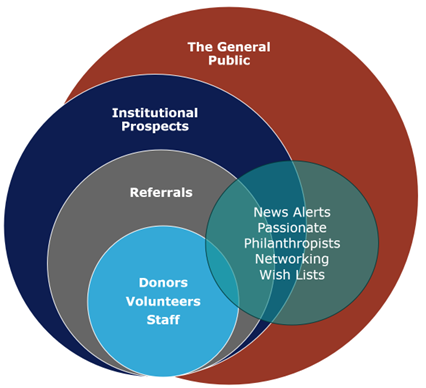
But here’s where it gets interesting. Once you and your development team really internalize this principle, you can start mapping out all the ways major gift prospects actually enter your pipeline. And I promise you, many of them aren’t entering via your annual wealth screening.

Think about it:

  • The grateful patient whose care team mentions a giving opportunity during recovery
  • The board member who brings a business colleague to your gala
  • The parent who gets involved with the advisory committee
  • The foundation executive who hears your CEO speak at a conference
  • The corporate partner whose VP falls in love with your program

These aren’t hypothetical scenarios. These are the everyday ways that million-dollar prospects walk through your door. And most organizations have no systematic way of capturing, vetting, and reporting on these individuals.

Your development team is probably already doing this work—identifying prospects through organic relationship-building, event attendance, and word-of-mouth referrals. The problem is, they’re doing it in isolation. Without your input. Without a process. Without documentation.

And that means opportunities are being missed, expectations aren’t managed, and you’re probably spending way too much time researching people with zero connection to your organization while high-potential prospects languish in the “someone should probably look into this person” pile.

Why Documentation Is Your Secret Weapon

I can already hear some of you groaning. Documentation? Really? You want me to document our prospect ID process when I can barely keep up with the profile requests I have now?

Yes. I do. And here’s why.

Documentation isn’t bureaucracy—it’s strategy in writing. Once you put your prospect identification framework on paper, something magical happens:

  • Leadership suddenly has opinions. And that’s exactly what you want. Because leadership has the authority to make decisions about how prospect identification actually works at your organization. Once they’re engaged, you have a powerful ally who can say “no, we’re not going to ask the researcher to find us 50 wealthy strangers with no connection to our mission” or “yes, we’re going to prioritize event attendees and board referrals over cold prospecting.”
  • You can make the case for what actually works. When you’re writing the documentation, you get to remind everyone that relationships drive fundraising. You get to frame prospect identification through that lens. And you get to set expectations—when leadership commands you to prospect outside the relationship sphere, you can point to your documented framework and say “absolutely, but our engagement ratio is going to be around 5% instead of 30%.”
  • Everyone agrees on what counts as prospect identification. This might be the biggest win of all. Once you document that event attendees require research vetting, that board referrals follow a specific qualification process, that news article mentions get the same treatment as wealth screening hits—suddenly all of these activities fall under the same umbrella. Which means they can be tracked, measured, and resourced appropriately.

But What If Your Culture Is Broken?

 I can hear you. Some of you are thinking: “This is great in theory, Jen, but you don’t understand my organization. The culture here is completely entrenched. I spend all my time researching deep profiles on people who will never be contacted. I’m not even allowed to talk directly with leadership. Documentation isn’t going to fix that.”

I’m here to tell you something that might sound harsh at first, but I promise it comes from a place of deep respect for what you do: You can do your best work anywhere.

No, really. Stay with me.

You can write your documentation and share it with team members who will talk to you. You’ll learn so much from those conversations, especially if you’re willing to listen to the frontline fundraisers who are actually in the trenches. They know which prospects have potential and which are pipe dreams. They know what information helps them and what just clutters their inbox. They’ll tell you the truth—if you ask and if you listen.

You can begin socializing your framework by giving your services marketing names that describe your actual process. This is where you get to be creative. Deliver a list of no-connection prospects under the service name “Cold Outreach Research-Wish List” and suddenly everyone understands what they’re getting.

Call your event attendee research “Hot Lead Vetting” and watch how much more enthusiastic people are about those prospects. Words are powerful. Use them strategically.

You can introduce innovations wherever you have authority to do so. For example, when you deliver a new prospect, include a brief “relationship statement” or “reasoning note” explaining why they’re a good prospect. This does two things: It educates your development team about what makes a quality prospect, and it invites feedback that helps you refine your process over time.

Here’s the bottom line: If you don’t practice your best work now—in whatever imperfect environment you’re currently in—you won’t be prepared when that golden job opportunity finally manifests itself.

The researcher who gets hired into that dream role isn’t the one who spent three years complaining about their dysfunctional shop. It’s the one who built innovative processes, documented their framework, and can articulate in an interview exactly how they would set up prospect identification at a new organization.

Practice your best work now so you’re ready for what comes next.

AI Is Here, and It’s Time to Step Up and Lead

Let’s talk about the elephant in the room: artificial intelligence.

AI has already begun disrupting our work. For some of you, that’s terrifying. For others, it’s exciting. But here’s what I know for sure—AI is poised to help you unleash your inner leader, whether you’re ready or not.

Think about everything we just discussed:

  • Writing that prospect identification framework? AI can help you draft it.
  • Coming up with creative service names that catch people’s attention? AI is brilliant at brainstorming.
  • Communicating differently with different personalities on your development team? AI can help you adapt your tone and approach.
  • Building a major gift prospect ID process that hums? AI can help you design it, refine it, and evolve it.

But here’s the thing AI can’t do: AI can’t be a leader. It can’t build relationships with your development team. It can’t advocate for resources. It can’t make the strategic decision about whether to prioritize board referrals or cold prospects. It can’t look a gift officer in the eye and say “I know you want me to research this person, but I think we’d get better results if we focused here instead.”

Only you can do that.

AI is a tool—an incredibly powerful one—but it’s still just a tool. The prospect researchers who will thrive in this new landscape aren’t the ones with the best technical skills or the fanciest databases. They’re the ones who step up and lead.

The ones who build frameworks, communicate strategy, and help their organizations make smart decisions about where to invest their prospecting energy.

This is your moment. The disruption that AI brings creates space for you to redefine your role. You can be the researcher who just finds information, or you can be the strategist who shapes how prospect identification works at your organization.

Which one do you want to be?

The Prospect ID Process That Hums

So what does a major gift prospect ID process that actually hums look like?

  • It’s documented, so everyone knows how it works and what to expect.
  • It’s relationship-focused, starting with your organization’s closest connections and working outward strategically.
  • It’s collaborative, with researchers and development officers working together to identify, vet, and qualify prospects through multiple channels.
  • It’s adaptive, using AI and other tools to increase efficiency without losing the human judgment that makes research valuable.
  • It’s communicated clearly, with service names and frameworks that help your development team understand what they’re getting and why.

And most importantly, it’s led by you—the prospect researcher who understands that wealth screenings are just one tool in a much larger toolkit, and who has the confidence to advocate for a better way forward.

The question is: Are you ready to build it?

Additional Resources

Wish you had access to more resources on prospecting? You do! The Prospect Research Institute has lots of resources to help you with prospecting:

  • Join Jen Filla for a free Backstage Tour of the Institute on 1/9/2026 at 12pm ET where you’ll learn about upcoming workshops such as: Strategic Prospect Identification – Smart Verification Framework – Solo Researcher Survival Kit
  • Connect with other prospect research professionals tackling these same challenges in the FREE Forums at the Prospect Research Institute.
  • Buy the Approach to Prospecting book or the course. This teaches you how to build a score card, which you can use for internal or external prospecting.
  • Check out our prospecting category on Prospect Research#ChatBytes the Institute’s podcast.
That Familiar Ask: ‘Can You Find Rich People?’ Here’s What to Do Instead

You know that feeling, don’t you? The development team walks into your office (or slides into your DMs) with a sparkle in their eyes. They’ve been strategizing. They’ve been planning. And they have a shiny new idea: “Can you get a list of wealthy people in the community who might be interested in our new program?”

Your heart sinks a little because you know what comes next. Hours of research on strangers. Cold prospect lists. Fundraisers making awkward cold calls to people who’ve never heard of your organization. And then, when the gifts never materialize, they come back with new strategies for more places to look out in the community.

I’ve been there. We’ve all been there. But here’s what I’ve learned after years of watching this play out: We have more power in this conversation than we think we do.

The Uncomfortable Truth About Stranger Danger

The truth is that asking for money, especially larger investments, requires relationships. Typically, the colder the relationships the more prospects it takes over a longer period of time to get the gifts your organization needs.

The uncomfortable truth is that your frontline fundraisers know they should focus on building existing relationships before chasing down strangers, but when they’re in the moment and feeling the pressure to fund the program, your organization’s database full of donors is a software program and strangers are people.

But we researchers know that the database is full of people. People who know us and support our organization.

Becoming a Trusted Partner

You could point out to the frontline fundraiser how ridiculous it is to chase strangers instead of mining your own database of existing relationships, but how well do you think that will go down?

In most development departments, research does not hold a lot of political power. What we can have is influence over our colleagues. And influence requires trust.

Instead of making your fundraiser feel stupid, you could try an approach along the lines of the following:

“That’s a great idea, and I can definitely help you find prospects from our community. But it might take a year or even a few years for gifts to come in from people with no connection to us. What if I also do some datamining on our existing donors? I might find some good prospects who already know and trust us—those gifts could come in much faster.”


This isn’t about saying no. It’s about saying “yes and.” Yes, you can do the research they have requested AND you also have a stellar idea to bring good prospects to the table.

Sometimes You Do Need to Look Outside

There are times when it totally makes sense to search for prospects out in your community.

Consider the following scenarios:

  • Maybe you really don’t have the internal prospects to support something new.
  • It might be time for your board members to step up and start introducing your organization to their networks.
  • If it is a new initiative, you might want to tap into foundations. They often prefer new projects.
  • You may want to deliberately diversify your funding sources!
  • Engaging the community through businesses, civic groups, or government could be an important complementary strategy to individual giving.

The Power of Reframing

I used to think my job was to say yes to whatever research request came my way. But I learned that our real value as researchers isn’t in being order-takers—it’s in being strategic thinking partners.

When development teams come to us with the “research rich strangers” request, they’re not wrong to want to expand their prospect pool. But they might not be choosing the best research technique to source the prospects they need.

If you become the trusted partner that listens to the need and delivers great prospects, what do you think will happen next time they are under pressure to raise funds for a project? They will RUN to you asking you to do it again! Or even better, they will ask you for advice.

A Challenge for All of Us

Next time you get that familiar request to research wealthy community members, I challenge you to pause and ask questions such as:

  • Could you tell me more about what a BEST prospect for this project looks like?
  • If you don’t want formal institutional funding, how would you feel about a family foundation that is local and has funded similar projects?
  • Before I search externally, would you mind if I checked to see if we have any existing donors that might be a good fit and run that by you first?

You might be surprised by what you learn from the conversations. More importantly, your fundraisers might be surprised by how much faster those gifts come in when they’re using the best strategy and especially if they are building on existing relationships instead of starting from scratch.

Because you and I both know: The best prospecting doesn’t just find people with money. It finds people with money who are connected to and care about your mission.

And most of the time, those people are already in your database.

Additional Resources

Wish you had access to more resources on prospecting? You do! The Prospect Research Institute has lots of resources to help you with prospecting:

  • Connect with other prospect research professionals tackling these same challenges in the FREE Forums at the Prospect Research Institute.
  • Buy the Approach to Prospecting book or the course. This teaches you how to build a score card, which you can use for internal or external prospecting.
  • Check out our prospecting category on Prospect Research#ChatBytes the Institute’s podcast.

If you say ‘no’ enough, you will probably get fired

I have been known to say: “If you say ‘no’ enough, you will probably get fired.” But what if you are a solo researcher and the development team comes at you with a tidal wave of requests? How can you create healthy work boundaries and avoid drowning?

Following are three ideas to help you stay in the moment while also giving yourself time to figure out how to get ahead of the problem.

1. Don’t fight the current.

Many solo researchers start off as database managers or development coordinators with the capability of doing much more. Some researchers come into the first research role created – with or without prior experience.

As you build a positive reputation it can lead to a strong current of research requests that feel random, disjointed, and extremely time consuming. What starts out as flattering can become overwhelming!

Do you have to start saying ‘no’? Sometimes you do.

But before you go there, give the following or some variation a try:

  • “If I could get you what you want, what will you do with it?”

When you ask this kind of question you are floating with the current instead of trying to swim against it. It reduces the tension of having to commit to a ‘yes’ or a ‘no’ and allows you to discover things such as:

  • They want to send out emails, not call each person individually – so you really don’t have to spend a lot of time qualifying the list. Can you pull an internal list with records that have emails? Can you purchase an external list of prospects?
  • They just want to know what other places the prospect has given to (or something else specific) – so you really don’t need to do a full profile.
  • They are planning ahead (woo hoo!) and don’t really need the work for months – so you can plan ahead too!

But what if it is yet another request for you to find prospects in the community and there is no clear strategy behind the request? Because we all know this happens A LOT.

For now, keep floating with the current and say something like: “That sounds interesting, but I’d really like to think it through some more. Is that okay?” And then…

2. Step back and take time to evaluate.

I’m going to continue with the prospecting example because it really is a common issue. Development officers have a very difficult job. They need to build relationships with humans and put money into the bank. These are two very different and sometimes conflicting goals.

Under pressure to bring money in, a development officer needs to get good at prospecting. Yes, they need to build relationships, but if they do it with people who are solid prospects, they can be more efficient and bring in more money.

If a researcher is being asked to prospect – especially outside the database – the assumption is that there is not enough value inside the organization’s base of donors. Or there may be a fear that the major gift pipeline is going to be running dry soon.

When you get asked to find prospects outside of the database, and you’ve gone through the “what will you do with it” and you need to answer, consider saying ‘maybe.’

If you tell someone ‘maybe’ then you have time to spend thinking through the bigger picture of prospecting at your organization. You can run some exploratory reports to find out things such as:

  • Of the major gift prospects identified, are they being contacted? If not, asking why not is valid and there could be a good reason why not, which will help you do better prospecting.
  • Has the donor base been rated for wealth and philanthropy or a predictive score for major gifts? If so, what is the unassigned potential of high affinity, high wealth prospects?
  • What are all the prospect ID tactics that are underway now or happened in recent past? Were they successful?

Now you can schedule time to discuss the request and explore the bigger picture of how you can help the development officer focus on the best prospects to raise more money. You can re-state the need, review what makes a best prospect, and offer ideas on how to find those best prospects. Ideally, each step of the conversation is a two-way learning experience.

And in the end maybe you just have to do the prospecting request as asked. Either way, you will have learned a lot about prospecting, that development officer, and your organization’s constituency.

And if you are still being overwhelmed…

3. Talk ‘big picture’ with your manager.

Now that you have stepped back and evaluated the prospecting strategies and tactics as a whole and whether they have worked or not, you are ready to have a conversation with your manager. You need your manager to help manage the team’s expectations about what you can do, which means you need to get your manager on board with the best path forward.

Looking at the bigger picture usually makes for a better conversation with leadership. Do your best to stay out of the details of how you do the work and focus on the outcomes. In this kind of conversation, you start by walking the through the same steps as above:

  • What are the fundraising goals?
  • What does a best prospect look like for those goals?
  • What are the ways prospecting has happened and how has that worked?

And then you get to ask…

  • Should I be doing all of them? How should I prioritize requests?

Hopefully, this two-way conversation helps your manager advocate more effectively for you with the team.

Either way, be sure you are writing up each research project with the goal, tactics, delivery, and results. You can present these reports at staff meetings when you update the team on what you’re doing. It could help the development team hold themselves accountable for acting on your work.

Accept the things we cannot change.

Sometimes the development team or the fundraising culture at your organization just isn’t ready for your research prowess. If development officers simply don’t contact the prospects, then it doesn’t matter how many prospecting projects you perform, or profiles you create, or any of the research you are providing.

It might be time to say ‘no’ judiciously, or ask your manager to give you direction on how to prioritize requests.

Regardless of your situation, if you haven’t already, it is definitely time to consider what you want for your career and make sure you plan your next steps.


Pictures and Patterns: Decision-making with Fundraising Insights

Imagine you emerge from a strategic planning session and your task is to raise more money from corporations. Your organization wants to expand its reach and you need to take the thousands of corporate donors in the database and transform them into a fundraising program. Why? Because everyone “feels” like there is a lot of opportunity there. Where do you start?

One of the most common mistakes in fundraising is to make decisions and invest money and resources in strategies that are based on intuition and anecdotal evidence alone. Let’s face it, sometimes it works, and maybe that’s why the behavior is so persistent. But much of the time data-weak decisions fail miserably, often slowly and painfully with lots of fingers pointed. There is a better way.

Leverage the talents of prospect research to paint pictures and identify patterns!

Well-trained prospect research professionals are methodical and analytical. That means that we enjoy solving problems, untangling messy information, and putting order to chaos. Share with us your dilemmas, your problems …your fundraising hopes and dreams. We can help you succeed!

In the new corporate fundraising program example, it means painting a picture of our corporate donors:

  • Where are they located?
  • How many of them are there and at what giving levels?
  • How long have they been donors?
  • Are they small, closely held companies, or large corporations?

And then identifying clusters and patterns:

  • Are there groups of donors in particular industries, geographic locations, or company size?
  • Do the donors that give the most and most frequently have anything in common?
  • Is there anything about the data that can help us understand the giving behaviors? Can we see any correlations between data points?

There is no standard checklist for exploring this kind of information. It requires a keen understanding of the fundraising being undertaken matched with an analytical mind trained in using data to solve problems.

When a prospect research professional works with you to explore your data and make an initial assessment, you can decide on strategies and tactics that will raise the most money now and in the future.

For example, you might discover some companies are more “ripe” for a new approach than others. If they have been giving frequently and increasing their giving, visiting them and discovering their philanthropic needs might uncover a unique corporate approach for your organization that you hadn’t thought of!

Knowing that your best donors are dominated by small, closely held companies gives you the opportunity to find out why. What makes your organization so attractive to them? Are they really individual donors in disguise or do they have company objectives for their philanthropy?

Uncovering an unusual pattern, such as expressions of faith on the company website, might give you an insight that challenges the way you perceived your donors and that opens the door to much deeper relationships.

Fundraising success through insights is not so much about the tools – data mining, statistical analysis, profile research – it’s about giving the donor story inside your data a voice.

When you hire a prospect research professional to help you understand your data, you are hiring someone with a unique skill set – someone who can uncover and communicate the “story” inside your data.

More Resources

Can you Achieve Faster-Better-Cheaper Profiles?

“I need a profile on this person today…can’t you just Google it?” It’s the kind of question that makes prospect research professionals cringe. But why shouldn’t a development officer want it faster, better, and cheaper? Why is your organization paying thousands of dollars a year for research tools if it still takes forever to get the information needed?

So what’s happening to cause this disconnect between development officer and prospect researcher? I suspect there a few causes, but first, let me tell you a story…

As a consultant I charge a flat fee for projects. I want my clients to be able to budget, and as a professional I should have a fair idea of how long it will take to do the research. Profile-type research falls into this category. And it’s this kind of pressure that keeps us razor sharp. It’s me and the team against the clock!

That’s how I “rediscovered” one of my favorite tools the other day – DonorSearch.net.

Faster-Better-Cheaper with DonorSearch.net

At Aspire Research Group we’ve taken on a few new clients that, in addition to standard profile research, needed some “situational” research done. Things like prioritizing, quick checks to be sure assigning for a visit is appropriate, or key items researched to prepare the president. So I asked myself, “How could we manage our time researching, keep up the high quality of information, and make it the right price?”

In my quest, I took a fresh look at our tools and settled on DonorSearch to start our projects. Of course, being able to upload a small batch of names for a prospect screening is a time-saver, but even when we entered only one name into the Integrated Search, suddenly everything was at our fingertips. DonorSearch had made so many updates to their product – the combined result meant we could be very competitive.

For example:

  • Time Management: The big name family business was clearly the source of wealth, but why was the prospect not listed on the website? Open Corporates in the Integrated Search demonstrated a long list of companies where he was a director – many with the same word in the name. From there a quick Google search revealed his specialty in the family business. Faster.
  • High Quality: There was a large, outlier gift to an organization with a strange name. I didn’t want to put it in the list without checking, but didn’t want to have to do a distracting search. A click on the source link gave me a searchable PDF – and lo and behold – it was an organization with a mission similar to the client! Better.
  • The Right Price: By letting the tool do all of the upfront “grunt” work finding relevant information we spent less time gathering and more time thinking, and that meant we could charge the right price. Cheaper.

Ask the Librarian: Can’t you just Google that?

But if you really want your research to achieve the business mantra of better-faster-cheaper, you need more than a great tool like DonorSearch. You need to start with a really good understanding of the need and continue with really good communication throughout.

So why do researchers get asked to Google it in seconds flat? Let’s go ask the librarians! Librarians are trained to interview the customer. When you go to the reference desk, the librarian has to figure out what you are trying to accomplish and then help you navigate your way to success.

While we don’t view the reference librarian as an expert on the subject matter that brings us to the library, we do view the librarian as someone who has received training in library science and is an expert on helping us find information. The librarian is a professional.

The “just Google it” request suggests that any amateur without training can perform quality prospect research, which can be insulting … but it also happens to be a great opening for a really good conversation to clarify the  problem to be solved.

Professionals are Always in Demand

The more that software tools are able to do, the more important prospect research professionals become. Librarians don’t worry that books will put them out of business!

And on the flip side, the more that software tools are able to do, the more we must use our communication and problem-solving skills to provide flexible, custom solutions.

If you manage a prospect researcher, if you are a prospect researcher, or if you want to be a prospect researcher, you can arrive at better-faster-cheaper profile research if you recognize the importance of great training (including communication skills) and tools. It’s what qualifies us as prospect research professionals!

More Resources

How do I make prospect profiles work for me?

I work with quite a few fundraising professionals who are taking a leadership role for the first time or are heading into their first ever serious fundraising campaign. Suddenly you have to figure out how to make the leap into managing significant gifts and create a major gift program that delivers. That’s a lot of pressure!
.
So, of course, you demand – and get – a budget for prospect research. Way to go! Now what?

What is prospect research exactly and how does one USE profiles?

As I mentioned in Re-Wiring the Trusty Profile, it helps when you and your team discuss and recognize how and where traditional prospect research, such as profiles, fundraising analytics, and relationship or prospect management intersect at your organization. Even in a small team, you’re no doubt running a full development program. Research will likely touch many parts of that program.
.
For example, I had a researcher describe to me how her initial snapshot profile went directly into the donor database for prospects that were assigned for a first visit. It was up to the gift officer to print the snapshot report and make the visit. Is that traditional prospect research (e.g., snapshot profile) or prospect management (e.g., proactive prospect assignment)? Well, it’s both, isn’t it?

But to know what you can get out of a profile, you need to know what goes into it.

In 3 Strategies to Choose a Research Tool I show you a graphic and describe the five building blocks of the profile. This structure identifies what information is relevant for fundraising, but your profile format could be any kind of mix-and-match from these building blocks.
.
In Can You Really Trust Prospect Research? I talk about some of the commonly held misunderstandings about the voo-doo we researchers do. There’s a lot of confusion about what information we can find and how accurate or complete it can be.
.
As a fundraiser meeting with donors, you are performing primary research. You find out all of the information we researchers usually can’t. In your face-to-face meetings you discover people’s philanthropic passions, family and health situations, and their interests and personal connections to your organization. What information do you need to perform those visits and ultimately ask for a major gift? Once you understand the five profile building blocks, you will be much better placed to answer that question well.

But the very best move you can make to use PROFILES WITH POWER is to communicate with your researcher!

With the five building blocks of the profile as your conversational guide, examine what you need to know at each stage of your interactions with donor prospects. What does your researcher recommend in terms of software subscription tools versus manual research?
.
In some situations you might do well with a quick look-up in a tool on your own and a first visit before asking for a researched profile. And sometimes getting a researcher’s edge from out of the starting gate will deliver better results in a shorter period of time.
.
Once you understand what you need and when, can you break it down into two or three types of standard profile requests? Of course you can always make exceptions – you’re the boss! But standardizing your practices will make it easier to manage expectations and easier to onboard new staff as you continue to grow.

Prospect Research is good and exciting work!

Discovering people’s paths to wealth and their expressions of philanthropy is sheer pleasure. As a prospect research professional I love being part of the team that connects people to the joys of giving. When I can work closely with a front-line fundraiser to cultivate and solicit a transformative gift it’s a breath-taking experience!
.
The power of profiles can be yours – especially if you treat your researcher as one of the fundraising team. Who knows? Your prospect research professional might just turn out to be your secret weapon!
.

More Resources

Learn to perform basic prospect research and find information on your prospects – fast!

Get your free Knowledge Seekers membership and gain access to profile templates, commentary, and more. Click here to discover Prospect Research Institute’s learning community.

Warning! Anyone can do analytics.

colorfulTwo of the strongest characteristics prospect research professionals have in common is insatiable curiosity combined with a surprising boldness. We are proudly generalists! And very good at it too.

I was inspired by a visit to the Philadelphia Museum of Art in September where an APRA Pennsylvania member shared how she fearlessly tackled fundraising analytics to upgrade the organization’s major gift prospect pools.

Suzanne Harris is a Research Analyst and her supervisor is Sarah Cadbury, Director of Prospect Research and Management. A new researcher, in 2014 Suzanne was a successful student of the Prospect Research Institute’s inaugural Introduction to Prospect Profiles course. When she joined the Philadelphia Museum of Art she jumped right into a campaign and the prospect identification and tracking that goes along with that.

Sarah had created a campaign rating – the amount a specific prospect was anticipated to give – as a way of sorting and compiling the campaign gift table. They also had external vendor ratings, including a capacity rating from 2014. As discussions swirled around segmenting prospects effectively it became clear to Suzanne that a score based on internal data was needed.

At a previous organization Suzanne had read Joshua Birkholz’ book, Fundraising Analytics: Using Data to Guide Strategy, and had become interested in creating an RFM (Recency, Frequency, Monetary) score, but she hadn’t quite figured out how to adapt the book’s method to their constituency.

At the Philadelphia Museum of Art she was using the Raiser’s Edge donor database. Raiser’s Edge provided summary financial data, which was exactly what she needed to calculate RFM.

But still, Suzanne struggled with how to make it come together for the Museum. She began having conversations internally with database/IT folks. She emphasized how the RFM data would be used and why that was important.

She attended an APRA conference where she heard Joshua Birkholz talk about the value of fundraising analytics. Upon returning to the office she read her notes out loud, verbatim, to persuade people of the importance of a score like RFM.

Then, finally, it all came together in one meeting. Suzanne sat down for about an hour and half with an internal database guru and they worked out how the RFM could be automatically calculated using an intermediary Access database. They cherry-picked the data points most relevant to the Museum and created the scores based on them.

Suzanne’s “I can do anything” generalist attitude, combined with her ability to boldly persuade others of the importance of an internal score had resulted in success!

Marcy Serkin, Deputy Director of Development for Development Operations, suggested they roll out the RFM scores with a party. So they did. The party was an inclusive, all-staff party. People who had no idea of what ratings were learned about them. They threw the party on a Monday because the Museum is closed on Mondays and the gift officers are usually in the office.

Much like any other product launch party, they introduced RFM with a theme, fun activities, and education. Inspired by the art of Lisa Frank, they chose a colorful rainbow and unicorn theme.

Data Mining: Because Unicorns Don’t Find Themselves.

They created custom stickers and let people “taste the rainbow” with Skittles candy. They played a game, too, where everyone had cards with RFM scores. The last three people standing – the unicorns in the room – all had high scores and were not assigned to a gift officer. Their prize was a swipe at the unicorn piñata!

Suzanne is not a statistician or a data scientist. She is a prospect research professional. A generalist!

She used her prospect research knowledge to persuade others about the importance of internal scoring and to collaborate with her to create and launch the scoring so that it could have a positive impact on the campaign – and even beyond the campaign to annual fund and planned giving.

Suzanne is a prospect research hero! You can be, too. Be confident in your skills and boldly persuade others to use research effectively for fundraising.

More Resources You Might Like

excel_tips_favorite_formulas

Join the Resource Collections online community to access this video tutorial.


Net Worth: Nasty, Nice, or Neutral?

cash-1169650_1280There was a cry for help on the PRSPCT-L list-serv: “I’m a new researcher and my boss wants me to provide net worth on a prospect. He says it was the previous practice to do this and I can get what I need to calculate it from Dun & Bradstreet.” What would your response be?

To begin, a simple definition of net worth follows:

Assets – Liabilities = Net Worth

The Three Common Responses to Net Worth

If you mention “net worth” in the prospect research field, you will likely hear one of the following three responses:

  1. Don’t do it! Or you will be voted off the prospect research island!
    .
    The argument against estimating net worth is usually this: If we cannot find or know the values of all assets and liabilities (which of course we cannot), then we have no business estimating net worth. This is often a strong, unequivocally held opinion.
    .
  2. Hide that you are doing it by using another term or keep it behind the capacity rating calculation.
    .
    This is the most common practice in our field. Instead of using the words “estimated net worth”, researchers rephrase with a term such as “estimated wealth”. Even more common is to use the results of wealth surveys, such as the chart on page 19 of the Capgemini 2016 World Wealth Report, to estimate net worth based on a known asset such as real estate and then take a percentage of estimated net worth as the gift capacity.
    .
  3. Boldly present estimated net worth.
    .
    There are researchers who feel comfortable presenting estimated net worth. Some provide disclaimers or educational explanations to communicate better generally or to clarify outlier situations.

Easy Formula, Tricky Calculation

Assets – Liabilities = Net Worth

The formula looks so simple, but this is deceptive. As prospect research professionals we know that we can’t discover and value all of a prospect’s assets or liabilities. It is the reason we use the word “estimated.”

Among the challenges in estimating net worth, there are two that jump out quickly:

  1. Many assets (and liabilities) are troublesome to value – none more than private company ownership.
    .
    I have discussed the difficulty of private company valuation before. A common route to wealth is to start a private business, and many of these successful entrepreneurs want to “give back”, among other motivations for giving.
    .
    And it brings us back to our fellow researcher’s list-serv plea. Dun & Bradstreet (DNB) sells data, including estimated values of a private companies. Assuming we know how much of that company our prospect owns, we could use the DNB dollar amount to estimate the prospect’s ownership value. Or could we? DNB uses its own formulas to estimate and can be very far off the mark.
    .
  2. Are we talking about titled ownership such as a name on the deed, or influence over money, such as sitting on a grant-giving family foundation board?
    .
    Our prospect could be a child of a wealthy family with very few public assets identified. And yet, we may find she has influence over millions of dollars in a family foundation. Estimated net worth and gift capacity clearly diverge at this point. You might estimate a low net worth, but still consider her to have a million dollar gift capacity because of her influence over grant giving.

Logic and Emotion – Let them Collaborate!

There is nothing simple about money. Money is one of the most emotionally volatile topics you can discuss, and those emotions flow into the workplace. Addressing your own emotions and biases about money is the first step.

You might want to seriously consider whether your difficulty imagining the wealth of multi-billionaires is affecting your ability to logically estimate net worth or gift capacity – and whether you have negative emotions attached to great wealth accumulation. Emotions are not your enemy. Ignoring them is.

Now you are ready to balance how you and your gift officers “feel” about your prospect’s potential wealth with the logical, quantifiable assets and liabilities found in the public domain.

Following are the most frequently used tools or ratings:

  • Estimated Net Worth
  • Gift Capacity Range
  • Affinity (how close they feel to your organization)
  • Philanthropic Inclination (do they give at all?)
  • Linkage (how are they connected to your organization)

When used responsibly, estimated net worth is one more tool prospect research professionals can provide to assist frontline fundraisers in creating major gift solicitation strategies. Don’t be afraid to use it!

More Resources You Might Like

Capacity_Ratings_icon_v2


Join the Resource Collections online community to access this handout. Use it to facilitate discussion with your gift officers and leadership.