Category Archives: Major Gift Teams

Secrets of Top-Performing Major Gift Officers

ShhhhDid you know that major gift officers who use prospect research raise more than their colleagues who go it alone? Prospect research is the secret sauce that has been helping some organizations out-perform others for years. Think about it. Can you name a higher-education fundraising powerhouse that does not employ prospect researchers? When I was working on the book, Prospect Research for Fundraisers, I had conversations with the very talented Nancy Lee, consultant and Executive Director for Donor Services at Thomas Jefferson University and Hospital in Philadelphia. She told me that fundraisers need to realize that it is the researcher who decides what goes in or stays out of a prospect profile, based on the request. Sounds kind of harsh, doesn’t it? But it fits right in with what we need most in this world of too much data – content curation. A good prospect researcher will sift through the overwhelming amount of information and give you what you need most. Or will she? The source of tension There is a natural tension between frontline fundraisers requesting prospect research and the researchers who deliver it. Requests for research are as varied as the organizations and the people within them. Requests might be emailed, left as voicemail or they might be a completed form or online request system. But even when requests are made face-to-face, there is room for misunderstanding. This causes tension. When you consider what is on the line – the success or failure of your major gift solicitation – it makes sense for you, the person talking with the donor, to take ownership of the requests you make for research. And you might be surprised how easy that can be. Two easy things you can do to get what you need 1. Be specific Any prospect researcher worth a grain of salt should be filtering prospect and donor data based on your organization’s mission, programs and overall culture. Beyond that you should be specific, regardless of what is or is not available on any form you are required to complete. By specific I mean that you should disclose what is worrying you, causing confusion, or has you excited. Let me give some examples.

  • I think she is related to the Moneybags family and could be a million+ donor!
  • I know he is a loyal donor to Knowledge University. I’m worried he has already made his stretch gift and there isn’t enough left to make a campaign leadership gift.
  • I have tried to figure out her interests, but she’s very reserved. Any clues on what might get her talking would help.

That’s not so difficult, is it? Recognizing why you decided to make the request and then clearly stating it to the researcher. If you do this you will get the information you need. Except that sometimes you still don’t get those info nuggets you were hoping for, right? It could be that your researcher needs more training, but you could try one more thing. 2. Feedback If you get a prospect profile that does not answer your questions, or that appears to be missing important stuff, take it back to the researcher and ask what happened. It might be that she could not find the information, but didn’t state that in the profile. There could be so many things going on. And the only way you’ll find out is if you ask. But you’re good at asking, right? Because it’s up to you to make the right ask to the prospect. Had any good conversations lately? It’s so easy for conversations between frontline fundraisers and prospect researchers to get negative. But I have worked with many frontline fundraisers who have helped me to help them. I love being part of the team that closes the big gift! If you have been reading this article and nodding your head the whole time because it validates what you have been doing so well already, won’t you comment and share your success? Need Help? Jen Filla helps fundraisers and researchers communicate and create process. Through Aspire Research Group she also provides organizations with outsourced prospect research. Call 727 202 3405 x700 or email jen at aspireresearchgroup.com

Other Resources You Might Like

Get Worried! About Asking for Too Little

When was the last time you had a knot in your stomach because you were worried you were going to ask for too small of a gift? If you are like many fundraisers, the answer is not often enough!

  • $8 Million gift from Glenn Korff to University of Nebraska-Lincoln’s School of Music.
  • $2 Million gift from Gene Feaster, an inventor of Superflab to the University of Kansas.

How badly do you want gifts like these?

The wealth screening companies tell us – perhaps with some bias – that organizations which raise more money and get whopping big gifts, screen their donor database for wealth regularly. This does not surprise me. Does it surprise you?

Bias aside, large organizations are much more likely to worry about asking for too little. It’s a high-pressure, go-get-the-gift environment and the winners are those receiving the largest gifts. And large organizations invest in fundraising, including prospect research.

Research gives them the facts that can validate what they suspect, or disqualify a prospect, or find new information that impacts gift type and size.

But what can I do?
Hey! I heard that! “But we have no money for a screening.” “We can’t hire a prospect researcher anytime soon.” “Our leadership won’t invest in research.”

And I have a response! (It wouldn’t be much of an article if I didn’t, would it?)

Whether you are a smaller organization dreaming big or one of a hundred gift officers, you are in control of your own behaviors. And here’s a few winning behaviors to adopt – and maybe even influence others, like your leadership.

Get worried about asking for too little.
Words matter. When you talk strategy for a gift, state your target ask amount and then say, “But I’m worried that might be too low.” (That was easy!)

Get wealth-educated.
Pay attention to articles, blog posts, studies and conversations about wealth. Because when someone asks you – “why do you think that ask is too low? – you will need an answer.

  • He sold one company. Could there be others?
  • He seems like the kind of guy to have a vacation home, but I don’t have the tools to find out.
  • Jane board member says he owns a number of restaurants, but I don’t know for sure.

Get search savvy.

No, you don’t have to be a full-fledged prospect researcher, but every fundraiser should be able to find key information online about prospects. When was the last time you visited your county tax assessor’s online database? How about Zillow.com? Do you have rule-of-thumb formulas to create capacity ratings?

Wealth screenings are one tool in the research toolbox. Even so, I hope you are actively thinking about a future budget that includes a screening. You might not need it now, but you will need it sometime soon.

Your mission and the people and causes you serve deserve funding. And if for no other reason, that should get you concerned about asking for too little.

If you want help finding information about your prospects, click here to contact Aspire Research Group.


Other Resources You Might Like:

Fall Fundraising Trends by Preeti

Filla Fast Favorite Links – a categorized list with wealth studies at the bottom

Relationship Mapping for New Prospects

I just can’t stop thinking about relationship mapping! Probably because I am deep within a project to use relationship mapping to generate new prospects and illuminate the path to identified prospects within a campaign. A soft touch for new software, I really, really want the product I’m using, Prospect Visual, to deliver the goods. But will it?

The Many Shades of Relationship Mapping

Relationship mapping is not new, but some of the tools used to find relationships are new. Essentially, you create a visual (think family tree style) or data map (like in Excel or a database) or both of someone’s relationships. Many organizations collect this information in the donor database as an afterthought or “extra”. Relationships might be mapped to family members, boards served, club memberships, religious involvement and others. Why, you could even map all of the interrelated relationships of the Mad Men television show characters…

Mad Men Relationships

In higher education there may be a wealth of information from the school that connects individuals to one another, such as club membership, degree majors, and sports participation among many others. In 2012, Queens University presented at a CASE conference on their use of TouchGraph to map relationships within their own database.

What some new products, such as Prospect Visual and Relationship Science, are attempting to do is allow you to take the relationships you have collected on one individual and find paths to reach other individuals “out in the wild”.

LinkedIn does a reasonable job of this for prospecting within business networks. I have used LinkedIn, in combination with verbally asking people in my network, to identify paths to prospects I would like to cultivate for business. A personal introduction by someone with a strong relationship is much preferable to a cold call!

A nonprofit organization can use a trustee or engaged volunteer to introduce it to new prospects who are likely to have an affinity for the organization. Nothing new about that!

The Missing Piece: Spheres of Influence

What is new is identifying, perhaps by visualizing, someone’s sphere of influence. Some people are connected to more people and some people have many people in their network that are strong or deep connections. Strong connections suggest that the person can influence the other person. In the triad of Linkage-Ability-Inclination, relationship mapping provides the piece research has not always been so good at delivering in the past: Linkage.

In our book, Prospect Research for Fundraisers, Helen Brown and I discuss relationship mapping in the last chapter. Helen provides a great example of an organization that used its alumni group on LinkedIn to identify individuals who were highly connected and then qualified them for affinity. This process uncovered some great new prospects.

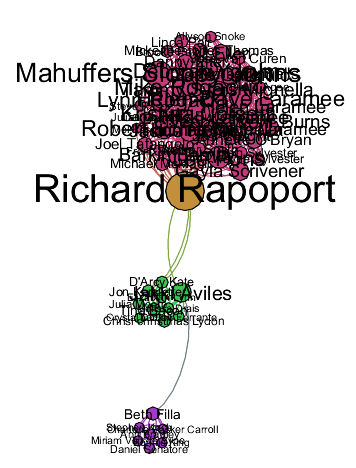
Jen Filla’s Facebook Spheres

I attended a course at the Nonprofit Leadership Center of Tampa Bay led by social media expert Bryn Warner, and I created a visual representation of my relationships from my personal Facebook page, which I have included here. Just look at all the connections around my husband and my favorite live-music venue, Mahuffer’s! Clearly this represents a sphere of influence. And it’s a messy, tangled ball of yarn, yes? I did not take the time to manipulate the graph results to make it pleasing to the eye or to make the names all readable. Make no mistake, these tools may be powerful, but they are time-hungry beasts!

Analyzing and Verifying

My experience so far using Prospect Visual is two-fold: (1) Visualizing spheres of influence is effective in identifying promising paths to new prospects; and (2) Just as in a wealth screening, this big relationship database is great at prioritizing, but I still have to analyze and verify the information.

What I have been doing so far in Prospect Visual is identifying clusters of relationships – spheres of influence – inside and outside the defined group of individual, foundation and corporation prospects in our project space. While one trustee may have strong relationships to identified prospects, another trustee may have a deep and wide network with organizations and people that my client has not considered before.

Once we see a sphere of influence, the next step is to confirm it truly exists and then discover whether there is any ability or inclination. Because there are errors in the underlying database of relationships – such as duplicate records and connections that are just plain wrong – the connections must be verified. And once the connections are verified, further research is needed to discover those shiny glimmers of affinity.

Getting Results

As with wealth screenings, moving the process from mass prioritization all the way through cultivation and solicitation takes time. It will likely be at least a year before any results, let alone gifts, are realized from the effort. And this project is not exactly number one on everyone’s to-do list. Prospects and donors in active cultivation and solicitation create the crisis of time that vacillate the prospect identification project between hot and cold attention.

Who is at the Watering Hole?

Are you actively using relationship mapping techniques and tools? Do you plan to? Do you wish you could be a fly on the wall hearing about it? Join the conversation! In a geographically dispersed environment where many of us perform prospect research solo, sharing our work successes and challenges builds our profession and ourselves.

Relationship Mapping Work Group

Aspire Research Group has created a free-to-participate work group that meets online. You can join the conversation – or lurk about listening – by signing-up for the email list. I’m looking forward to sharing with you!

When Should You Look for Cold Prospects?

It's COLD out there!

It’s easy to tell fundraisers to look at their donors first, but are there times when it makes sense to look outside the donor pool? If so, when and how should you do it?

This may sound obvious, but usually the best time to go after cold prospects is after you have looked in your donor pool and need more. Apart from general donor acquisition, this might happen for a few reasons including:

(1) You need more major gifts than your current donor pool can support

(2) You need qualified prospects to fill board member positions

(3) You are strategically reaching out to a new constituency

Branching Out

When you are looking for more major gifts or new board members, a great technique is Branching. This technique is described in Prospect Research for Fundraisers: The Essential Handbook (p.26) and you might also hear it described as Relationship Mapping (p.175). The idea is that you take your high-powered, well-connected donors and trustees and put them at the center, branching their connections outward.

A simple, but great example, of this technique is demonstrated by Dan Blakemore in his blog post, “How One Web Search Led to a $20,000 Gift”. When the board chairman passed away and he needed to find donors for a named fund in his memory, Dan branched out from the board chairman’s connections to identify a donor who made a first gift of $20,000. Dan started with his existing donors, but he took an extra step outward and was successful. You don’t have to start with a huge project to get results.

Strategic New Direction

Branching exercises sometimes result in more of the same prospects because you are working within a network of connections. There are organizations that do not want more of the same. They make a deliberate decision to reach out to new and different constituencies. This might take the form of populating the board of directors with people who are more similar to the people they serve. It might also be a concerted effort to engage an entirely new group with the organization in a meaningful way.

In the book, Prospect Research for Fundraisers, we tell the story of Jeff Lee at Wycliffe Bible Translators (p.164). He was hired to build stronger fundraising efforts in Asian countries where Wycliffe operates, but also to build engagement with the U.S. Asian-American community, hopefully at some point in the future linking that engagement back to the home countries. Some institutes of higher education and other organizations are strategically building engagement with countries where new wealth is emerging, such as China and India. When you are starting out new there are usually few existing donors and relationships, so how do you go about it?

Building Up and In

In the U.S. there are many sources of information specific to industries, ethnic communities and more. For example, local Business Journals usually publish a “Book of Lists” each year. You can build a list of the top philanthropists in your community, the top business leaders and more. You can ask a researcher to build you a specific list, or as a frontline fundraiser you might start by, for example, joining a local association of Chinese business owners and using a researcher to help you get more information after you have identified specific individuals.

First you build up your list of cold prospects (some people call them targets, but that often sounds harsh to a fundraiser’s friendly ears) and then you make the inside, face to face connections, getting prospect profiles on individuals once you have made a connection.

Cold Prospecting Takes Effort

No matter how you go about it, cold prospecting consumes a lot of time and resources. Make sure you set yourself up for success. Following are some tips:

Plan & Track:
Make sure you have a plan in place. You wouldn’t just show up on a plot of land and build a house willy-nilly. Draw up a plan and track your progress periodically.

Polish Skills:
You may find it takes a different set of skills to engage a new group of people. Be sure to get any training you need. Network with colleagues who have done similar work successfully.

Educate Yourself:
You may need to broaden your knowledge of the culture and history, inside or outside of the U.S. Researchers can help you gather this information as well.

There are good reasons to do cold prospecting, but it needs to be treated with careful respect because of its expense. Just as you nurture donors acquired through direct mail to ensure you raise much more money in the long-term than the initial cost of acquisition, likewise you need to plan your major gift prospecting projects to ensure that they lead to large gifts and deep relationships.

About the Author

Jen Filla is president of Aspire Research Group LLC where she works with organizations worried about finding their next big donor, concerned about what size gift to ask for, or frustrated that they aren’t meeting their major gift goals. She is also co-author of Prospect Research for Fundraisers: The Essential Handbook.

Warning! Did You Recognize Your Million-Dollar Donor?

You are launching a campaign or pushing forward with a major gift initiative and finally have the budget to order some profiles. Yay! You pick the first name – a prospect you’ve met who comes across as wealthy – only to discover the capacity of the prospect falls under $100,000. So disappointing. What went wrong?

Even when an organization has performed a wealth screening, sometimes gift officers still gravitate toward lower-capacity prospects. Many times this is because they are not aware of the lifestyle and asset differences between affluent and high net worth. High Net Worth Individuals (HNWI) do not look like the typical fundraiser – you or me. They are different. And sometimes that can make us feel uncomfortable.

HNWI According to Knight Frank

The recently released Knight Frank annual Wealth Report helps to illuminate some of those differences. Many groups define a HNWI as someone with $1 million in net assets, but Knight Frank cranks it up to an individual with $30 million or more in net assets. Let’s give those numbers some context. Suppose your prospect is passionate about your mission and wants to donate 5% of her net assets.

  • At $30 million, she gives you $1.5 million.
  • At $1 million, she gives you $50,000.

Among these elite, Knight Frank finds the following:

  • London and New York are the top destinations in the world.
  • HNWI’s in North America own an average of 3.6 homes.
  • The top 3 most popular investments of passion in North America: Fine art, wine and classic cars

Affluent vs. HNW – Some Examples

One prospect I researched was so interested in wine that he founded a vineyard and winery – as a hobby! His capacity was very different from his partner’s, who also invested in the winery and ran the operations. The partner invested his savings and was earning his living. The prospect was a HNWI and his partner was affluent.

Another finding by Knight Frank was that 25% of HNWI’s net worth is accounted for by their main residence and second homes that are not owned purely as an investment. I researched a prospect who owned four condos on the beach in Florida. One of them was his home and the others, some in the same building, he held as investments and rented them to vacationers.

That is a very different picture from a prospect who owns a few condos on the beach, all but one purchased during an economic downturn, as well as home and a New York City condo. The prospect living in the beach condo appeared to manage his properties personally and likely earned income of around $100,000 – that’s affluent. The prospect with the New York City condo is a top executive who saw an opportunity to own valuable beach-front real estate near his favorite vacation spot and used cash to purchase when the prices were low – that’s a HNWI.

In Your Own Backyard

You don’t have to be an expert on how wealth and assets are accumulated and managed, but you do need to be a student of wealth to begin recognizing the difference between a prospect capable of a $1 million gift and a prospect capable of a $50,000 gift. If you are in a mid-west rural community your HNWI is going to look different from someone in New York. It’s up to you to know your community – although a skilled prospect researcher can always help you out.

As a frontline fundraiser, recognizing and embracing HNWIs is a valuable skill that could make a tremendous difference for the cause you serve. You might be out of your comfort zone at first, but you can get through that with education, practice and a little help from your peers.

Other Wealth Reports You Might Like

2012 Bank of America Study of High Net Worth Philanthropy

2011 Capgemini-Merrill Lynch World Wealth Report

About the Author

Jen Filla is president of Aspire Research Group LLC where she works with organizations worried about finding their next big donor, concerned about what size gift to ask for, or frustrated that they aren’t meeting their major gift goals.

Got Software. Got Research?

Many fundraisers know they need research on donors and prospects, but what is the best way to get it? Should you buy a software subscription? Are there any other options? Let’s answer those questions with a story.

A Software Tale
November has most of us thinking about Thanksgiving and other holidays around the corner. But many accountants are thinking about closing out the books and the approaching tax season. Imagine for a minute that you overhear two guests talking at one of the numerous holiday parties you find yourself attending. Bob Business Owner tells Ann Accountant all about how complicated his finances are for the past year now that his small business is growing and expresses some concern about how it will impact his taxes.

“What are you going to do to make sure your tax filings best reflect those changes?” Ann Accountant asks.

“Oh, I splurged and purchased the latest version of TurboTax this year,” says Bob.

Ann looks genuinely confused. “How does that help you make decisions?”

Important Outcomes
TurboTax is great software, but when your finances are complex a software package is not going to help you make key decisions about your tax filings. When the outcomes are truly important, software doesn’t usually make the grade. Software can’t think, strategize or get creative about its approach.

There are many wonderful software options that meet prospect research needs. I have my own favorite subscriptions and purchases. Software speeds up the time it takes me to research individuals by grouping important resources together. Software makes data analysis possible, and fast.

But software does not recognize that what seems like a random company incorporated by your prospect is likely to be a family limited partnership with at least $10 million in invested assets. Software does not recognize that you were not able to mail your usual spring appeal two years ago and that is why giving frequency went down.

What About You – The Fundraiser?
So how do you know when to buy software? Or when you need a person who has expertise? Or some combination? Whenever you have a fundraising goal or objective, ask any potential vendor or consultant whether their solution will get you where you want to go. The answers may surprise you. But let’s illustrate it with another story.

An organization wants to launch its first campaign. They have campaign counsel to coach them through, but they need to prioritize their database and get detailed information on their best prospects. This campaign is very important to the future of their organization and they have a tight budget. The CEO is a visionary and she knows that spending a little more in the right places can have transformative results. She hires a prospect research consultant who makes sure they get as much out of their database screening as possible.

The consultant works closely with the fundraising team, including campaign counsel, to segment their best prospects and code them in the database to work in tandem with their relationship management system. Through this process the team recognizes that they need to restructure their approach based on the giving potential found. Instead of struggling near the end of the campaign, the team knows exactly when to change gears and re-focus their energy on a different prospect segment. It works!

At this point you might be saying to yourself:

“That’s all well and good, Jen, but how do I pick a good prospect research consultant? I’ve heard of organizations who have suffered with bad advice and bad information. I don’t want to be one of them!”

Choosing a prospect research consultant – any consultant really – can be confusing and risky. Take the time to communicate clearly what you want to accomplish. Is the consultant listening? Or doing all of the talking? Did you check references? Look for posts in the future on how to choose and manage a consultant.

Other Articles You Might Like

5 Ways You know You Need a Research Consultant

Mistakes That Nonprofit Organizations Make Hiring Consultants – Karen Eber Davis

3 Consultant Relationship Types that Succeed. Which One for You?

The Shocking Truth About Prospect Research Consultants

About Aspire Research Group LLC

Headquartered in Tampa Bay, Florida, Aspire Research Group was founded so that every development office could have the benefits of professional prospect research. Known for our creativity and clear communications, we work with organizations who are worried about finding their next big donor, concerned about what size gift to ask for, and frustrated that they aren’t meeting their major gift goals. Do you need to close more major gifts?

www.AspireResearchGroup.com 727 231 0516

So really…When do you use a prospect profile?

Many of my clients have never used prospect research before. Many of them have used it. All of them have questions about what they need in a profile and how they can use it. If they have these questions, I figure lots of fundraisers out there might be wondering the same thing.

We know we use prospect profiles to inform cultivation and solicitation – to help us ask for the largest appropriate gift. In addition to sometimes finding surprising and new information about a prospect, profiles often confirm and validate the fundraiser’s assessment of the prospect, providing even more confidence in preparing for the ask.

Using Profile Levels

I like to leave it up to the fundraiser to decide just how much information she needs. You know yourself and your prospect the best. But I do like to give different levels of profiles to choose from:

Identification Profile – A brief profile to confirm the ability to give and look at giving history and community involvement. A major gift capacity rating is provided. This is for when you don’t know anything about the prospect or need to confirm wealth and inclination before spending your time.

Solicitation Profile – A long profile that searches for everything relevant to making an ask for a major gift. In addition to capacity ratings, this profile includes an executive summary to help you with strategy. As the name implies, this profile helps you prepare for a major gift solicitation.

The Customized Approach

These are the two most popular profiles among Aspire Research Group clients, but they are used in many ways and sometimes customized:

  • One client in a campaign preferred Solicitation profiles first on her prospects, with an update as she neared the actual ask. She knew her campaign volunteers had great connections and wanted a head start on her strategy. It worked.
  • Another client had budget restraints, but really needed more than the Identification profile. We came up with a custom profile that addressed her specific need-to-know items, but remained within her budget.
  • A consultant client needed a profile more basic than Identification, as a way of prioritizing donors for small organizations. We did it.

The Pitfalls to Avoid

It all sounds so easy, doesn’t it? Warning! There are some common mistakes that fundraisers make when requesting profiles:

  • Asking for profiles as a way of showing activity, when really you are just too afraid to call on the prospects
  • Asking for a profile when you have no way of connecting with the person and no idea if the person has any interest in your organization (e.g., the local version of pursuing Oprah Winfrey)
  • Requesting a standard profile when what you really need are specific questions answered

An Unbeatable Team!

The most experienced and successful fundraisers do something differently when it comes to prospect profiles. They communicate regularly with the prospect researcher!

  • When you talk to the researcher about your donor prospect and what information you need to move forward, she can give you a much better profile.
  • When you review the profile with the researcher to help you match your personal knowledge with the “paper” knowledge, you gain a much deeper and more colorful picture of your prospect.
  • And when you share the results of your visits with the researcher you create an unbeatable team!

Do you have an unbeatable team?

If you are considering using prospect profiles as part of your major gifts strategy, call Aspire Research Group to learn more about how we can help you reach your fundraising goals with research: 727 202 3405 or visit www.AspireResearchGroup.com

Other Articles You Might Like

Dating Donors, Data Mining & Donor Profiles -oh my!
Score a touchdown with prospect profiles
Is Prospect Research Too Expensive?

Prospect Profile Samples

Identification Profile (PDF download)
Solicitation Profile (PDF download)

Fundraisers and the Family Limited Partnership

On July 6, 2012, The New York Times ran an article talking about the family limited partnership and how more families are looking at this wealth planning vehicle now that the tax break allowing up to $5.12 million to pass to heirs tax-free is set to expire at the end of 2012. What’s it to you, a front-line fundraiser or research fundraiser?

For me it was an “Aha!” …another indicator screaming “high net worth possibilities here!”  So when you see a prospect with a family limited partnership (e.g., Filla Family LP), you want to take a second look.

How do high net worth individuals use family limited partnerships to manage their wealth?

Whether it is a married couple or includes extended family members, a limited partnership allows family members to pool assets, typically for a business purpose, and these assets are now discounted because the assets are less liquid – that means a lower tax rate. The New York Times suggested that a 25 percent discount was usually acceptable to the IRS.

According to the CPA Journal (July, 1999), there are three main advantages:

  • The general partner of the limited partnership can retain control and direction of the assets;
  • It aids in business succession planning; and
  • The assets can be passed between generations at the lowest permissible cost in estate and gift taxes

Consider your highly philanthropic entrepreneurs. Mr. and Mrs. Prospect start what becomes a very profitable business. They have four children, two are involved in the business and two are not. By placing the business interests into a family limited partnership, the couple can maintain control over the business while planning for succession and transfer of assets to their children – all this at a reduced tax rate.

The New York Times article also suggested that some families might use a family limited partnership to pool assets to reach the higher investment requirements that hedge fund and private equity managers require.

It so happened that just after I read The New York Times article, I was researching a donor prospect who was a very successful entrepreneur. He created family limited partnership each time there was a substantial financial change in his life – selling a company or realizing value to a patented medical invention. The New York Times article suggested that $2 million was a very low investment. Based on this I estimated that the combined value of his three family limited partnerships might be $15 million to $30 million or more. He and his wife were the only partners.

Do you have a donor prospect story that involves a family limited partnership? Do you have more to add about how high net worth families might be using this investment vehicle? I hope you will share!

Feel free to comment or email Jen at aspire research group.com

Other Links You Might Like:

6 Family Limited Partnership Developments In 2011 (Forbes blog post-FLP stories)

Investopedia Definition of Family Limited Partnership-FLP (webpage)

Capacity and Ask Amount – Magic Numbers! (blog post)

Mastering Moves Management: 3 Key Pieces

Moves management is the process of moving a donor prospect from identification to major gift. Also known as prospect management, when you throw those terms into a search engine most of the results are for software companies, especially donor database companies. But I argue that moves management is not primarily a software solution but sincerely a *people* solution!

A database is a tool. Its importance increases as the number of an organization’s donors and friends increases. We need our donor database to keep track of gifts and all of the other information and tasks surrounding our donors and friends.

The more gift officers and the more major gift prospects you have, the more important it is to use your database in your moves management system. But beware! Anytime you spend more time typing into your database than you do talking with your prospects, you will struggle to raise enough money.

Moving a prospect usually requires a pretty intense relationship over a year or two. You need to discover her interests and motivations for giving and connect her in a very personal way to your organization. What if you have 100 prospects being moved? How about 300? And what if you have 3 gift officers moving prospects? Or 5, or 10, or more?

Now you seriously need a system!

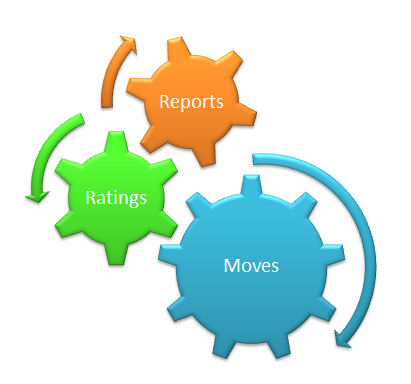
Pretend you are an astronaut looking down on earth. Now pretend you are consultant looking at an organization from a distance. This organization has a moves management system humming along. You notice there are three gears in motion producing consistent relationships with prospects capable of making a major gift. These gears are:

Ratings – Each prospect is rated so you can stay focused on those who can help you reach your dollar goal.

Moves – Actions with prospects are deliberate and planned (and tracked in the database).

Reports – Regular printed reports are reviewed and regular meetings are held to build internal skills and keep all the moving parts in balance

Can you do moves management without a database? Of course you can! You could keep track of your gifts in Excel too, but it is rarely the best solution.

Mastering moves management requires learning the balance for your organization between the three moving gears:

  • How many ratings do you need to stay on path with the most capable prospects?
  • How will you plan for moves, make your moves, and record your moves?
  • What measurements should you report on to keep you accountable?
  • How often should you meet and who should meet to keep your major gifts program growing?

Everything in our world is in constant flux. Moves management requires re-balancing as your major gifts program grows and changes. If you keep the emphasis on the moves – on the in-person interactions with your donor prospects – everything else will find its place.

Have you mastered your moves?

Identification to Discovery Visit: 5 Fun Questions to Ask

Once you have identified your donor prospect, the next step is usually to make a discovery visit. Sometimes this happens over the telephone, but ideally it will be a visit at the person’s choice of location. The goal is to meet her where she feels most comfortable and qualify her as a major gift prospect.

Most often we aim to determine or confirm the following:

*Affinity, or how close she feels to our organization
*Inclination, or how philanthropic she is to us and others
*Capacity, or whether she has the ability to make a major gift

Confirming Affinity and Inclination

No matter how much or how little time you have in your first visit, do NOT walk away without finding out about the individual’s giving, passion, and movement to the next step:

1. Why does the prospect give to our organization?

You can begin your conversation with a “thank you” for past giving and a natural curiosity for how the prospect first discovered and began giving to your organization. If there is no giving to your organization, or even if there is, consider asking if she is involved with any other organizations.

2. How does the prospect feel about the relationship?

Next, you can guide the conversation naturally to ensuring that the prospect likes the mailings and other information received or if you need to make adjustments. Maybe you need to add or change the type of mailing to cater to the prospect’s specific interest.

3. Would the prospect like a tour, visit a program, etc.?

Now that you are talking about what the prospect likes about your organization, you can make an appropriate suggestion about a tour, talking with a program director, or some other activity that would interest her.

Confirming Capacity

To confirm or verify a prospect’s capacity to make a gift, guide conversation toward the primary source of wealth:

4. What a wonderful award this is! It looks like your business has been doing well…

You do not have to have constant eye contact with your prospect. Take a look around you and ask normal, curious and fun questions about what you see on the walls or on the shelves.

5. I’d love to learn a little more about your business. How many employees do you have here?

Don’t be afraid to change the conversation. Keep track of time and be sure to bring the conversation around to answer your questions before the visit is over!

Discovery visits take practice.

If you find yourself back in the office wondering how you spent an hour talking and still don’t know anything new about your prospect, forgive yourself and replay the visit in your head or talk it over with a colleague until you recognize where you could have done things differently. Then schedule another visit.

Once you become adept at your discovery visits, you will find that you are able to shorten the time between identification and actually asking for the gift. Discovering a prospect’s true interest in your organization prepares you to deepen that interest into passion. And once you have passion, in-depth research on your prospect prepares you to ask for the right amount.

Best wishes to you on your next discovery visit!

Click here to register for the 6/14/2012 webinar: Savvy Conversational Research Techniques for Fundraisers

Other blog posts that might interest you:

3 Steps to Major Gift Mojo!

Will Your Donors Talk to You?

How to get from $250k to $40m