Tag Archives: fundraising

There's a new blogger in town!

There is a lot to be said about the prospect research and fundraising community. People are saying it all the time– on blogs, on Facebook, in news articles, and just about everywhere else that writing can be published. All of these opinions, facts, and experiences are out there waiting to be digested…so who gets the job?

Me! I’m Jakki, the new Marketing Intern at Aspire Research Group.

My job is to take a deep look into how prospect research is at work in the fundraising community, digest the material, and present it to you, the people who want to know, right here on this blog. My goal is to give you insight into others’ experiences in the field, feature real-life stories about landing major gifts, and hopefully give you an idea of the kinds of benefits that can be gained from using the services that Aspire Research Group provides.

So keep an eye out for my weekly guest-blogs. Feel free to comment with feedback, or your own opinions on whatever I cover for the week. The fundraising community is full of people looking to add on to what they already know…so why don’t we learn together?

Celebrating Philanthropy in 2010

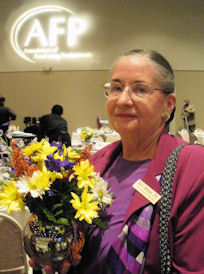
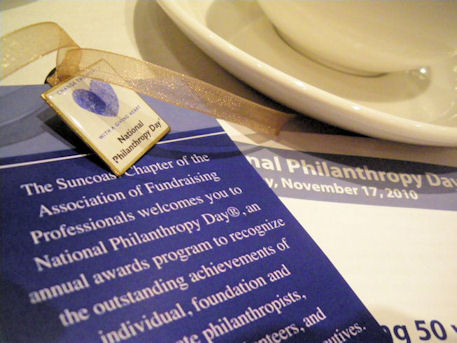
There is something about a large crowd of people all congregated for a mutual purpose that creates a feeling of belonging, a swelling of emotion. In the case of National Philanthropy Day that wave surging from more than 500 attendees in Tampa, Florida was well worth clapping for.

This is the 25th year that the Association of Fundraising Professionals has hosted National Philanthropy Day and it was my second year attending the celebration organized by my Suncoast chapter. Award ceremonies do require a lot of clapping and some people’s speeches are more moving than others, but just watching and listening to the winner of the Youth in Philanthropy Award is usually enough to sustain me. So many incredible and HEROIC stories in my own neighborhood!

And there is always one of our own fundraising professionals being honored. This year Nina Berkheiser CFRE, founder of Your Nonprofit Advisor received the J. Lloyd Horton Lifetime Achievement Award. Not every fundraising consultant is guided by philanthropy, but Nina’s actions speak louder than any words about her committment to promoting and empowering philanthropy and the fundraising profession.

Visit the AFP Suncoast website to see all the honorees and keep checking the Suncoast chapter’s Flickr account for official photos.

An easy-to-use, kickbutt cultivation strategy tool

I usually attract two types of clients: those that want to identify major gift prospects and those that want research on identified prospects. No matter which service I provide, sometimes my clients get stalled on the next steps. You might have the donor prospect right there in front of you, but over time the path to a gift gets as lost as Hansel and Gretel’s bread crumbs in the forest of development activities.

Prospect research consultants (including me) often talk about moves management or relationship management systems. These are powerful tools capable of catapulting your major giving to a new level. But there is another tool you can easily customize that gives you a laser-like focus on one donor prospect at a time. Just like the one you have in front of you right now. 

Creating a Cultivation Strategy document is easier than you might think. This document should highlight key considerations such as capacity to make a gift, when you expect to ask for a gift (average is 18 months out), primary giving motivations and other vital pieces of information. But the true beauty of a Cultivation Strategy document is the action steps section.

Using everything you know about the donor prospect you have to sketch out the actions and completion dates that take you to the day you solicit the gift (just like a roadmap). If you have just identified a prospect these actions might be vague and the dates might just have the month. In the worksheet I created  each action requires you to list the objectives. Those objectives are the lasers!

When you sketch out your actions for the first time you will immediately recognize just how short the time really is between your start date and your solicitation date. Yikes! Knowing the objective, the outcome you desire from each action, ensures you stay on track. No meandering. None of the “let’s just pick another prospect” because you dropped the ball on the first one.

At Aspire Research Group we want you to close more major gifts. Gifts reward your donors, the people you serve and you. Call or email us today to find out how we can help you close more major gifts.

Raising Money for the Arts – with Crowdfunding

Never heard of crowdfunding? Me either. But it’s raising millions from tiny gifts for artists around the world. The September 4, 2010 issue of the Economist featured a story, “Putting your money where your mouse is” that described the crowdfunding phenomenon quite clearly. People’s comments on the article were even more illuminating.

Going beyond social media and “tip jars” on websites, crowdfunding takes advantage of both of those methods to fund creative works through a defined dollar goal, within a specific time. If the minimum amount is not raised, no funds are collected. Interesting, huh?

Let’s say I need seed funding to create a documentary about the dynamics of homelessness in Tampa Bay, Florida. Using an intermediary like Kickstarter, IndieGogo or Sellaband (yes, they collect a fee), I create a campaign to raise $5,000 minimum within six months. I promote the campaign on my website, Facebook, Twitter, MySpace and anywhere else I have built a fan following. Once I reach $5,000 committed I can keep raising money until the time limit. Funds successfully raised for projects have ranged from under $5,000 to as much as $200,000.

The reality is that the funds raised many times do not meet the full project funding needed. Most projects have grant or other funding secured as well. What crowdfunding does is give artists the social leverage they need to secure additional funding and give their fans the chance to be a part of the creation.

Fans getting the opportunity to be part of the creation. Wow! Doesn’t that sound familiar? C’mon! Let’s re-phrase that into language familiar to the fundraiser. Donors getting the opportunity to be part of the campaign. Hah! Now that I’ve got you on that thought-train, doesn’t it highlight how important it is to start with our donors when we are looking to raise funds? They have already given to us, they like us, and they want to help.

Helping fundraisers prioritize the donors in their databases is a service Aspire Research Group is proud to offer its clients. Sometimes we get so excited about the big dollars we hear in the news we forget that there is gold right inside of our own well-nurtured donor base, just waiting to be called upon. Call on yours today!

Capacity and Ask Amount – Magic Numbers!

In the “On Fundraising hosted by AFP” LinkedIn group, a fundraiser was asked by her board to assess the capacity of other board members and she was looking for a formula or strategy that has worked for others. The conversation that ensued fascinated and delighted me. I sent her to my free worksheet on capacity ratings, but the different approaches and opinions in response to her question are well worth discussing.

There were two basic paths that diverged from the “simple” question of assessing capacity. The first had to do with what stage the prospects were in. Was she identifying, qualifying, or ready to solicit and was it a first gift, second gift or big-hairy-scary gift? The second was whether she was also considering affinity, or how close the prospect felt to the organization, and inclination, whether the person liked to give gifts to nonprofits generally. Lots of good comments and advice on these aspects.

Prospect researchers often tie these two pieces of prospect assessment into a prospect tracking or moves management system. And although she was not asking about anything other than capacity, readiness to give and likelihood of giving matter (dare I say) much more than capacity. I’ve known nonprofit employees who give big gifts on modest salaries. The prospect’s passion matters!

And then there was some confusion and some clarifications on what does capacity mean when used in fundraising? Similar to one of the comments posted, Aspire Research Group uses the following language in its profiles when providing capacity ratings:

  • This rating is a major gift dollar range for a gift over 5 years if only one gift was made. It is strictly based on wealth indicators and not on affinity or inclination. The capacity rating suggests ability to give without considering unknown liabilities and is NOT a solicitation amount.

The overall consensus was that determining capacity (and ask amount too) is a mix of art and science. Prospect research can’t uncover every asset and liability so assessing capacity turns out to be an informed guess.

If the question was about determining the ask amount and not capacity, I’ve got strong feelings on that. Unless you are so close to your prospect that s/he opens up his/her finances to you, not having in-depth research done on your prospect is a costly mistake. If you ask for too much you can probably flatter your prospect, but if you ask for too little you won’t hear a prospect say, “Oh gee, and here I was ready to give you $5 million – I’m so glad you only need $1 million.”

Yes, capacity matters in major gift fundraising. Yes, your prospect can have more money than god and refuse to give you any. And yes, determining capacity and ask amounts involves some art and science.

But the exciting part of this particular LinkedIn group discussion was hearing from fundraisers who, with or without dedicated prospect research staff, give their prospects the respect they deserve by taking time to know them in-person and through tried-and-true prospect research techniques. Cheers!

So how do you determine the magic numbers of capacity and ask amount? Do you give more weight to affinity and inclination to give or more weight to capacity or ability to give? I’d love to hear your thoughts!

A challenge to prioritize a LARGE list of donors

I spoke on the phone with a prospective client. She described a type of fundraising I have never had contact with before and yet we came up with a guerilla prospect research strategy to help her meet her goal.

She is a gift officer for a regional affiliate of a national organization tasked with getting 10 new major gifts before the end of the fiscal year in June. Her research budget is under $2,000.

The donors at the gift levels below major gift in her geographic area number in the thousands. There was a wealth screening performed, but no ratings for likelihood to give. Other affinity indicators are just now being recorded, such as event attendance, but have not been recorded in the past. Choosing among thousands based on capacity alone has not yielded good donor prospects. She needed help!

At first I suggested looking at recency and frequency and the consultant who had brought me to the table recommended identifying high lifetime giving. It felt like a slap on the face to me to learn that none of those were good affinity indicators for her. Her organization was a direct mail machine operating as if it were selling widgets instead of asking for gifts. The only donors kept in the database and solicited were those who gave every single year. If you stop giving you are dropped from the list. New donors are acquired every year.

Recency is irrelevant because otherwise the donor is not solicited. Frequency is a given or the donor is dropped from the list. Lifetime giving is high because those that stop giving are dropped from the list.

Think about that for a minute. Imagine yourself, a gift officer, alone in the ocean treading water watching a huge wave of donors approaching you. There is no shallow water of engagement to allow donors to walk closer to the organization’s shore. No surf to get donors excited about being the ones who can change the landscape of the cause. Instead it feels enormous and insurmountable. She will be swallowed by all that water – all those donors that look the same.

And she needs 10 new donors giving cash at a certain level or higher. In eight months.

Lucky for her, there is one prospect researcher on staff. Not so lucky is that he supports the entire national organization. And a wealth screening did add capacity ratings to each donor record. But how can she identify affinity to get a good prospect list?

In order to narrow the list on a very small budget, I suggested pulling all donors at two levels below the target gift level who also have a high capacity rating AND high lifetime giving. The cream of the crop from that list can be checked, one at a time if necessary, to see if a gift at the desired level has been made to any charity using NOZA or DonorSearch.

She will start with a small number, around 50, and begin calling each one to get a visit. Starting small ensures narrowing the list this way actually yields good prospects and gives her a chance to tweak her approach. The consultant had some strategies for getting that first visit including a warm-up letter. I can support her with donor prospect profiles when she is close to a large gift.

When a prospect researcher works intimately with a gift officer the results can be magical. I enjoy being part of a team. Knowing that the pleasure I take in data can be translated by gift officers into a donor’s love affair with a worthy organization keeps me LOVING my job!

If you are looking for a prospect researcher to work with you to reach your fundraising goal, click here to contact me.
How to use Prospect Profiles for Successful Solicitations

Sometimes when I tell fundraisers that my firm does a lot of prospect profiles they balk at the perceived price tag. “I can find everything I need to know on Google – for free.” But we all know that doesn’t ring true. The real cost is when you ask for $10,000 and the prospect was ready to give at least $100,000.

How much you know about your major gift prospect matters. You work hard to engage your prospect and when you walk through the door and ask for a major gift, you expect the answer to be “yes”. Or better yet, “I need to talk with my accountant”. The people your organization serves deserve those major gifts and it is your job to raise them.

What the Fundraisers Say

But the answer isn’t always “yes”. In his article, “Prospect Research: A Tool for Professionalism in Fund Raising“, Michael J. Worth, Vice President for Development and Alumni Affairs at The George Washington University writes the following …way back in 1991:

“The greatest risk in fund raising is that too little will be known about the donor, resulting in approaches that are ill-conceived, insensitive, and ineffective.”

Ouch!

Even further back in time, in 1933, John D. Rockefeller Jr. commented, “You cannot deal successfully with all people the same way. Therefore, it is desirable to find out something about the person you are going to [visit]…. Information such as this puts you more closely in touch with him and makes the approach easier.”

Professionally researched prospect profiles give you the information you need to prepare for successful solicitations. Online resources continue to improve and prospects are posting more and more information about themselves publicly. A prospect researcher is skilled at homing in on the most important information and checking the most reliable sources. Moving through the solicitation process without a prospect profile is like driving naked – you might not get caught the first time, but eventually you will be embarrassed!

Exactly How to Use the Information

Major gift donors are sophisticated and savvy. Flatter them with your knowledge of their business and philanthropy. Listen carefully to discover what can’t be found online – their personal motivations for giving and their values. Don’t alarm them with facts on their real estate, securities holdings and other wealth.

Instead, keep your knowledge of their wealth in the back of your mind so you can effortlessly respond, moving gracefully into an ask that is welcomed and answered with an enthusiastic “Yes! …just let me talk to my accountant”.

  • Are you choosing your prospects randomly?
  • Do you feel like you are going on prospect visits blind?
  • Are you confident in your ask amount?

If you answered “yes” to any of the above questions, call Aspire Research Group today to learn how we can help: 727 202 3405 or visit www.AspireResearchGroup.com

A *Middle Child* Donor Speaks Out

The Chronicle of Philanthropy held a live discussion with Jill Warren – a self-described middle class donor – and then wrote an article about it for readers. The moral of the story was that some people with middle-class incomes are passionate enough to make annual gifts representing $10,000 or more – in Jill’s case, up to 60% of household income. That’s a major gift for many organizations.

I worked for an organization who had a “Jill” on staff. The fundraising team did not want to put her on the major gift track because her income was not great, but her passion for the organization was inspiring and she gave a high percentage of her income to demonstrate that passion. I found it confusing. Based upon her demonstrated giving and absolutely by her lifetime giving she was a significant donor to the organization. But she was never assigned a solicitor or specifically cultivated and nurtured as a donor.

An analogy might be a Mercedes customer who drives a Ford. She drives her Ford into the Mercedes dealership and routinely purchases Mercedes for her chauffer business, but the dealership treats her the same as a customer who has only ever once purchased a Mercedes. Why? Because she drives a Ford. Ridiculous? Absolutely!

Wealth or perceived ability to give should not be our *primary* indicator for a best donor prospect. Sometimes the prospect screening and software vendors lead us astray. Vendors are looking to make a profit and focus on those organizations with the biggest budgets to buy their products.

Nonprofit organizations are not looking for only the biggest wallets to give to their organizations. Nonprofits are looking for the most philanthropic people, the people most passionate about their mission AND THEN of those people, the ones who have the ability to support that mission. Passion trumps wealth.

Passion provides us with donors who:

  • give recurring or monthly gifts that pay keep our organization running every day
  • give us multiple major gifts and challenge other donors to stretch their gifts
  • leave us part or all of their estate
  • inspire our program recipients, our donors, and ourselves

If you look for wealth first you will miss the passionate “Jill”s in your database.

You can use common sense prospect research techniques to identify those people in your database with passion. Affinity searches can be as simple as filtering for recency, frequency and longevity of giving or you can invest in a more sophisticated statistical analysis to take into account event attendance and other data points.

Get your list together and then get out there!

Can business learn from your organization?

In early July the YMCA announced a name change to “the Y”. Following for-profit protocol they spent two years of analysis before launching their re-branding strategy. The Economist wrote an article titled “Profiting from non-profits” suggesting that sometimes the learning might flow best in the opposite direction – from non-profits to for-profits.

So many non-profits do an incredibly good job of growing deep relationships with all of their constituents – recipients, employees and donors. My job as a prospect researcher is such a joy because everything I do is about bringing donors and prospects closer to the organization. Not so many for-profits operate with such a successful emphasis on all of their relationships.

So tell me, what could the for-profit world learn from your organization?

Moves Management = Money

In the business world it’s called Customer Relationship Management or CRM. In fundraising we usually call it moves management or prospect tracking. Whatever we name our system, we use it to keep our prospects on track to a gift and to steward our donors to keep giving.

In larger shops there are prospect research positions devoted to the data maintenance involved in moves management. Small shops do not have the luxury of prospect research staff, but have the same need to bring in gifts. I have a free publication on my website that describes in some detail how to build a moves management system.

So I thought I would use this space to share with you great solutions that some small and mid-size development shops are using successfully.

  • A woman at the Planet Philanthropy conference in Boca Raton, Florida, described how she exports her top prospects to a spreadsheet. Because she does not have the time or staff to input all of the data into her database, she tracks her progress in Excel. Gifts and significant pieces of information go in the database, but the tracking does not.
  • Another person I spoke to uses the free individual version of Salesforce.com because her donor database does not have a function to track actions taken with a prospect. This online software allows her to get reminders and document the contacts she has made with prospects and donors. It even has a tracking mechanism she uses to print reports on just her proposals and solicitations.
  • More than one fundraiser I have spoken to uses Outlook to manage top prospects and donors. By making notes in the address book and marking actions to be taken on the calendar, people have been crafting their own methods of tracking. Whatever works to keep you in contact with your prospects!
  • And for those very special donors and prospects, people do all sorts of things to keep them on their minds. A post-it note on the computer as a daily reminder is my favorite.
Creating a moves management system that uses the full potential of your donor database is the most effective and efficient way to go, but there are alternatives when database functionality is limited. Aspire Research Group helps organizations create custom moves management systems that work for you, your organization and most importantly, your donors. If you have questions about creating a moves management system, call us at (727) 231-0516.

Whether you have 10 top prospects or 110, if you stay in touch with them consistently the gifts will arrive. So get moving!