Tag Archives: major gift

Insiders. Profiles. 3 Tips to Keeping It Simple.

Whether you are trying to improve your profiling skills on public company insiders or whether you need to upskill your research team, when it comes to insiders, it pays to keep it simple! Because once you master the core skills, it is much easier to tackle more difficult financial concepts. Following are 3 tips to keeping it simple.

1. Get really good at the two key wealth indicators first, and then keep adding to your expertise.

When it comes to public company insiders, whether they are top executives or directors, there are essentially two types of wealth information to find first: (a) annual cash (non-equity) compensation, and (b) stock (equity) holdings. Yes, there are all kinds of other equity compensation, such as stock options, performance stock units (PSUs), and more, but mastering cash compensation and stock owned right now is a big step. If you don’t have a subscription tool like KALEIDOSCOPE Insider Focus to make it easy, you can always find the Proxy Statement (Form DEF14A) by searching the Securities and Exchange Commission (SEC) database named EDGAR at www.sec.gov From the Proxy Statement you want to master two tables: (a) Executive (or Director) Summary Compensation Table, and (b) Beneficial Ownership Table. Following are some tips for you:

  • On any table in the Proxy Statement, be aware of whether the number is a count (#) or a dollar amount ($).
  • Read all the footnotes! Especially on the Beneficial Ownership Table, this is where you often discover how much of the count of are actually shares of stock and how much of the count is potential stock, such as options or units.
  • If you don’t understand the word, look it up or let it go, but don’t add something to the profile that you don’t understand. Because of course that will be the one thing the development officer asks you about!

2. Drop the jargon for your end-user.

As I type this up it makes me cringe to realize how much jargon we still use at Aspire when we present insiders in our profile! It sounds easy, but it is a challenge for researchers who want to be accurate and correct to drop jargon. Of course we need to be accurate and correct, but how we present our accurate and correct information can be in plain language. Consider the difference between the two compensation tables below. Complex Non-Equity Compensation

  Salary Bonus Non-equity Incentive Change in Pension Value Other Comp Total
Year1 $852,000 $0 $4,000,000 $450,000 $760,000 $6,062,000
Year2 $845,000 $1,250,000 $3,500,000 $125,000 $725,000 $6,445,000

This table includes all compensation that is non-equity (no stock). I have been very guilty of this for decades! (Thank you to Elise Lynch at Kaleidoscope Insider Focus who asked me why I was reporting on compensation that is not cash.) Does your development officer really need to know the change in pension value that was realized during the company’s fiscal year? Of what value is it to the development officer to know the type of other compensation, such as use of the company jet? If you are wondering whether to include information, ask yourself if it has any relevance or meaning for fundraising. If it doesn’t, drop it. Keeping It Simple Cash-Only Compensation

  Salary Bonus Total
Year1 $852,000 $4,000,000 $4,852,000
Year2 $845,000 $4,750,000 $5,595,000

This table only includes the compensation that puts cash into the insider prospect’s pocket. Even better, the table consolidates the bonus and non-equity incentive compensation. Why? Because for the everyday person, they are the same thing. Bonuses got a bad reputation during the Great Recession when insiders were paid their performance bonuses even as companies went bankrupt. If the insider met their performance obligation, then they were entitled to their bonus. To counter this negative publicity, creative professionals created a new category of “non-equity incentive” that is simply a performance bonus by another, more obscure name that the general public is less likely to understand.

3. Emphasize the context.

If you want to be a truly valuable intelligence asset to your major gift team, you need to do more than find, understand, and present the numbers. Even if you are an insider novice and just beginning to master cash compensation and stockholdings, you can provide key insights that could make all the difference for your development officer. Following are three simple things you can assess – especially in times of volatility or uncertainty like recession, pandemic, or political chaos – to give your development officer context for the compensation and stock values you provide in the profile.

  • Stock price trends: Check the price of the stock over at least 5 years as well as the past 30 days. The stock price may have climbed quickly over 5 years and your prospect is now sitting on significant stock value. This is great! But if it just had a drop in the past 30 days – even though it doesn’t greatly affect the prospect’s wealth – it could certainly affect the prospect’s outlook on giving! When there is price volatility, including a picture or graph speaks volumes.
  • How many years in public companies: If your insider prospect is sitting on his first ever public company board and has no other public company history, their wealth picture is likely to look wildly different from someone else’s 30-year public company career collecting stock the entire journey.
  • Industry outlook: If you follow the business news, you will probably know when big things are happening, but regardless, it never hurts to look at recent news coverage of the company on a site like marketwatch.com You don’t want your development officer to be caught by surprise in a meeting.

Get out of your own way and get started!

If you are intimidated by SEC financial filings, you are not alone. But if you keep it simple and master the basics first, you will find it is not nearly as difficult as you thought it was. And you will be providing your development officers with fundraising intelligence they can quickly understand and act on. Hungry for more training on public company insiders? If you are looking for training on how to assess public company insider wealth from Securities and Exchange Commission (SEC) filings, check out the training offered at the Prospect Research Institute!  

Additional Resources

Public Company Insider. So What?

Maybe no-one in your fundraising office would say “So What?” but that does not mean they are not thinking it. What is the big deal about public company insiders and how can you succinctly convey that relevance in conversation – or even profiles? I have three things to say about that!

1. Years of Growth (or not)

Especially during economic volatility, a 5-year or 10-year chart of stock performance can visually demonstrate whether your insider is experiencing heady wealth accumulation – or not.

Because your insider is likely getting paid a cash salary and a cash incentive/bonus, those stockholdings represent long-term incentive and they grow at rates your savings account can merely fantasize about.

That means that if the stock price chart is moving up significantly in value, your insider’s stockholdings are highly appreciated assets that are untouched by living expenses.

What is that stock price chart? Oh that. That is your insider with “excess” assets making great rate returns.

2. Gifts of Stock

I do not know what percentage of insiders make gifts of stock, but at Aspire, we find a good portion of the insiders we research make gifts of stock. However, it is not always to an operating nonprofit.

But many times the stock is gifted to a family foundation, which is significant, or to a family trust, which is, again, excess assets making great returns.

Regardless of who the stock is being gifted to, the key point here is that the insider has the knowledge and maybe even has the habit of gifting stock.

When you reach a deeper relationship and the insider is keen to make a significant investment in your organization’s work, gifting stock may be an option your prospect already uses – no education required.

3. Counting Cashed Out Stock

It is possible to skim through the insider’s Form 4 filings for specific file types that indicate which sales of stock resulted in cash in the insider’s pocket. But you have your work cut out for you untangling them from all the sales of stock used to exercise stock options, pay taxes, or other sale types.

Aspire recently subscribed to Kaleidoscope’s Insider Focus research tool and it is the perfect use for A.I. The software has no problem making the calculations to tell me exactly how much stock was cashed out during a specified time-period.

This is an amazing number! Did your prospect cash out stock to the tune of millions of dollars in the past year or two? Now you can know with a click!

Knowing that this cash is above and beyond salary and bonus gives you a snapshot of what kind of money is “psychologically” available. In other words, it is money that the insider is already comfortable cashing out of stockholdings.

Even if this cash is being invested elsewhere, it gives you a sense of how much money could be available if the insider is deeply motivated.

When someone is an insider it is a good bet there’s significant wealth

For at least the three reasons above, if you are trying to identify $1 million+ potential donors for your campaign, or otherwise trying to spot the most capable prospects in your donor base, do not underestimate the insiders!

Money is never enough, of course. Prospects need to have an interest, be philanthropic, and be reachable, but there is no doubt that big visions need big money.

Do you need to learn to read SEC filings?

If you are looking for training on how to assess public company insider wealth from Securities and Exchange Commission (SEC) filings, check out the training offered at the Prospect Research Institute!

Curious about compensation and beneficial ownership, but also how to incorporate into capacity and the profile? This 3-workshop bundle has you covered! Enroll Now

Additional Resources

Insiders and the Paycheck that Keeps Paying

Most of us are familiar with getting a paycheck as well as the practice of receiving a bonus incentive for achieving top performance. And many people are familiar with investing in mutual funds to benefit from the stock market without having to manage a personal portfolio. But exactly how is it that public company insiders can accumulate such tremendous wealth? Is it just because the total numbers are bigger?

I have always thought of stock options and stock grants as the “paycheck that keeps paying.” If the company’s stock price continues to rise – and perhaps rise dramatically – the original option or stock value also increases.

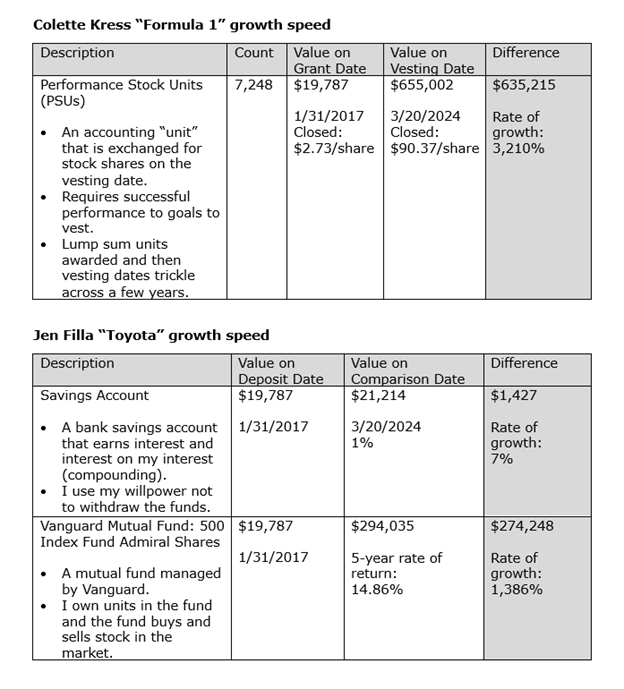
In my head I imagine I have my Toyota at the starting line with the insider’s Formula 1 race car next to me. Sure my “Toyota” mutual fund rate of return is awesome, but the insider’s “Formula 1” performance stock units can go so much faster!

But how does the insider make incredible gains on their incentive awards in real life?

NVIDIA Corp. (NASDAQ: NVDA) chief financial officer Colette Kress is our obliging volunteer with a demonstration below.

The savings account is not even a real comparison is it? In that scenario, my Toyota is more like a beat-up, barely moving, 20-year-old Toyota compared to the insider’s Formula 1 – and that is with what has been a generous, harder to get 1% rate!

But when we get to a double-digit rate of return on the mutual fund – which is invested in the stock market – we see something close to a comparison to the NVIDIA stock rise — but not really. Why? Because NVIDIA stock rose in value faster and I had to make the initial investment. Ms. Kress was given the stock for her performance. Yup. The paycheck that keeps paying!

At this point someone usually reminds me that stock prices can go down, too.

This is true. But for a public company executive insider like Colette Kress, she earns a cash salary and bonus every year too, which has been around $897,000 from 2022 through 2024.

Her Performance Stock Units are a long-term incentive (i.e., long-term bonus). She receives her annual salary and short-term bonus in cash and her long-term incentive in performance stock units (PSUs), which vest into stock a little bit each year — adding a very generous layer of stock value.

This is Why I Say That Long-Term Incentives are Like the Paycheck that Keeps Paying

Hopefully, this example gives you a better perspective of how stock is an outsized addition to salary and cash incentives in the compensation package. And it is not just the executives who receive stock as part of their compensation package.

Top executives are considered insiders and must publicly report their compensation, but management and other employees likely receive stock awards, too. Just not quite so many!

When your prospect is a public company insider this automatically indicates the potential for significant wealth.

To know how much – or how little – requires some knowledge and skill. This is where the prospect research professional steps in to clearly present the full wealth picture of a prospect.

If you are looking for training on how to assess public company insider wealth from Securities and Exchange Commission (SEC) filings, check out the training offered at the Prospect Research Institute!

Curious about compensation and beneficial ownership, but also how to incorporate into capacity and the profile? This 3-workshop bundle has you covered! Enroll Now

Want to know more about insiders? Check out “Why Insiders” by Elisa Shoenberger.

Most Popular Posts in 2024

The change of the calendar year is a crossing. This makes it a great time to pause and look backwards before stepping into the new.  Whether you are checking how you performed relative to goals, celebrating what you did well, or seeking to ensure that what went awry can be mitigated or avoided altogether, I hope you take time to reflect and celebrate.

Since this is a blog, I thought it would be fun to see which posts were visited the most in 2024. May you enjoy them again or anew!

  1. Can you really hide LLC ownership? You betcha!
  2. If you say ‘no’ enough, you will probably get fired
  3. A Screening By Any Other Name Would Read As Rich
  4. Why Do Insiders Disclaim Beneficial Ownership?
  5. Upskill your Development Team with Research – Without Breaking the Budget!


Money and Messages: The Missing Major Gift Donors

Did you know that your organization might be missing major gift donors? There is a major gifts trend happening in organizations across the United States and it may well apply enough pressure to burst through outdated thinking and unleash the power of the missing major gift donors. Will you and your organization be among the early innovators and adopters?

Fundraising leadership is waking up to the reality that technology keeps promising instant identification of major gift prospects, but is not delivering, especially when it comes to wealthy women and people of color. And some of the best, most transformative donors are missing – hidden among all the other donors.

Why can’t the tech companies wave their magic rating wands and deliver the prospects?

Because the very best data is locked up inside the donor. Because technology can’t create messaging and relationships with donors that will unlock the mega gift.

Who can’t help but love the story in the Chronicle of Philanthropy about the retired clarinetist, Edward Avedisian, who gave $100M to his alma mater, Boston University? The only meaningful data points were Avedisian’s giving history to the organization and his desire to give that he expressed to the development officer – who listened and acted. Is she ever glad she did!

But if the data can’t find and rate the next best megadonor from your organization’s donor list, what is a savvy development professional to do?

Remember that data supports fundraising relationship strategies – it is NOT the strategy.

Back in 2015, research professional, Preeti Gill, challenged me to research the woman first when profiling. It was a simple demand and it shook me out of my routine enough to realize how biased Aspire had been in its approach to researching households!

Read Preeti Gill’s story in “What About Women?” a free PDF download.

Preeti argued that there was a huge transition of wealth to women and fundraising was ignoring these women. And she was right. Conversations with researchers in the next few years were fascinating.

They expressed problems such as:

  • Sure, I can find women who look like good major gift prospects, but the fundraiser is asking for hard asset amounts and I don’t have them.
  • Our organization tried inviting women to a fundraising program that has been successful for us, but they didn’t come. Maybe women don’t really want to give?
  • We have so many records in the database and none of them are coded for gender. How am I supposed to even run a report to find women?

And slowly, things began to change. Organizations became aware of women as philanthropists through many channels, including the Women’s Philanthropy Institute at Indiana University and the “Women Give” research series with accessible infographics and presentations. Female prospects were encouraged to make naming gifts and to publicize their giving as a model for other women.

Most importantly, the messages to women donors began to change. Now we hear about a university’s women’s leadership group or an organization’s women’s giving circle that are successfully raising money and cultivating major gift prospects. Now, when a development officer visits a prospect, it’s a known strategy to include the spouse who likely influences and sometimes directs the household philanthropy.

These are not data strategies — they are fundraising messages and strategies – and they raise more money. Have data practices evolved? Of course! To support the fundraising strategy, but not to be the fundraising strategy.

Prospect Research Professionals can be prepared and share.

I was feeling BIG imposter syndrome when Yolanda Johnson asked me to be a panelist at the WOC Symposium this year. As a white woman, what could I know about inclusion in prospecting and research practices?

It turns out that I could add to the conversation. I have been learning and testing and caring about inclusion for a long time. Inclusion is a value and success story for the ages. As a research professional and a human being, I can continuously learn and share.

One of my favorite characteristics of inclusion is that even when the focus is on a subgroup, inclusive actions and messaging means everyone gets pulled in. I can include the spouse in my meeting and I have the opportunity to get the big splash naming gift and a program gift.

Spotlight on a Resource

One of the speakers at the WOC Symposium I attended was Doria Josma, Development & Fundraising Specialist at Cool Culture Inc. The panelists were clearly stating things that needed to be spoken: yes, there are very wealthy donors of color and yes, they are philanthropic and want to give big.

Doria told us about the Donors of Color Network and their newest report, Philanthropy Always Sounds Like Someone Else: A Portrait of HNW Donors of Color.

So many gems in this report for strategy, messaging, and research!

Philanthropy Always Sounds Like Someone Else: A Portrait of HNW Donors of Color

The Study:

The study conducted research interviews with 113 individual people of color with high or ultra-high net worth. Nearly a quarter of the sample reported they had net liquid assets of $30M or higher.

Some Gems:

(Quoted directly from the report with my notes added in parenthesis)

  • The universality of the experience of racism, discrimination, and bias reported by each interviewee is a striking finding of this project. (You have to be mindful with strategies and messaging for this group.)
  • Many shared a visceral contempt for the idea that people “pull themselves up by their bootstraps,” and did not see their prosperity as the result of individual effort alone. For many interviewees giving was an expression of gratitude. (Messaging opportunity!)
  • All donors expressed a desire to be more effective as donors, but very few had worked with professional philanthropic advisors. (Your organization could offer networking and educational options.)
  • They expressed great excitement about the possibility of new networks that could connect them to other HNW donors and donors of color. The overwhelming support for the formation of a new donors of color network was striking — support that has translated into the successful launch and formation of the Donors of Color Network.
  • Donors gave most often to educational institutions which many credited as critical to their success, and to racial and social justice causes. (Hello researchers! Data point.)
  • Their giving styles, priorities, and vehicles were diverse: they gave through giving circles, donor advised funds, community foundations, or other pooled strategies, occasionally through their own foundations, and often, directly through their checkbooks. (Research and find and share how we see prospects giving.)
  • However, they belong to an impressive array of civic, professional, and other civil society organizations. (You can usually find this easily online and in bios.)
  • HNW donors of color interviewed were mostly first-generation wealth creators, and often the people in their families of origin who had crossed into a new socio-economic class. (This speaks to messaging and the psyche of many first-generation wealth creators as well as data point to find in occupation.)

How can Prospect Research support finding the next layer of missing major gift prospects? Work smarter AND harder.

When data is the fundraising strategy, the urge is to collect, collect, and collect more data. If only we knew who was a person of color! If only we knew the gender! If only we knew…the clarinetists? Chasing the data points first is a mistake.

In past misguided attempts, I have tried looking for people based on their identity and it is a truly humiliating experience! Trying to define what makes someone Black vs. African American vs. immigrant vs. refugee vs. white vs. European American vs. all the ways a person might identify does not build a better list.

I’m suggesting a prospect approach like this:

  1. Identify the fundraising strategy. Do you want a more robust major gift pipeline overall? Do you want to broaden your donor base specifically to include a certain type of donor? Do you need billionaires? Once the strategy is crystal clear and the activities are sketched out, then research can…
  2. Begin testing the data. Can you pull reports and manually research key points to yield lists that respond to development officer outreach? This is iterative and takes many, many months overall. You may need some data enhancement/appends. Maybe not.
  3. Repeat and evolve your prospect sourcing strategies. Sometimes a report that worked well for the first three rounds dries up. Can you change the list-building criteria? Is there a messaging problem with the organization’s donor acquisition activities? Can you try a new source? Do you need to go outside the donor database?

The tried and true approach to prospecting, when it follows the fundraising strategy and when the organization is engaging and messaging in ways that appeal to the desired audience, works well. It’s a long-term strategy, but it works. But remember that Research and data are not in control of fundraising strategy or messaging. If the strategy and the messaging ignore the needs of the intended audience, that is a problem that no amount of data collection can solve.

Don’t Misfile your Major Donors!

It is not easy to be inclusive – for anyone. Our brains are hardwired to categorize and find patterns. This generates implicit bias, which is what happens when we automatically assume someone works at a store even though their attire or behavior should clue us in otherwise, for example.

As you seek to qualify prospects for wealth and giving, ask yourself critical questions all the time, such as:

  • These two donors have a similar career path but I gave them very different wealth ratings. Am I missing something?
  • First-time wealth-creators might live modestly. Did I check on the size and scope of the company my prospect founded? For example, a trash hauling company isn’t glamorous work, but when that company has a multi-state presence it could be a recession-proof wealth catalyst!
  • What assumptions am I making about the lack of data found? No giving found doesn’t mean the prospect doesn’t give. No second home doesn’t mean a person in a high-income occupation isn’t making a high income.

When research and fundraising leadership partner together, so many good and inclusive things can happen that result in higher fundraising support – regardless of how a major gift gets defined.

Additional Resources


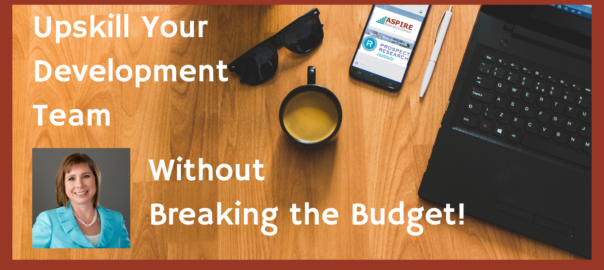
desk with coffee and laptop and picture of jen filla

Upskill your Development Team with Research – Without Breaking the Budget!

When people hear “prospect research” they often assume that prospect research is a software or using Google to find things like company bios or, sometimes, that it is an employee that creates prospect profiles. Usually, the definition relates to the kind and scale of development operations they have been exposed to. And, really, everyone is as correct as they are wrong!

When we consider the growth of an organization from start-up to raising billions of donor dollars, the core of prospect research is the act of better understanding your donors through data and information.

Even if you have the luxury of a full-time, prospect research professional, everyone on the development team needs to be good at some basic prospect research skills. And if you don’t have the luxury of having a prospect research professional on staff, there are great ways to upskill existing staff to provide additional research support.

Finding contact and occupation

When it comes to personally asking a donor for a gift – most often in a mid-level or major gift program – the first thing you need is contact information: address, phone, email, or social media.

Hand-in-hand with contact information is the donor’s occupation. Occupation is useful for a few reasons:

  • Finding business contact information is easier and usually more accurate.
  • Psychologically, at work we probably expect to be contacted by people we don’t know more than at home.
  • Especially in higher education, development officers can connect with donor prospects on LinkedIn, if appropriate.
  • Occupation is a quick and easy indicator of likely wealth.

Everyone on the development team needs to be good at finding basic information about donors and this is why Aspire and the Prospect Research Institute created the booklet, Search Tips for Fundraising Research.


Search Tips book cover

This 15-page booklet introduces the five fundamental building blocks for fundraising research and gives you tips, tricks, and resources to find what you need. Purchase your copy today!


Information is great – when it’s accurate!

Once everyone is upskilled on basic search —  from the president’s assistant to major gift officers to the database administrator and beyond – it’s time to address whether the information everyone is finding is correct.

The proliferation of misleading and outright erroneous information can be overwhelming. As anyone who has clicked through a scam email knows (and c’mon, we’ve all fallen for one at least once!), when you’re busy, stressed, or preoccupied, it’s difficult to maintain a critical, watchful eye for discrepancies or take the time to double-check information.

At Aspire, we were once asked to perform due diligence research on a donor prospect with whom the organization was in negotiations for a major gift. Beyond reputational risk, the question was whether he actually had the wealth he claimed to have.

It was super challenging! Why? Because the information we sourced seemed to be in a perpetually unconfirmable loop. For example, what appeared to be a published interview was really his own blog article. Live media interviews only seemed to cite information that he had seeded in his biographies and multitude of websites.

And the worst? He claimed to have bought out dozens of bankrupt companies – all incorporated in Delaware with no owner information published!

After hours of creative searching, we finally found the fatal flaw and it was in plain sight. If you tried to purchase any of the products or services on offer through the various companies there was either no option to purchase on the website or no physical address to visit.

Finding accurate information is so important, the Prospect Research Institute created a FREE course to educate your development team (and anyone really) – Solid Intel.


Solid Intel Course

Solid Intel is a multi-module course teaching you how to evaluate sources critically and feel confident in the accuracy of the information you present. Fun quizzes test your comprehension. Share with your team and Enroll Today.


Wealth and philanthropy indicators

If your organization needs deeper research to support major gifts and hasn’t had this support previously, you may want to upskill an existing staff member, such as a development coordinator or database administrator.

You probably have a few specialty tasks you’d like this person to accomplish, such as the following:

  • Identify major gift prospects from the database
  • Provide prospect profiles prior to solicitation
  • Help coordinate moves management for the team

Leveraging your existing staff member or hiring someone at entry level can be economical and helps build internal capacity for upgrading donors and moving toward major gifts. In the past, training a staff member on prospect research support for the growing nonprofit was challenging.

Prospect research industry conferences are expensive and dominated by sophisticated healthcare and higher education environments. Webinars and local conferences offer tidbits, but usually don’t give your researcher key skills with step-by-step instruction on how to apply the skills to their work.

Recognizing the need, Aspire developed a course at the Prospect Research Institute specifically for the nonprofit researcher that needs to do all the research things – and at an economical price.


The Essentials for Successful Fundraising Research course is at least 7 to 8 weeks of on-demand content with a downloadable textbook, homework feedback, ability to earn a digital badge demonstrating competency, and 12 months of monthly group coaching. Give your organization the research edge. Enroll Today!


Growing your Fundraising with Research

When your development team has the information it needs, big things – and gifts – can happen!

  • Routine stewardship can happen with better contact information
  • Stewardship calls can turn into major gift prospect qualification
  • Donors can be moved more methodically toward larger gifts
  • Deeper information can give development officers greater confidence to ask for larger gifts

Upskilling your development team doesn’t have to break the bank. Aspire, through the Prospect Research Institute, has created a variety of training options to meet your needs at affordable prices.


What are you waiting for?
Visit the Institute now!


launch your prospect portfolio; rocket

Add Speed to Major Gift Portfolios with RPM

When a current client created a job posting for a Research and Prospect Management position a light bulb went off!

Research and                                  Revolutions
Prospect                                            Per
Management                                   Minute

More frequently you’ll see this type of combined role posted as Prospect Management and Research (PMR). But if you reverse that to Research and Prospect Management (RPM) …can you get more speed into your major gift portfolios?

Which comes first – research or prospect management?

Unlike a similar question about chickens and eggs, there is a pretty definitive answer to this question. Research usually comes first in the form of prospect identification.

Most organizations grow into major gifts. A common nonprofit story begins with institutional funding, such as foundations and corporations, who want to support early and continued nonprofit growth. Along the way, nonprofits attract small dollar individual gifts and refine their individual giving program to the point where larger gifts receive more personalized attention and individuals are personally asked for larger gifts.

Usually with the first capital or other campaign, there comes a need to more methodically or reliably identify donor prospects who can give lead campaign gifts. Enter prospect research with major gift prospect identification!

When there are just too many donors requiring personal attention to keep track of in one person’s head, the CRM database comes to the rescue with prospect management. Prospect management provides a systematic way of tracking prospect’s progress from identification to a gift and stewardship.

But what happens to research when prospect management becomes a separate specialty in-house?

Sometimes research and prospect management get out of sync, prompting major gift portfolios to get as stubbornly stuck as a zipper out of alignment!

When research is disconnected from the management of major gift portfolios, various things begin to break down. Sometimes the criteria that research is using to identify prospects does not fit with the funding priorities or the development officer’s views on what makes a great prospect. Research might not be aware of specific regions or development officer portfolios that need more or different prospects than others.

When prospect management is disconnected from research, important information learned from development officers is not passed along. For example, a development officer might learn critical information about a wealth event for which research could provide capacity insight. Also, the prospect manager might not be aware of the criteria used to source new prospects and then they cannot explain it to the development officers.

Adding research in at the “front” of prospect management – the RPM perspective – recognizes that the smooth coordination of prospect identification with portfolio management is where major gift speed is generated.

When the zipper is not aligned, movement is difficult and slow. When there is alignment, the zipper zips easily and quickly.

Similarly, when research and prospect management are aligned, development officers zip through qualifying and disqualifying!

(This all assumes, of course, that development officers are trained in qualification techniques and have a disciplined work process. But that is a different subject!)

Major gift fundraising: Can’t have one without the other

Whether you like to call the work PMR or RPM, the bottom line is that you can’t have one without the other. Without research, pipelines eventually run dry. Without prospect management, development officers lack support to move prospects effectively and efficiently toward a larger, major or transformative gift.

Additional Resources

workshop ad, people around a table

How connected is your major gifts team to its donors – really?

Do you really know how well your major gifts teams is performing? Maybe they are raising millions of dollars every year and hitting the targets set for them — but are those the right targets? Evaluating donor engagement could help you answer those questions.

If you are one of those organizations that fundraises your budget every year and has grown to command a major gifts team, you have my deepest admiration! Scaling a nonprofit organization is not an easy task. Neither is growing and scaling a major gifts team.

At Aspire, we work with fundraising leaders who are tasked with taking their major gifts team up to the next level of performance. It can be surprisingly difficult for even an experienced major gifts officer, trained at a larger institution, to make headway with a legacy major gifts team.

Donor Engagement as a Framework

Having major gift officers assign their prospects a donor engagement level is one way to find out what’s happening on your team and in their portfolios.

It has been a common practice to focus on portfolios through the lens of the gift cycle — identification, qualification, cultivation, solicitation, and stewardship. And this works very well for gift proposals, but human relationships don’t fit very well into those process-oriented terms. Donor engagement is different.

Many major gift officers intuitively view their portfolio through the lens of donor engagement – discovery, early cultivation, and deep cultivation.

It also fits the rule of three, which means when major gift officers show up to work, they only have to remember three categories of donors in their portfolios. This can help them manage their time and prioritize the right people.

Honest Discussion Leads to Real Change

When you ask each major gift officer to assign a donor engagement level to every person in their portfolio, surprising conversations may arise and lead you to what’s really happening.

For example, you might learn that someone on your team is struggling to find contact information, leaving them with only snail mail letters to communicate. You may also discover that some team members don’t know how to build a deep relationship with a major donor, which is why they have stagnant, lower gift sizes.

To create fertile ground for these kinds of discussions, it’s important to clearly define the donor engagement levels. It’s also important for each major gift solicitation to be recorded and tracked as a proposal or gift opportunity on the donor record.

Major gift officers also need routine portfolio reviews. This is time-consuming, but it’s where all the stories start pouring out. And when you combine portfolio reviews with monthly team meetings, now you have a platform for coaching and developing process and policies.

Which Comes First – The Process or the Outcomes?

If you are like most fundraising leadership, you need more dollars raised and now. Using donor engagement as a framework isn’t for every organization, but it can help you assess the reality of your team’s performance while you are working to identify and assign new prospects.

And there is an added bonus with this framework. It is within the full and complete control of each major gift officer to categorize their relationships with the donors in their portfolios – as it should be. When major gift officers have ratings of all sorts assigned to their donors it can feel like their relationships and the information they have gathered are ignored.

With a donor engagement framework, it’s about the relationship first, ratings second.

Avoid the Rabbit Hole? When to Stop Searching.

Avoid the Rabbit Hole? When to Stop Searching.

How many times have you heard a prospect research professional tell a story about how they dug just a little deeper out of curiosity and found the key piece of information that their gift officer used to make a successful solicitation?

We all want to be the hero researcher who expertly identifies the right information. But the truth is that most of the profile research we do is pretty routine. And for many of us craving the excitement of a scintillating find, we spend far too much time unraveling threads of information that have no substantial benefit to our work.

Continue reading Avoid the Rabbit Hole? When to Stop Searching.

I want to be a major gift officer! Say very few researchers ever. But should they?

What would happen if researchers adopted the technique of method acting for one week out of every year? What if the researcher “became” a major gift fundraiser? Could this be the kind of training that could differentiate between superstar researchers and all the rest?

Are you familiar with method acting? It’s where the actor stays in the role of the character, even off camera. Jack Nicholson — he starred as Jack Torrance in the Shining, Col. Jessup in A Few Good Men, and too many more to list — was reported to have modestly said, “There’s probably no one who understands method acting better academically than I do, or actually uses it more in his work.”

And I have heard of organizations where the researcher tags along for some donor visits or makes thank you calls to donors. As part of the development department, it’s not unheard of for a researcher to help staff major donor events. I have. All of these interactions shift the researcher out of his or her research mindset and into a donor-facing mindset.

Because whatever research you’re doing – profiles, data mining, prospect lists, verifying a screening – could benefit from one last review by you, but in the mindset or role of major gift officer. When I say “one last review” I mean that there needs to be distance of some kind between performing the work and reviewing the work.

Just as writers will put down their work for a few days or a few weeks, picking it up again with “fresh eyes,” so researchers can put down their work and pick it up again with “major gift officer eyes.”

Reviewing Research through “Major Gift Officer Eyes”

Anyone who routinely reviews donor prospects with talented major gift officers can’t help but to start thinking like one. Imagine that you both have the profiles up on your computers and the major gift officer starts commenting and asking questions in each of the five building blocks of the profile, like this:

  1. Institutional Information: Is this the same couple that met while on one of our sponsored donor trips? (Yes, it was, and by golly that level of high affinity changes everything about approaching them for a campaign gift!)
  2. Biographical Information: I clicked through to her Twitter account and did you see that in her profile line she describes herself as a “disability advocate, wife, and mother?” I wonder if they have a disabled child! (Obviously, you didn’t read it because you put “none found” under children and didn’t find any connection to your cause beyond her first gift to your organization.)
  3. Community Involvement: They gave a million dollars to Sunshine Charity? Really? I wonder what that was about. They’ve only ever given us $1,000 and everything else found shows giving under $5,000. (After tracking down the annual report it turns out it was a typo from the vendor and you need to re-examine the screening capacity rating.)
  4. Occupation: His wife is Janita Billingswart? Do you think she’s the celebrity attorney? A name like that, surely… (But you didn’t search her name because the deep relationship has been with the spouse and you were in a hurry.)
  5. Wealth and Assets: Can you tell me more about the family limited partnership you mention here? Doesn’t that mean they have a lot of money? (You check it out when you’re off the call and realize it does indicate significant wealth and now you notice it was formed the same year that they sold their first company.)

You might not be able to practice method acting and live the life of your major gift officers to understand them, but you can live their work life vicariously by engaging in frequent conversations about their prospects. It takes dedicated effort, but so does method acting. And you will learn LOADS about doing research better.

Getting Good Without Shock Therapy

It was rumored that Jack Nicholson underwent shock therapy in preparation for his role in One Flew Over the Cuckoo’s Nest. I don’t recommend diving deep into every single research project or you might just go crazy!

Here’s how I described to a client, and an amazing major gift fundraiser, what he could expect from our profiles so he could know when to question us about the work and when he should run off on his own with his questions:

  • Our Snap Bios are a quick look, a snapshot, and it is unlikely that we would jump out of our usual process to follow a lead or ask a deeper question about the prospects.
  • Our Tactical Briefings are confirming philanthropy and wealth and while we are spending more time and digging deeper, we’re unlikely to wander off following a hunch unless there is an anomaly — unless something looks strange or we want to be sure we are accurate.
  • Our Strategic Assessments are the deep dive, following all those questions, untangling ambiguity, and laboriously seeking information not directly related to the prospect, but directly related to the prospect’s philanthropic or wealth story.

Of course, the fewer hours it takes us, the lower the cost, but the less information, too. Sometimes we do get dazzled by a prospect, spend more time, and the inspiration unlocks key information. We love our work and that’s inevitable!

Anything You Do, You Could Do Better

The prospect research field is full of people who are fulfilled in their work because it demands constant learning across, well, everything! We can have confidence in knowing that we don’t know a lot, and this opens us up to learn from everyone, everywhere.

So, even though the examples I’ve given in this article relate to prospect profiles, you could do better in every aspect of your work. Maybe your major gift officer loves Excel and enjoys filtering and sorting a long list of potential prospects for an upcoming trip, but is that the best way to provide the information? Could the process be improved?

If you don’t look at your work product through “major gift officer eyes” you may never know. I’m curious. Aren’t you?