I was poking around to see what I might find on the internet and thought I would share my favorite finds related to data mining. I hope you enjoy them too!
I have had a few requests for articles on simple data mining techniques and the related database maintenance necessary to make the results meaningful. Look for my upcoming companion blog post on data mining resources, too.
Before we get started, let’s talk a little bit about what might be holding us back.
Fear that it’s too complicated – Not much anyone can do about this one, except you. Jump in! The water is warm!
Assumptions that leadership will not invest and support it – Data mining and analytics are keyword candy to leadership. Leadership loves to get intelligent answers to questions like “What percent of donors rated at $100K+ gave at that level?”
No clear understanding of the pain/need/goal – What keeps your leadership awake at night? Is it prospect pools that don’t perform? Finding leadership donors for the upcoming campaign? If you don’t know, you can’t make a compelling case for data mining.
Donor Database Reports
Do you remember that scene in the Sound of Music where Maria is trying to teach the von Trapp children to sing? She stops singing “Do-Re-Mi” and says, “Oh, let’s see if I can make it easier”. We can do that in data mining too. (I haven’t come up with a song yet, but I’m working on it.) Here is an easy and fun way to get started in data mining – explore all the canned reports in your donor database. I’m not kidding! Even if you have no idea what deep, insightful questions you want to answer, you can begin with reports.
Consider these common reports:
Consecutive years giving – When donors give many years, especially consecutively, it usually means they really like us. Who are these people? Do they have high wealth ratings? Could they be good planned gift prospects?
Top donors – Are all of your top-giving donors getting regular attention?
LYBUNT, SYBUNT, & new donors – Within these reports you might find donors capable of increasing their gift, some major gift sleepers, and some new donors with wealth.
Lifetime giving and number of years giving – So many forgotten donors can be found in this list as well as some very good planned gift prospects.
Digging a Little Deeper
MS Excel is on most of your desktops. If you take a little time to learn to use it – I’m not talking complicated formulas, just tips and tricks – it will truly open the world of data mining to you. Imagine that you pull a report into Excel with all of the key fields in the above reports (last gift date and amount, largest gift date and amount, lifetime giving, etc.). Add in wealth ratings if you have them.
Now consider this scenario:
Custom sort: First by largest gift amount (descending), second by lifetime giving (descending), third by last gift date (descending)
Analysis: By scrolling down the list you can see if any donors who have made larger gifts (largest gift amount) and have lapsed (last gift date). Is there some high lifetime giving low on the list? Why?
Imagine sorting first by wealth rating and then largest gift. How about lifetime giving and wealth rating? This is fun! (I told you the water was warm.) Just be sure to watch your time. Prospect researchers have gotten lost in the data mining game.
The Secret Data Mining Trick
The secret trick to analyzing your donor information is to understand your fundraising fundamentals. Remember the fundraising pyramid?


The pyramid illustrates your areas of opportunity:
Occasional: Did that first-time $1,000 donor get personal attention?
Annual: Are there small annual gift planned giving prospects in there?
Annual: Can we motivate annual donors to move up a giving level?
Major: Do any of your major gift donors have unexplored planned gift potential?
Planned: Are there any planned gift donors who could make a cash gift?
Common Data Errors that Under-Mine Your Efforts (pun intended)
Now that you have the idea that you can sort on specific fields in your donor database, you will very soon realize that even sorting becomes problematic if the data is full of errors and omissions. Use your blossoming interest in data mining to clean up the database! Then when you are ready for more complicated data mining challenges, your data will be ready for you.
Data errors in any of the fields you pull – e.g., incorrect or missing dates or dollar values
Duplicate records – often happens in gift entry or multiple hands in the database
Deceased or bad address – if you don’t mail to your list, you probably aren’t getting your list cleaned; if you are mailing, you might not be getting a file back from the printer to update the records
What can you do about problems like these? People don’t usually like to hear this, but you need some documentation.
Your database probably has some maintenance reports. Set up a schedule to run them and fix the errors.
Do you need to run a report of all changed records daily or weekly?
Gift entry staff should be trained to search for the donor name first, instead of entering a new record. As in, create your own training manual for how gift entry is performed in your organization.
Someone should review all gifts entered, probably daily.
Robert Weiner is a consultant with some excellent free articles about keeping your database up to snuff. You can find his articles here: http://www.rlweiner.com/articles
Taking Data Mining to the Next Level
Once you have your data in order, some understanding about how the information is stored, how you can retrieve it, and what kinds of things it can tell you about your donors and prospects, I suspect you will be a lot more likely to sign up for that data mining webinar or take advantage of the APRA Analytics Symposium. It feels good to be ready, doesn’t it?
When was the last time you had a knot in your stomach because you were worried you were going to ask for too small of a gift? If you are like many fundraisers, the answer is not often enough!
$8 Million gift from Glenn Korff to University of Nebraska-Lincoln’s School of Music.
$2 Million gift from Gene Feaster, an inventor of Superflab to the University of Kansas.
How badly do you want gifts like these?
The wealth screening companies tell us – perhaps with some bias – that organizations which raise more money and get whopping big gifts, screen their donor database for wealth regularly. This does not surprise me. Does it surprise you?
Bias aside, large organizations are much more likely to worry about asking for too little. It’s a high-pressure, go-get-the-gift environment and the winners are those receiving the largest gifts. And large organizations invest in fundraising, including prospect research.
Research gives them the facts that can validate what they suspect, or disqualify a prospect, or find new information that impacts gift type and size.
But what can I do?
Hey! I heard that! “But we have no money for a screening.” “We can’t hire a prospect researcher anytime soon.” “Our leadership won’t invest in research.”
And I have a response! (It wouldn’t be much of an article if I didn’t, would it?)
Whether you are a smaller organization dreaming big or one of a hundred gift officers, you are in control of your own behaviors. And here’s a few winning behaviors to adopt – and maybe even influence others, like your leadership.
Get worried about asking for too little.
Words matter. When you talk strategy for a gift, state your target ask amount and then say, “But I’m worried that might be too low.” (That was easy!)
Get wealth-educated.
Pay attention to articles, blog posts, studies and conversations about wealth. Because when someone asks you – “why do you think that ask is too low? – you will need an answer.
He sold one company. Could there be others?
He seems like the kind of guy to have a vacation home, but I don’t have the tools to find out.
Jane board member says he owns a number of restaurants, but I don’t know for sure.
Get search savvy.
No, you don’t have to be a full-fledged prospect researcher, but every fundraiser should be able to find key information online about prospects. When was the last time you visited your county tax assessor’s online database? How about Zillow.com? Do you have rule-of-thumb formulas to create capacity ratings?
Wealth screenings are one tool in the research toolbox. Even so, I hope you are actively thinking about a future budget that includes a screening. You might not need it now, but you will need it sometime soon.
Your mission and the people and causes you serve deserve funding. And if for no other reason, that should get you concerned about asking for too little.
If you want help finding information about your prospects, click here to contact Aspire Research Group.
Do you know how it is when you find a new tool and suddenly it appears EVERYWHERE?! This is how I feel about relationship mapping. Ever since I purchased a subscription to Prospect Visual, I have started to notice different relationship mapping techniques and applications all over the place. My recent quest for facial recognition searches on photos is a case in point.
My typical nonprofit client doesn’t have a huge warehouse of internal data and often feels an urgency to add to its current donor pool to meet special fundraising initiatives. Relationship mapping holds such promise for identifying prospect gold in uncharted territories! Or does it? Yet?
My feel for the technologies involved is that it is early days. Some of what is currently being commercialized could be easily disrupted by what we might now consider ancillary or “extra” services. Facial recognition is a good example.
Technologies like facial recognition are both shockingly advanced and woefully inadequate. Most things start out expensive and, especially with technology, can become affordable in a remarkably short period of time. Here’s hoping that happens with facial recognition. Unless of course you are searching on me!
Here’s how my facial recognition quest began. I was working on a difficult prospect assignment. Not many donor lists out in the public domain in this particular city, and board members with limited profiles and middle-income wealth. And then I stumbled on a Flickr account with gala pictures from a past event of a similar organization. Eureka!
But no captions on the photos. And I am not personally familiar with the who’s who of that city. Bummer! Or is there a way? To find out I consulted the best talent around – the research list-serv hosted by APRA – and received two good sources:
Did you know that you could search for other images using an existing image? You can! And it did make good *exact* matches to find pages where my picture was located (because, of course, I tested it on myself first). But when it came to similar matches…wildly differing pictures appeared. But, ahem, it did find one of Julia Roberts, which I agree is very similar to mine.
This site seemed so promising, but it didn’t find any matches on my photo, which was disappointing.
These sites were not enough to help me identify the pictures on that Flickr account. But apparently there is some seriously powerful software available that has the potential to make a prospect researcher’s dream come true and find out way more than just linkage or connection.
Social media maven and all-around talented researcher, Lori Hood Lawson, pointed out a 60 Minutes episode that demonstrated the power of some maturing technologies – and has me even more determined to vote at every possible opportunity!
With the proliferation and popularity of photos and videos all over the public domain, it creates an opportunity not currently considered in the text-based products such as Prospect Visual and Relationship Science that are on the market for nonprofits right now.
Relationship mapping and other prospect research techniques often follow behind competitive intelligence and other for-profit efforts. The uses are similar, but not the same, and as prospect researchers, we often find ourselves getting “creative” to make products work for us. However, with the nonprofit industry growing to such a powerful size, we might see a shift.
But don’t worry donors, prospect researchers have a code of ethics we take incredibly seriously!
There’s a bit of buzz about whether prospect research is going to get dumbed down by smart software products or if it will get lifted into the realm of strategy and management. The reality is probably a bit of both. Today I thought I’d bite off one little piece of the bigger conversation. I want to take a tried and true prospect research task – the trusty profile – and toss it up in the air to discover a new perspective on its utility and value.
As you might have noticed, the topic has many layers of discussion points and profiles are somewhere amongst them. Can we re-wire the humble profile to make it more strategic and cost efficient? What does that mean?
I’ve heard conversations along these lines:
The paper profile is dead. It should all go into the database.
Research should be finding the basics – ability, inclination, linkage/affinity – and spend not a minute more.
My gift officer was struggling to connect with a prospect and I dug deep and found some nuggets of interest that helped him to solicit and receive a multi-million dollar gift.
My two cents? They are all correct! Prospect research is positioned differently at each organization depending upon the structure and culture of its fundraising operations. But sometimes people are so excited about their success with their hammer that they begin to view every problem as a nail, even if it’s a screw.
My favorite type of client to work with has no research staff and is tasked with raising million-dollar gifts. She relies on the paper profiles to give her really deep insight into what makes this prospect tick because the pressure is high to get the largest gift possible for her organization. She doesn’t hesitate to call me and question the information so she can feel confident in her ask amount.
It’s my job to know how much and what kind of detail to include.
That’s a big sentence. And it leads me to an interesting interaction I had recently with another client. We were talking about her need for corporate research. She wanted all the usual info, but they had specific strategies they were focused on for corporate prospects. My profiles are typically organized to best present the information collected, but what I was hearing was that she wanted to know exactly how to approach the company for each strategy.
So I reorganized the profile to highlight info relevant to each strategy first and then other sections to hold traditional, but necessary, information second. I did the first couple of profiles to be sure it worked and, well, it felt awkward. It took extra effort to parse the information into the right spots. I truly had to think first about the strategy and second about the information I was scanning. But it kept the profile laser-focused on what was most important to creating the cultivation and solicitation strategy. That felt good!
But, What About You and Your Office?
When deciding how much and what kind of profile types your prospect research department should be producing, I recommend engaging your fundraising staff in dialogue around these big questions:
Does everyone understand…
What the three main functions of prospect research areas are? (Prospect Identification or proactive, Prospect Profiling or reactive, and Relationship Management)
How those functions affect and support their specific specialty (events, annual fund, major and planned gifts, alumni relations, etc.)?
Where they fit within the strategic goals for the organization’s overall fundraising?
(Just remember that, as in search technique, less is often more. We’re not talking two weeks of training, but a simple, framework discussion.)
With everyone on the same page, now you can begin to have a discussion about things like if and when prospect research should be doing in-depth, six to twelve hour individual research profiles or who should be preparing bullet points for major gift prospects at events.
Now everyone knows where the priorities lie and how prospect research is going to be used to support them. It might not make everyone happy, but hey, happiness is a personal journey, right?
Onward to the Future!
Yes, the world is a-changing. We need to have the confidence and courage to re-engineer our services. We need to become more competitive and tie what we do to its impact on giving. And as we pursue big-picture discussions about the future of our profession, we need to recognize the diversity of our experience, context and strategies to create best practices focused on problem-solving.
With professionals like Sabine Schuller, Helen Brown, Mark Noll, Chris Mildner and You, I have no doubt we can ride these waves of changes with aplomb. I can’t wait to hear what you have to say!
I just can’t stop thinking about relationship mapping! Probably because I am deep within a project to use relationship mapping to generate new prospects and illuminate the path to identified prospects within a campaign. A soft touch for new software, I really, really want the product I’m using, Prospect Visual, to deliver the goods. But will it?
The Many Shades of Relationship Mapping
Relationship mapping is not new, but some of the tools used to find relationships are new. Essentially, you create a visual (think family tree style) or data map (like in Excel or a database) or both of someone’s relationships. Many organizations collect this information in the donor database as an afterthought or “extra”. Relationships might be mapped to family members, boards served, club memberships, religious involvement and others. Why, you could even map all of the interrelated relationships of the Mad Men television show characters…
Mad Men Relationships
In higher education there may be a wealth of information from the school that connects individuals to one another, such as club membership, degree majors, and sports participation among many others. In 2012, Queens University presented at a CASE conference on their use of TouchGraph to map relationships within their own database.
What some new products, such as Prospect Visual and Relationship Science, are attempting to do is allow you to take the relationships you have collected on one individual and find paths to reach other individuals “out in the wild”.
LinkedIn does a reasonable job of this for prospecting within business networks. I have used LinkedIn, in combination with verbally asking people in my network, to identify paths to prospects I would like to cultivate for business. A personal introduction by someone with a strong relationship is much preferable to a cold call!
A nonprofit organization can use a trustee or engaged volunteer to introduce it to new prospects who are likely to have an affinity for the organization. Nothing new about that!
The Missing Piece: Spheres of Influence
What is new is identifying, perhaps by visualizing, someone’s sphere of influence. Some people are connected to more people and some people have many people in their network that are strong or deep connections. Strong connections suggest that the person can influence the other person. In the triad of Linkage-Ability-Inclination, relationship mapping provides the piece research has not always been so good at delivering in the past: Linkage.
In our book, Prospect Research for Fundraisers, Helen Brown and I discuss relationship mapping in the last chapter. Helen provides a great example of an organization that used its alumni group on LinkedIn to identify individuals who were highly connected and then qualified them for affinity. This process uncovered some great new prospects.
Jen Filla’s Facebook Spheres
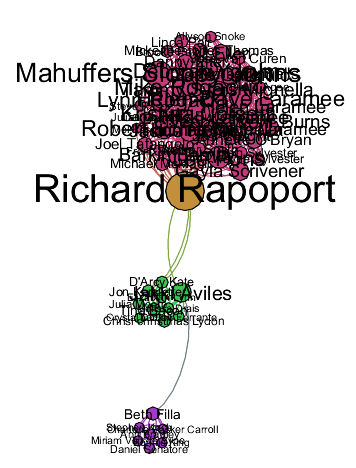
I attended a course at the Nonprofit Leadership Center of Tampa Bay led by social media expert Bryn Warner, and I created a visual representation of my relationships from my personal Facebook page, which I have included here. Just look at all the connections around my husband and my favorite live-music venue, Mahuffer’s! Clearly this represents a sphere of influence. And it’s a messy, tangled ball of yarn, yes? I did not take the time to manipulate the graph results to make it pleasing to the eye or to make the names all readable. Make no mistake, these tools may be powerful, but they are time-hungry beasts!
Analyzing and Verifying
My experience so far using Prospect Visual is two-fold: (1) Visualizing spheres of influence is effective in identifying promising paths to new prospects; and (2) Just as in a wealth screening, this big relationship database is great at prioritizing, but I still have to analyze and verify the information.
What I have been doing so far in Prospect Visual is identifying clusters of relationships – spheres of influence – inside and outside the defined group of individual, foundation and corporation prospects in our project space. While one trustee may have strong relationships to identified prospects, another trustee may have a deep and wide network with organizations and people that my client has not considered before.
Once we see a sphere of influence, the next step is to confirm it truly exists and then discover whether there is any ability or inclination. Because there are errors in the underlying database of relationships – such as duplicate records and connections that are just plain wrong – the connections must be verified. And once the connections are verified, further research is needed to discover those shiny glimmers of affinity.
Getting Results
As with wealth screenings, moving the process from mass prioritization all the way through cultivation and solicitation takes time. It will likely be at least a year before any results, let alone gifts, are realized from the effort. And this project is not exactly number one on everyone’s to-do list. Prospects and donors in active cultivation and solicitation create the crisis of time that vacillate the prospect identification project between hot and cold attention.
Who is at the Watering Hole?
Are you actively using relationship mapping techniques and tools? Do you plan to? Do you wish you could be a fly on the wall hearing about it? Join the conversation! In a geographically dispersed environment where many of us perform prospect research solo, sharing our work successes and challenges builds our profession and ourselves.
Relationship Mapping Work Group
Aspire Research Group has created a free-to-participate work group that meets online. You can join the conversation – or lurk about listening – by signing-up for the email list. I’m looking forward to sharing with you!
Wouldn’t it be great if we could discover the personalities, values and needs of our donors and prospects? Now we have access to demographic information – things like age, sex, marital status, residence, average income. But what if we could really *know* what makes our prospects tick?
Of course, businesses would love this deeper layer of extremely personal information too. And a group of researchers at IBM’s Almaden Research Center in San Jose, California are getting much closer to making this information accessible. How? Well, just for fun, let’s use the current buzzword – Big Data!
But it’s a little more nuanced than that. Really it’s social media. That’s the place where we bare ourselves the most. We talk with our friends candidly and share our feelings along with facts. Led by Eben Haber, the IBMers are capitalizing on research done by Tal Yarkoni at the University of Colorado on how certain words correlate with certain personality traits. Dr. Yarkoni looked at blogs. Dr. Haber and crew are looking at Twitter.
What do you say in your Twitter feed? A new product created by Dr. Haber and his team is being tested by a financial services company. The claim is that in just 50 tweets it can describe your personality reasonably well. In 200 tweets it gets uncomfortably accurate.
The big question is: Could we use information about personality traits to raise more money?
Up until now, the big data sets have been pretty exclusive to higher education and sometimes other large institutions. This is not because they have so many individual records (although they often do), but because universities have so many pieces of data on each of their alums. They keep track of things like what clubs they belonged to, how many degrees received, events attended, participation in directories and more recently, online alum communities. The local food bank is not likely to ever have that much information about each of its donors. But could organizations have more information in the future?
Multi-channel fundraising – print, email, website, Facebook, Twitter, etc. – means that organizations have access to multi-channels of data. This data is attached to specific individuals. Before you can blink your eyes, the software to ride the big social media data beast will drop in price and become more accessible to the masses of nonprofit organizations. Okay, maybe it will take a few eye blinks, but if the past is a good predictor of the future, it is definitely coming.
Right now the most common piece of data we use to determine whether someone has an affinity (likes our org) is giving. We want to see things like frequency, recency and longevity. We can do a wealth screening to identify people capable of giving a lot, but that does not help us turn them into donors – into people who have an affinity for our organization and its work.
Now close your eyes and imagine … wait! read this first before closing your eyes … that you can run your database through a screening that assigns rated personality traits to each constituent record. Ahhhh! Now you can group people by personality traits and create messaging that resonates with who they are – resonates with the core of their personality. WOW! People would convert to donors at amazing rates! Right?
Until that magical day, let’s see if we can’t work on our current messaging. Little things like communicating with donors in the medium in which they like to give. No more of this sending paper to people who have demonstrated online giving. Many organizations are still struggling with what feels like “traditional” message segments, but are quite new to many. Messaging. It’s like exercise and good nutrition. There’s no magic pill (or database screening) that will ever replace it.
Which brings us back to the heart of fundraising – relationship building. Some organizations are better at it than others – regardless of budget size or the depth of data.
So although it is always fun to play with new technology and to imagine a day when science will turn “magic” into a software product, the feet on the ground (you and I) need to stay focused on what builds the best and most relationships with our organizations and missions. The right messages. The phone calls and face-to-face visits. Being real with real people.
P.S. Are you on Twitter? Let’s connect! You can find me @jenfilla I promise I won’t try to predict your personality!!
This post debuts the InfoSeeking4Researchers series! I decided residential real estate would provide a great conversation starter. It appears simple, but is laced with multiple perspectives depending upon organization size, skill levels, prospect capacities and more. As in, a deceptively simple topic!
I have started the conversation here, but I’m expecting you to finish it. Each conversation starter I write will be emailed to InfoSeeking 4Researchers subscribers and posted here on the InfoSeeking blog under the 4Researchers category. You can subscribe to the e-newsletter to get extra tips and resources, or follow the blog category. Wherever you read it, I encourage you to post your experiences, tips, and questions as blog comments so everyone can benefit.
Residential real estate is one of the first things we researchers look for and yet sometimes we overlook the nuanced information it can provide. I was reminded of just how much it can shape prospect strategy as I was reviewing a prospect profile with a new client… but I’m getting ahead of myself. First, let’s discuss presenting the information. Second, I’ll give an example analysis. And third, I’ll start a list of examples that I hope you will add to!
Presenting Residential Real Estate
As the years roll forward, I have moved to presenting more of my researched information in tables. It ensures that no matter who does the work, everything looks the same, and it also helps me remember the pieces we need to check for. My real estate table looks like something like this:
Property
Year
Valuation
[depending on the level, I might include a picture here]
1234 Best Vista Drive, Indian Shores FL 33785
Pinellas County Gulf-front residence; 5-bed, 4776 sq ft interior
Purchased in 2002 for $8 million
Owned by Pillsbury and Jane Dough
Revolving line of credit recorded in 2007 for $1 million
2013
$11 million
I choose to present an estimated market value, which I round so the end user doesn’t interpret it as an exact value.
Are you presenting your research in a document or does everything go directly into the database?
Are there places in your database to include the bullet points above that will print in a database generated profile?
A Quick Analysis
So what do I now know about Mr. and Mrs. Dough?
They own a big house on the beach.
They purchased before the real estate market tanked and paid cash (no mortgage).
They took out a loan during the recession, which happened to coincide with when Mrs. Dough launched her new and very successful business.
And that means…
They already had wealth when they bought the house and leveraged that wealth during the recession to launch a business when the business market was quiet. I’d say they likely have significant capacity.
Other examples of things I have learned through real estate
When the property is owned in a trust named after the prospects and listing them as trustees, I want see if the trust name on the deed record states exactly what kind of trust it is. Holding the family home in trust suggests to me that they have done some estate planning, which the gift officer will want to take into consideration.
One prospect held a property in trust in his name and yet he was living in a retirement home. When this was pointed out to the gift officer, he told me that he had heard the prospect’s daughter was having troubles and that this house was likely bought for her use. So it’s not likely the property is going to factor into a gift, is it? Good to know.
When a prospect has owned the property 10+ years and still resides in the home, even if only part-time, it suggests a different approach to life and wealth than someone who buys and sells the primary residence as often as you might sign a car lease.
When there is a mortgage, and especially if it is a large one, it suggests that there must be a certain amount of income to support those mortgage payments. A mortgage calculator is a handy tool to get an estimate.
There’s a big difference between a successful real estate investor who sits on vacant land through the downturn (because she paid cash) and one who is stuck holding vacant land (because she has debt)!
Now it’s Your Turn!
Our profession is rife with experienced, intelligent and very creative people who also share. Won’t you share too?
Do you have examples to share like the ones above?
What nuggets of info routinely gets ignored, but shouldn’t?
Or should we spend less time on real estate and more on something else?
Click on “Leave a Comment” below or any of the social media buttons.
Knowing whether a donor prospect has children is a critical piece of information, but even more important for planned giving prospects. According to a study by Russell N. James III, J.D., Ph.D., Assistant Professor at the University of Georgia*, the absence of grandchildren as an indicator of likelihood to make a planned gift trumped even giving history – by a wide margin. Yes, go ahead and read that sentence again!
After those findings were presented at AFP’s International Conference I received multiple inquiries asking if there was a way to append child relationships to the donor database. Thank goodness the answer is “no”! I’m not confident that a centralized database of familial relationships is in our best interest generally. But it sure would be a powerful piece of information in our ability to predict inclination to give.
Whether you are a frontline fundraiser or a dedicated prospect researcher, there are a few ways to tease out information about children when it might not otherwise be obvious.
1. Biographical Sources
The first places to look are biographies, obituaries and wedding notices – any place where family information is described. Sometimes it is tucked at the end of the executive’s company biography and may or may not include names. Sometimes the Who’s Who listing is detailed. Other times a search engine might find a genealogy page for your prospect’s family.
2. In the News
Many of you have access to newspaper and other news databases online with the use of your public library card. Other news articles show up in search engine results. This is often a good place to find references to children and grandchildren.
3. Search on Address
I like to use Lexis Nexis for Development Professionals (LNDP) and perform a “People” search using only the home address – especially when the prospect has lived there for a long time. But you can also use a site like www.switchboard.com and do a reverse search by address. Any search that will give you a list of the names of the people who have been associated with that specific address is useful. The bonus from the LNDP search is that those addresses are referenced against voter’s registration and other sources and a birth year is often included in the search results. This gets me closer to uncovering how likely those associated names are to being children, instead of other family members.
4. Giving and Private Schools
When a prospect gives regularly to a private school, especially one from which s/he did *not* receive a diploma, I like to perform a search in Google of the school’s website. You can use the Google Advanced Search form, or type in your own. It looks like this: LastName site:schoolname.edu Many times I have found likely children’s names, and sometimes even grandchildren who are attending or have attended that school.
5. Social Media
If your prospect is active on Facebook, Twitter, or other social media websites, you might be able to tease out family relationships. Many times the prospect has tight privacy controls, but it is surprising how much can still be discovered in the public domain. I have even encountered prospects who keep detailed, and very public, blogs online.
Once I have found a likely child’s name, I have often been rewarded by doing a couple of searches on only the child’s name. The younger generation is more comfortable sharing online and the child, especially if post high school, might share parent names and pictures more publicly. This helps us with making an accurate match, but we need to be careful when approaching the donor prospect.
Children are special and protected relationships, and the last thing we want to do is make the donor prospect feel like we are stalking her with our prospect research techniques! Without trust there will be no gift. Because of this, we as fundraisers need to be skilled at opening the conversational door to allow the prospect to tell us what we already know.
There is always room for error when we search for information anonymously. If you are a prospect researcher working with a new frontline fundraiser, it is worth having a conversation with him about how important it is to allow the prospect to confirm the information we find.
Whether you are a frontline fundraiser or a prospect researcher, at some point you are faced with decisions about how much time and effort to put into measuring your fundraising success. But watch out! It’s all too easy to be deceived by the numbers you measure. You might be measuring the wrong items, get the wrong numbers altogether or get slowed down with numbers that don’t move you forward.
Are you measuring the right things?
No matter what size our organization, time and resources are limited. So where do you start in your fundraising office? With your donors, of course!
We know that we need to acquire and keep donors in order to provide sustaining income to support our organization’s mission. A recent client of mine was excited to tell me that his direct mail acquisition had a high rate of return. Nice!
But where were those donors now? It turned out that he had retained 14% of them. Ouch. Measuring acquisition without measuring retention is a mistake. Be careful that your measurements tell you the whole story about your donors.
Do you have the right numbers?
As you decide what to measure, keep asking yourself if the resulting number means better fundraising. For example, it might be exciting to count the number of people attending your event as it grows, but wouldn’t dollar-raised-per-person reveal whether your goal of raising more money was met? You may have a lot of attendees, but more people do not always translate into more dollars raised.
Are your numbers slowing you down?
Take the time to think about your goals and choose measurements that will reveal whether you are reaching your goals. Most of us have goals more or less like these:
Acquire X number of new donors = more dollars raised
Retain/renew X percent of all donors = more dollars raised
X number new major gift prospects identified/assigned = more dollars raised
Raise X dollars = more dollars raised
This is a very basic description, and your office may need a more complex set of measurements. For example, you may want to track different kind of dollars raised – direct appeals, major gifts, events. But don’t get caught in the trap of measuring too many things! You want to choose the most critical elements that will move everything else forward.
For example, my client decided to measure the retention rate of all donors instead of breaking it down to the retention of new donors acquired through direct mail. With a staff of three they only have time to focus on the most important measurements.
Ask yourself, “What are the key items that will move all of our efforts forward”? Set goals and measure those items religiously.
If you try to measure too many things or perform more complex analysis all of the time, you run the risk of bogging down your fundraising energy and effort.
No matter what your fundraising role you play, your actions should result in more money raised. As fundraising leadership, you need to determine the key goals that will move everything forward. As a prospect researcher you often play the role of “data translator”, helping frontline fundraising to translate goals into measurements. No matter what your role is, always ask if the items being measured and the numbers being reviewed translate into more money raised.
Cookie Consent
We use cookies to improve your experience on our site. By using our site, you consent to cookies.
Contains information related to marketing campaigns of the user. These are shared with Google AdWords / Google Ads when the Google Ads and Google Analytics accounts are linked together.
90 days
__utma
ID used to identify users and sessions
2 years after last activity
__utmt
Used to monitor number of Google Analytics server requests
10 minutes
__utmb
Used to distinguish new sessions and visits. This cookie is set when the GA.js javascript library is loaded and there is no existing __utmb cookie. The cookie is updated every time data is sent to the Google Analytics server.
30 minutes after last activity
__utmc
Used only with old Urchin versions of Google Analytics and not with GA.js. Was used to distinguish between new sessions and visits at the end of a session.
End of session (browser)
__utmz
Contains information about the traffic source or campaign that directed user to the website. The cookie is set when the GA.js javascript is loaded and updated when data is sent to the Google Anaytics server
6 months after last activity
__utmv
Contains custom information set by the web developer via the _setCustomVar method in Google Analytics. This cookie is updated every time new data is sent to the Google Analytics server.
2 years after last activity
__utmx
Used to determine whether a user is included in an A / B or Multivariate test.
18 months
_ga
ID used to identify users
2 years
_gali
Used by Google Analytics to determine which links on a page are being clicked
30 seconds
_ga_
ID used to identify users
2 years
_gid
ID used to identify users for 24 hours after last activity
24 hours
_gat
Used to monitor number of Google Analytics server requests when using Google Tag Manager