Tag Archives: prospect research

Top Tips for Everyone: Power Searching with Google

Kate Rapoport, Research Associate

In July I attended an online class Google offered called “Power Searching with Google.” The class reminded me of a bunch of tricks to Google searching, and taught me some new ones as well.  Here are a few that I think will be useful for prospect researchers.

Patent searching

If the prospect that you are researching has been involved in research and you want to gather information on what patents she may hold, Google can help with that. On the left hand panel in the search page, under the word “Shopping” click on the word “More”.  The list will expand and you will see “Patents”. Now you can search for your prospect’s name and Google will find patents that contain that name.

Site and Filetype Operators

These operators allow you to narrow your search significantly. The site operator confines your search to one website or domain. For example:

“Jazzy Jay Jefferson” Site:Stanford.edu

…would produce only results that included Jazzy Jay Jefferson on the Stanford.edu website.

“Jazzy Jay Jefferson” Site:.edu

…would find every instance of Jazzy Jay Jefferson on every website that ended in “.edu”.

The filetype operator confines your search to a type of file. For example:

“Jazzy Jay Jefferson” Filetype:pdf

…would produce only results that include Jazzy Jay Jefferson and are PDF documents. (Think: online donor recognition reports!)

Date Range Limiting

If your prospect created a great deal of news in 2008 because of a controversy that you already have sufficient information about and you are now only interested in search results that give you information about your prospect from 2009 to the present, Google offers date range limiting. On the left hand panel of the search page at the bottom is the option “Show search tools.” Once clicked on, the first option is for date range. I can search SlideShare founder “Rashmi Sinha”, click “Show search tools”, select “Custom range”, enter 2009 to 2012, and receive search results from that time frame only.

Search Translated Foreign Pages

If your prospect is an immigrant from or has an interest in a company from another country, you can try to find more information by using the Translated Foreign Pages search function. Type in your search keywords, go to the left hand panel, select “Show Search Tools”, and then select “Translated Foreign Pages”. This will bring up searches for your prospect in available translated pages. You can customize the languages you wish to look through at the top of the search page once you have made the search request.

Conversions

This one is clearly not just for prospect researchers. I can never remember the correct ways to convert feet into meters, for example. Google has a really neat tool that does that for you. Enter “16 feet in meters” into the search box and it immediately gives you the answer (4.8768, just in case you were curious). You can use Google to convert any measurement as long as you use the formula “Number units in units.”

I hope you found these top tips informative, or at least a helpful refresher!

About the Author, Kate Rapoport:

Kate graduated from Smith College with a B.A. in Women’s Studies. She began her career in non-profit administration, became a mother and now, at Aspire Research Group LLC, applies her intelligence and curiosity to preparing prospect profiles that tell the stories that lead to major gifts.

Power Searching with Google Course: A Review

Kate Rapoport, Research Associate

In July, Google invited the public to take a free course entitled “Power Searching with Google.” Google offers many easy ways to find information that the general public doesn’t know about. This course offered anyone the opportunity to learn about the advanced tools Google provides to help search the internet.

As a prospect researcher, I’m always looking for new ways to find things. Also, I was curious to see how Google was going to present the information and how accessible it would be. I signed up for the course and over two weeks completed the six classes and the review exams.

The classes were very easy to follow. The lessons were recorded as video lectures given by a Senior Research Scientist at Google, Daniel Russell. The videos were never longer than ten minutes, and many of them were only five minutes. After each video I completed an exercise to demonstrate that I had learned the material. Usually five short videos made up one class.

Structuring the classes as a series of short videos made it much easier to grasp each concept quickly, but didn’t allow my attention to wander the way a longer video lecture might have done. Also, each class session had an overarching theme, such as interpreting results, advanced techniques and finding facts faster. I found Mr. Russell to be an engaging lecturer, which kept me from wandering away, which I have been known to do in other online lecture classes.

I recommend that other researchers take this course if it is offered again. Although I already knew at least fifty percent of the material, the course clarified things and introduced new ideas on how to perform searches. In a later blog post, I’ll talk about the most useful search skills that the class taught.

About the Author, Kate Rapoport:

Kate graduated from Smith College with a B.A. in Women’s Studies. She began her career in non-profit administration, became a mother and now, at Aspire Research Group LLC, applies her intelligence and curiosity to preparing prospect profiles that tell the stories that lead to major gifts.

So you have a prospect researcher on staff. Now what?

Data is only as good as the people who use it!

You know that managing and using your donor data is becoming increasingly important to fundraising success and now you have a person designated to perform prospect research tasks for you. Congratulations!

Do you have any idea what your prospect researcher should be doing?

I have three suggestions that will put you and your researcher on a productive path in no time!

1 – Budget for Serious Training
Prospect research is a broad skill set that requires training and practice over time. It involves so much more than putting a prospect name into a search engine or software subscription. It is about using data to drive fundraising strategies. That means understanding fundraising *and* how to research. And that means training. Seriously consider sending new and experienced researchers to the Association of Professional Researchers for Advancement (APRA)’s national conference. Get a grant or a scholarship. Just do it. Even if she sleeps through half of it you should notice significant productivity gains when she returns – it’s that good!

Also, it should not be overlooked that prospect research can be a painful hot button if your board and staff are not well educated on how it works. Your researcher needs to understand how to perform her job ethically and responsibly and be able to communicate that to others.

2 – Ask Really Good Questions
As a front-line fundraiser you should know what is in your overall fundraising plan and what your goals are for the year. Based on that knowledge you need to begin asking your researcher really good questions. Such as…

We are going to add planned giving prospects to our major gift pools. How many of our donors have a lifetime giving of more than $$, and have given more than once a year for the past 2-5 years? And of those, how many live in a geographic area where we can visit without significant expense?

Hopefully, it is obvious how asking good questions related to your goals could open up productive conversations with your researcher. Now she can say things like…

I noticed a cluster of matching zip codes so I reviewed the names. Did you know that one of our trustees lives in a community with 10 percent of the people on the list you asked for?

Now I bet you are asking, “I thought researchers did prospect profiles?” We do that too. Proactive research identifies opportunities through data. Reactive research, like prospect profiles, gives you the information edge to maximize giving.

3 – Include Researchers in Fundraising Discussions
A trained researcher who is engaged in the conversation around using data is a marvelous asset to your team. So be sure to include her in your fundraising discussions. Musing over a capital campaign? She could have a LOT to add about who is in your database and best practices and trends in research used by similar organizations.

But I’m not just talking about formal meetings or discussions. After your meeting with a donor, mention new information or strategy you are thinking about. Was the ask amount on target with the wealth information found? Debriefing your researcher means she can learn and grow, providing you with more and better information next time.

Prospect Research Adds Value – So Value Your Researcher

It is virtuous circle – the better trained and engaged your researcher is, the better able she is to help you raise more money. And thankfully, researchers are often independent learners. If you can communicate your fundraising objectives and where you think research could provide support, your researcher can probably figure out and communicate to you the best practices in the field.

These conversations might pull you and your researcher out of your comfort zones for a while, but your efforts will be well rewarded by more dollars raised for your mission. And heck, you’ll probably have more fun at work too!

Jen Filla founded Aspire Research Group so that every development office could have the benefits of professional prospect research. Known for her creativity and clear communications, she uses her direct fundraising experience to craft research solutions for organizations across the country that answer the questions that lead to more and higher gifts, guiding fundraisers comfortably every step of the way.

Other Posts You Might Like

3 Actions That Demonstrate Your High Prospect Research IQ

The Dangers of (Not) Managing Prospect Research

Can you really trust prospect research? 10 things you should know

Fundraisers and the Family Limited Partnership

On July 6, 2012, The New York Times ran an article talking about the family limited partnership and how more families are looking at this wealth planning vehicle now that the tax break allowing up to $5.12 million to pass to heirs tax-free is set to expire at the end of 2012. What’s it to you, a front-line fundraiser or research fundraiser?

For me it was an “Aha!” …another indicator screaming “high net worth possibilities here!”  So when you see a prospect with a family limited partnership (e.g., Filla Family LP), you want to take a second look.

How do high net worth individuals use family limited partnerships to manage their wealth?

Whether it is a married couple or includes extended family members, a limited partnership allows family members to pool assets, typically for a business purpose, and these assets are now discounted because the assets are less liquid – that means a lower tax rate. The New York Times suggested that a 25 percent discount was usually acceptable to the IRS.

According to the CPA Journal (July, 1999), there are three main advantages:

  • The general partner of the limited partnership can retain control and direction of the assets;
  • It aids in business succession planning; and
  • The assets can be passed between generations at the lowest permissible cost in estate and gift taxes

Consider your highly philanthropic entrepreneurs. Mr. and Mrs. Prospect start what becomes a very profitable business. They have four children, two are involved in the business and two are not. By placing the business interests into a family limited partnership, the couple can maintain control over the business while planning for succession and transfer of assets to their children – all this at a reduced tax rate.

The New York Times article also suggested that some families might use a family limited partnership to pool assets to reach the higher investment requirements that hedge fund and private equity managers require.

It so happened that just after I read The New York Times article, I was researching a donor prospect who was a very successful entrepreneur. He created family limited partnership each time there was a substantial financial change in his life – selling a company or realizing value to a patented medical invention. The New York Times article suggested that $2 million was a very low investment. Based on this I estimated that the combined value of his three family limited partnerships might be $15 million to $30 million or more. He and his wife were the only partners.

Do you have a donor prospect story that involves a family limited partnership? Do you have more to add about how high net worth families might be using this investment vehicle? I hope you will share!

Feel free to comment or email Jen at aspire research group.com

Other Links You Might Like:

6 Family Limited Partnership Developments In 2011 (Forbes blog post-FLP stories)

Investopedia Definition of Family Limited Partnership-FLP (webpage)

Capacity and Ask Amount – Magic Numbers! (blog post)

Mastering Moves Management: 3 Key Pieces

Moves management is the process of moving a donor prospect from identification to major gift. Also known as prospect management, when you throw those terms into a search engine most of the results are for software companies, especially donor database companies. But I argue that moves management is not primarily a software solution but sincerely a *people* solution!

A database is a tool. Its importance increases as the number of an organization’s donors and friends increases. We need our donor database to keep track of gifts and all of the other information and tasks surrounding our donors and friends.

The more gift officers and the more major gift prospects you have, the more important it is to use your database in your moves management system. But beware! Anytime you spend more time typing into your database than you do talking with your prospects, you will struggle to raise enough money.

Moving a prospect usually requires a pretty intense relationship over a year or two. You need to discover her interests and motivations for giving and connect her in a very personal way to your organization. What if you have 100 prospects being moved? How about 300? And what if you have 3 gift officers moving prospects? Or 5, or 10, or more?

Now you seriously need a system!

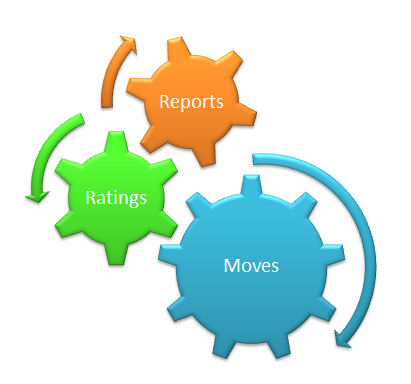
Pretend you are an astronaut looking down on earth. Now pretend you are consultant looking at an organization from a distance. This organization has a moves management system humming along. You notice there are three gears in motion producing consistent relationships with prospects capable of making a major gift. These gears are:

Ratings – Each prospect is rated so you can stay focused on those who can help you reach your dollar goal.

Moves – Actions with prospects are deliberate and planned (and tracked in the database).

Reports – Regular printed reports are reviewed and regular meetings are held to build internal skills and keep all the moving parts in balance

Can you do moves management without a database? Of course you can! You could keep track of your gifts in Excel too, but it is rarely the best solution.

Mastering moves management requires learning the balance for your organization between the three moving gears:

  • How many ratings do you need to stay on path with the most capable prospects?
  • How will you plan for moves, make your moves, and record your moves?
  • What measurements should you report on to keep you accountable?
  • How often should you meet and who should meet to keep your major gifts program growing?

Everything in our world is in constant flux. Moves management requires re-balancing as your major gifts program grows and changes. If you keep the emphasis on the moves – on the in-person interactions with your donor prospects – everything else will find its place.

Have you mastered your moves?

3 Actions That Demonstrate Your High Prospect Research IQ

As a fundraiser, you may not need to know how every tool works, but you need to know enough to choose the tool with the right fit. How high is your prospect research IQ? Do you demonstrate the following three actions?

1) Knowing that an electronic wealth screening is not the same thing as having a prospect researcher profile your donor prospect.

When discussing best practices around prospect screenings and wealth screenings, the conversation always seems to start with “it depends”, and rightly so. But I state with conviction that an electronic screening is not and should never be confused with the work of a live, well-trained human being.

I don’t care how awesome their match method is or how many sources and formulas are used, an electronic screening is meant to prioritize a large group of records. A human being, a prospect researcher, is meant to qualify individual names and add a dose of reality to the data. A prospect researcher knows that Bugs Bunny, a seasoned executive with grown children, is not the same Bugs Bunny who graduated from Stanford in 2009.

Are you prioritizing a large list? Electronic screening. Are you working on a solicitation strategy? Donor prospect profile.

2) Recognizing that an investment in prospect research is well worth it – when you act upon the information.

I don’t want to tell you how many times I have provided profiles, rated a database, or otherwise identified and researched donor prospects only to learn that the information then sat dormant for months, even years. Why does this happen? I work mostly with small and medium organizations. Among them, the two most common reasons are (1) no performance goal tied to implementing the results, and (2) development staff underestimated the time they would need to spend acting – actually cultivating and soliciting donors.

We are as human as our donors.

If our donors give best under a sense of urgency, we also do our best cultivating and soliciting under a sense of urgency. Whether it is a campaign goal deadline or a target ask date, creating some kind of urgency will help you achieve more. Major gifts can provide a high rate of return on the prospect research investment, but it requires a serious dedication of time and resources.

Urgency will cause stress without success if there are not enough hours in the day to complete your tasks. If you are a busy fundraising professional already working a full day, you may need to consider either eliminating or deferring some of your current tasks, assigning them to another staff member, or hiring additional staff. Be practical about planning the time in your day before spending money on prospect research.

3) Raising major gifts by following through on prospect/moves management.

A prospect management system is like an exercise plan. If you keep neglecting your workouts, every time you exercise it will be difficult and you will feel tired. But if you follow the program, you will feel good and have more energy.

If you prioritize your prospects, take the actions necessary to deeply engage your prospect, and track and report your progress, you will be working the plan and will raise more and higher gifts. The level of excitement and interest you can generate in your donors (and yourself) through a disciplined prospect management system is amazing!

Other Blog Posts that Might Interest You

3 Steps to Major Gift Mojo!

5 Ways You Know You Need A Research Consultant

The Dangers of (Not) Managing Prospect Research

Defining an Action in Moves Management

Identification to Discovery Visit: 5 Fun Questions to Ask

Once you have identified your donor prospect, the next step is usually to make a discovery visit. Sometimes this happens over the telephone, but ideally it will be a visit at the person’s choice of location. The goal is to meet her where she feels most comfortable and qualify her as a major gift prospect.

Most often we aim to determine or confirm the following:

*Affinity, or how close she feels to our organization
*Inclination, or how philanthropic she is to us and others
*Capacity, or whether she has the ability to make a major gift

Confirming Affinity and Inclination

No matter how much or how little time you have in your first visit, do NOT walk away without finding out about the individual’s giving, passion, and movement to the next step:

1. Why does the prospect give to our organization?

You can begin your conversation with a “thank you” for past giving and a natural curiosity for how the prospect first discovered and began giving to your organization. If there is no giving to your organization, or even if there is, consider asking if she is involved with any other organizations.

2. How does the prospect feel about the relationship?

Next, you can guide the conversation naturally to ensuring that the prospect likes the mailings and other information received or if you need to make adjustments. Maybe you need to add or change the type of mailing to cater to the prospect’s specific interest.

3. Would the prospect like a tour, visit a program, etc.?

Now that you are talking about what the prospect likes about your organization, you can make an appropriate suggestion about a tour, talking with a program director, or some other activity that would interest her.

Confirming Capacity

To confirm or verify a prospect’s capacity to make a gift, guide conversation toward the primary source of wealth:

4. What a wonderful award this is! It looks like your business has been doing well…

You do not have to have constant eye contact with your prospect. Take a look around you and ask normal, curious and fun questions about what you see on the walls or on the shelves.

5. I’d love to learn a little more about your business. How many employees do you have here?

Don’t be afraid to change the conversation. Keep track of time and be sure to bring the conversation around to answer your questions before the visit is over!

Discovery visits take practice.

If you find yourself back in the office wondering how you spent an hour talking and still don’t know anything new about your prospect, forgive yourself and replay the visit in your head or talk it over with a colleague until you recognize where you could have done things differently. Then schedule another visit.

Once you become adept at your discovery visits, you will find that you are able to shorten the time between identification and actually asking for the gift. Discovering a prospect’s true interest in your organization prepares you to deepen that interest into passion. And once you have passion, in-depth research on your prospect prepares you to ask for the right amount.

Best wishes to you on your next discovery visit!

Click here to register for the 6/14/2012 webinar: Savvy Conversational Research Techniques for Fundraisers

Other blog posts that might interest you:

3 Steps to Major Gift Mojo!

Will Your Donors Talk to You?

How to get from $250k to $40m

How safe are you at your donor prospect meetings?

Everyone loves online research, right? You can find out so much about a person online! But is all that information helping you in your donor prospect meetings?

Whether you are a frontline fundraiser prepping for your next meeting or a prospect researcher preparing a donor prospect profile, you need a plan *before* you start looking for information.

Ask yourself these questions:

*  Where is this prospect in the gift cycle? How close is she to making a gift?
*  Do I know what her passions are?
*  What is my best guess on likely capacity given what I know right now?
*  Do I know how she is connected to our organization?

Once you have answered these questions you are ready to do some research! Or are you? At this point you should know what you want to accomplish during your next contact with the donor prospect. Do you? I encourage you to be very specific about it. Here are some examples of specific goals:

At the next visit I want to…

  • Discover whether the prospect has an interest in our organization and is otherwise a good major gift candidate.
  • Confirm the information we know and solidify the next step.
  • Deepen the prospect’s engagement with a special invitation that matches her interest.
  • Ask her for a transformational gift!

If you are a prospect researcher you will want to have a conversation with the frontline fundraiser that exposes the motive for the visit and the research request. You can try to get the person to be specific by repeating what she says to you. For example, you might say things like:

  • Oh, so you are trying to find out what the prospect is passionate about so you can figure out which program to talk about?
  • Aha, her secretary is blocking your calls and you need to find another way to connect with the prospect. I can help with that.

Now you really are ready to do some research! But you are still in danger of being ill-prepared for your donor prospect meeting. How is that? Because online research is like visiting the witch’s house that Hansel and Gretel happened upon in the woods. Everything is so yummy you might crawl right into the oven without even thinking about it. You might follow so many different trails of fascinating information that you sit down with your donor prospect and lack the vital information you need. Yikes!

Maybe you have been diligent and answered the questions mentioned above. You also know specifically what you are trying to accomplish at the next visit. Here are three research pitfalls to avoid as you embark on your online research journey:

(1)  Not documenting the information you collect. If you don’t have a template or a spot in the database for the things you learn, you assume the risk of selective memory. As humans we remember what we hoped to learn instead of what we really found out. And worse, we completely forget everything the next time round.

(2)  Spending too much time on the wrong things. Let’s face it. Our prospects are fascinating people. But we need to find specific answers and then move on. Once again, templates help to keep us focused. Your job is either to get away from your desk and raise money or help your frontline fundraiser get away from her desk and raise money. Period.

(3)  Not answering important questions thoroughly. Once you have collected your information and feel you are finished and ready for the visit, take a few minutes to imagine yourself at the visit. This goes for prospect researchers too. Pretend you will be on that visit. Now look at the information you collected again. What is missing? Are you wondering if she still sits on that board? Go back and answer the (now) obvious questions.

Online research is a powerful tool. As we apply our research prowess to fundraising we need to keep a razor-sharp focus on our donor prospects. We are not playing Jeopardy, we are playing Family Feud and it is up to your development shop to work as a team to effectively and efficiently answer the fundraising questions that will lead to more and larger gifts.

Other blog posts that may interest you:

The Dangers of (Not) Managing Prospect Research

I met a guy who was previously a Vice President of Development at a decent-sized higher education institution. When he found out I was a prospect researcher he admitted that he never really did know what those prospect researchers did in his office. He was in charge, and he didn’t want to fire them, but there was a perception of zero value to him.

Since then I have met accomplished consultants and other nice fundraisers who are completely ignorant of what prospect research does – even though it is a critical piece of their success. Pretty wild, huh?

That’s like suggesting you know you need your cell phone, but you’re not sure why. You don’t have to know how to use every bell and whistle on the new phones, but you would be seriously limited if you didn’t have a cell phone at all. Why? Because you make phone calls with it!! Prospect research helps you focus on your best donor prospects. That’s pretty important!

I’m not exactly sure why the words “prospect research” make so many fundraising folks uncomfortable, but I’d like to do what I can to change that. As I was sitting at a conference contemplating this surprisingly common resistance to prospect research, I thought I might break it down with journalist questions. Here’s what I came up with:

Who? Identifying. Prospect research identifies which donors to spend time with. You wouldn’t start with “A” and go to “Z” for 10,000+ records, would you? (not even for 1,000 records!)
What? Tracking. Prospect research creates tracking systems to ensure you know what actions you must accomplish to keep your prospects cultivated and eventually solicited. Can you keep up with 100+ prospects in your head? I think not.
Where? Reporting. Prospect research helps you keep track of where you are in reaching your goals. Reporting on things like the number of proposals likely to close before fiscal year-end is critical for planning!
When? Strategy. Want to know when you should send out those appeal letters? Want to know if you have capacity in your donor pool for a campaign goal? Prospect research informs strategies with your own donor data.
Why? Money. To raise more money for your mission! Prospect research answers the strategic fundraising questions that lead to wildly successful fundraising programs. Period.

So the next time you or I run into someone who claims ignorance of prospect research, we can say to them: “It’s so easy! Prospect research helps you focus on your best donor prospects.” And then when we get back to our offices and send the “nice to meet you” networking email, we can direct them to this blog post, which (I hope) quickly and easily explains the value prospect research has in any serious fundraising endeavor.

Whatcha think about that?

Are You Making These 5 Donor Research Mistakes?

Whether you are a prospect researcher or a front-line fundraiser, you need to find accurate and relevant information about your donor prospects. As an individual living in the information-age, you need to avoid data pitfalls. How well are you doing this? Check out these five donor profiling mistakes to find out.

1.  Misleading Estimates
We often use estimates when reporting on our prospect’s assets. Zillow.com gives us a Z-estimate on the value of residential real estate. Dun & Bradstreet gives us an estimate of private company earnings. The Forbes’ Rich Lists provide estimates of net worth. Don’t make the mistake of presenting these figures as true or exact. Be sure to round your numbers. For example, use $433,000 instead of $432,951. Exact numbers often mislead people to believe they are true, even when you state them as estimates. And Forbes cannot know Bill Gates’ true net worth (net worth = all assets minus all liabilities) unless Bill personally discloses that information.

2. Portraying a Secondary Source as Primary
A primary source is the original producer of the information, like the tax-assessor’s office for real estate ownership or the university that bestowed a degree. A secondary source is someone else who tells you about the information, like an online website reporting on real estate sales or an online data aggregator listing an honorary degree for your prospect. As you might imagine, newspapers and magazines are usually secondary sources as well. Be suspicious of secondary sources. When you record the information, especially if you only found it in one place, cite the source so everyone knows it is not primary. For example, you might lead the sentence with the following: In 2004 The New York Times reported that Pauline Prospect…

3.  Not Checking Self-Reported Information
Who’s Who has been a fabulous source of information for decades, and it is all self-reported information not verified by an independent source. With the popularity of social media and the ease of online publication, our prospects often create a lot of public information about themselves. Be careful to disclose the source of your information if you cannot verify the information elsewhere. Use an asterisk (*) or quote within the text to alert the reader the information is not confirmed. For example, sometimes the data is just too dated to be confirmed online. You might provide a footnote like this one: *These volunteer leadership positions were provided in various biographies, but were not otherwise able to be confirmed.

4.  Overlooking the Deep Web
The majority of the public uses search engines to find information online, but sometimes we need to visit a specific website to access the information in the “deep web”. For example, if you want to check that your airplane flight is on time and that you are still on it, you must visit the airline website and search its database. You cannot search on Google to find this information. As prospect researchers, we need to know when to visit a website directly, especially to find primary or original sources of information. Examples include political contributions, real estate data, incorporation records, and public company filings. Start collecting key links and link lists.

5.  Omitting Dates
We scan through hundreds of data sources to extract relevant information about our donor prospects. It can be easy to forget to check the date of the source. Keeping track of the chronology of the data you are collecting is critical to providing an accurate picture. For example, you might come across information confirming your prospect’s occupation only to discover the source is dated five years ago. It can also be critical to know that the multi-million dollar named endowment was only last year.

Online search sources and methods change swiftly. Stay curious and keep reading!

Some other post you might find helpful:

How to Find Giving History
Can You Really Trust Prospect Research?
What I Like About Google