Category Archives: Major Gift Teams

The A.I. Tug of War in Fundraising—And How to Find Your Footing

Let me ask you something: How many times has a piece of technology promised to change everything… and then promptly driven you absolutely crazy?

You know the scenarios. It can do all the things, but only after you’ve configured everything yourself. “Integration” turned out to mean something very different from what you imagined. The upgrade wiped out every custom setting you spent hours building. And whenever you try to do something just slightly outside the norm, the software fights you like a toddler at bedtime.

I could go on. We have all been there.

And yet—here’s the tension—technology genuinely has made our lives easier. Microsoft Word may not make complex formatting a walk in the park, but it has transformed how we create documents. And because it plays nicely with the rest of the MS Office suite, whole categories of headaches have simply disappeared.

Welcome to the tug of war.

The Two Ends of the Rope

When it comes to A.I. in fundraising, this same push and pull is playing out in real time. On one end of the rope are the people who believe A.I. is too messy, too risky, and too unreliable to touch. On the other end are the people who believe A.I. has ushered in such a leap in accuracy that we can use machine-generated information as-is, no human review required.

New technologies that arrive with enormous hype—and A.I. certainly arrived with enormous hype—have a way of polarizing us. But is there something useful to be found in the middle of that rope?

Spoiler alert: There is.

Yes, A.I. Has Been Around. But This Feels Different.

A.I. has been woven into our digital experience for years. Recommendation engines. Spam filters. Autocomplete. But when OpenAI released ChatGPT in 2022, it felt less like a product launch and more like a digital eruption. Things are moving fast. New and genuinely exciting capabilities are emerging. And yes, things are getting broken along the way.

For many in our field, the speed of that change feels dangerous. Whatever you do, don’t ask A.I.

But much like the anxiety that greeted Google’s debut—remember when people worried that nobody would learn anything anymore?—there is real and practical value here, if you know how to use it.

One of the most useful features of a generative A.I. chatbot is that you can ask it to show its work. Where did that information come from? What sources support that conclusion? What transactions were used to build that summary? That transparency is actually a significant feature, not a quirk.

Where A.I. Is Changing the Game for Prospect Research

At Aspire Research Group, one of the most dramatic shifts A.I. has made in our day-to-day work is in writing bios. Even setting aside the time required to gather information, writing a few well-crafted paragraphs about a prospect has always been time-intensive. Using DonorAtlas, we now have well-written bios and the underlying sources for verification—almost instantly. We can deliver a significantly stronger product at the low end, in far less time.

Until, of course, A.I. fails us. And it does fail us.

People in the arts, for example, seem to get misrepresented by A.I. with striking frequency. What is their “job,” exactly? They don’t fit the pattern that it expects. In those cases, we take over the steering wheel and drive that one ourselves.

This is not a reason to abandon A.I. It’s a reason to understand it.

Algorithms Are Only as Good as the Data Behind Them

Remember when Netflix’s recommendations felt almost eerily accurate—until they didn’t? If you shared an account with someone whose taste was wildly different from yours, the algorithm got confused. It was doing its best with messy inputs.

The same principle applies to your fundraising database. If your data is a hot mess, A.I. is going to struggle to give you reliable scores or meaningful analysis. But here’s the thing: it might still give you better results than statistical modeling did. And if better-than-before scores get gift officers out the door and into conversations with donors faster, that’s not nothing. Something is better than nothing.

But that raises the next question—and it’s an important one.

If A.I. Is Better Than What Came Before, Why Not Just Trust It?

If A.I. analysis outperforms statistical modeling, why shouldn’t we lean on it entirely? Why not let it drive portfolio assignments, staffing decisions, campaign planning?

I recently interviewed Vered Siegel on the Prospect Research #ChatBytes podcast, and she said something that I keep coming back to:

“One of the biggest shifts generative AI has introduced in our industry is that information is no longer the scarce resource. Judgment is now the scarce resource. We can generate lists and summaries and signals faster than ever, but that doesn’t automatically make our decisions better. One key aspect of being a strategic partner right now means helping the room slow down just enough to ask the right questions.”

Read that again. Judgment is now the scarce resource.

Finding the Balance

The key to leveraging A.I. well is knowing where human judgment needs to enter the picture—and deciding what level of risk is acceptable for you and your organization.

I’m not suggesting that every single name assigned to a portfolio requires a human review. Not anymore. But what if a feedback loop was built into the prospect assignment process? What if gift officers had a routine way to tell your analytics team when things are working—and when they’re not. That loop is human judgment at scale.

Here’s what breaks down when human judgment is undervalued or eliminated altogether: efficiencies go down. Not up. The risk of an error that could damage donor trust or cause your organization harm goes up. The promise of A.I. is efficiency, but that promise only delivers when the humans in the process are engaged at the right moments.

Get the balance right, and productivity goes up. New opportunities surface. Gift officers work with better information. Researchers spend their energy where it actually matters.

Get it wrong—either by refusing to use A.I. at all or by outsourcing your judgment to it entirely—and you’re just holding a rope with nobody on your end.

This Is Your Moment to Lead

Here’s what I want you to take away from all of this: the disruption that A.I. is causing in our field is real. But it’s also creating space for researchers and prospect management professionals to step into a more strategic role.

A.I. can generate the bio. It can surface the signal. It can produce the list. But it cannot decide which signals matter for your organization’s specific mission and relationships. It cannot make the judgment call about when a score doesn’t pass the smell test. It cannot be the strategic partner in the room who helps leadership slow down and ask the right questions.

Only you can do that.

The question—as always—is whether you’re ready to step up and do it.

Additional Resources

picture of Jen Filla and Aspire Research Group logo

The Magic Rainbow of Prospect Identification

Major gift prospect identification is often the overlooked “middle child” of the prospect research family. Somehow it lacks the glamor and clamor of prospect management and prospect profiles. It doesn’t possess the tech geek clout of data science, either. It’s somewhere in the middle – critically valuable and perhaps the true “artist” of the prospect research field.

Identifying major gift prospects is a remarkable talent, as it blends all the skills of other research tasks and tools and creatively applies them to find good prospects.

Our story begins with the fundamentals of a good major gift prospect.

A good prospect will have a combination of (1) affinity or love for the organization, (2) capacity to make a major gift, and (3) philanthropic inclination to make a gift.

The debut of wealth screenings in the late 1990s and refinement through the early 2000s suddenly made this balanced triangle of criteria a relatively simple matter of matching algorithms, expressed into Excel spreadsheets, and segmented through sorts and filters. The resulting, suitably-sized top segment can then be served up to be validated by manual research.

When the fundamental triangle of criteria are in the donor database as fields, the identification project can grow rapidly! Well, this depends upon how much other information is found inside your donor database. It could be paired with volunteering, occupation, interest codes, degree earned – the possibilities limited only by the data collected by your organization.

When the 2000s ushered in statistical data modeling on a robust database of donor information, it almost felt like an explosion of quality major gift prospect identification hit the nonprofit sector.

But did it?

Statistical modeling – and now A.I. – attracts a LOT of attention, but what about the many thousands of nonprofits that don’t have a lot of data beyond giving history? The ability of A.I. to employ big data to improve its algorithms holds promise, but could it also be a distraction from applying a clever human mind to major gift prospecting?

Sometimes the most expensive scores you can purchase feel as helpful as telling a store owner that the data show that when her parking lot is full, she sells the most product. What that store owner really needs to know is how to fill the parking lot!

And all those splendid software solutions are limited.

The pursuit of profits demands that software tools be developed that will be desirable to the largest customer base possible. But when it comes to major gift prospect identification, the local animal shelter is quite different from a national nonprofit news outlet focused on climate change, which is quite different from a regional healthcare system.

So, what does the clever prospector do?

Use everything to create the magic rainbow of prospecting!

Whether you want to find prospects for lead gifts to the largest campaign to hit your region or fund your current fiscal year budget, if you keep an open mind and creatively employ all of your research skills and tools you can find the prospects you need.

Beyond the typical wealth screening or scoring, you might do things such as:

  • Routinely read the best media – blog, podcast, news, journals – that is specific to your organization, cause, or project. Because inevitably you will start to find the people, companies, and foundations highlighted in those outlets that could be potential prospects.
  • There are so many digital tools that provide alerts based on a variety of options, such as name, keywords, and more. Creating a fast and efficient routine to evaluate and act on this information yields results over the long term – and sometimes the short term too.
  • Relationship mapping can take many forms. You can ask people directly to introduce you to their social networks. You can build lists from tools, which can include paid subscriptions, LinkedIn, your own donor database, and others.
  • Generating “wish lists” of the top donors to causes like yours or in geographic areas where you want to grow provides the opportunity to submit the names to key players at your organization for connection pathways, and also keeps the names in the front of people’s minds so they recognize connections when they come to light.

Any of these kinds of scenarios (and so many more) means subscribing to newsletters and other content and then when you find a name or list of names, then using internet search, research tools, and generally all the “things” to confirm wealth, find community involvement, motivations and interest, and connections to your organization.

The more you do prospecting, the more you learn.

You learn things such as…

  • The “tells” your best prospects have that identify them, such as various patterns of giving to others, belonging to a particular group, or living in a specific neighborhood.
  • All the key data points that quickly disqualify someone as a good major gift prospect for your organization.
  • All the places your best prospects congregate in the wild, such as clubs, associations, organizations, companies, and more.
  • Reasons why gift officers won’t contact prospects, such as not having information to build rapport in early outreach, no contact information, needing a connector to introduce them, and others. Now you can adjust your research to find this information.
  • Reasons why gift officers will contact prospects, such as belonging to the same organization but a different chapter, both owning the same breed of dog, alumni from the same school, or being an athlete in the same sport. Now you can recognize this information and include it when you find it.

Some researchers are disheartened by what can feel like endless hours spent searching for what feels like so few good prospects, but the more practice you get, the more those few good prospects start looking and behaving like magic beans, growing into massive bean stalks, that ultimately lead to the golden goose!

Okay, maybe that’s a bit of a stretch, but it underscores the distinctive talent of great prospect identification. It is a creative effort that is honed with practice and skill. It is much like the artist that spends 10,000 and more hours practicing, learning, producing, and promoting …to become the next Frida Kahlo.

Because some of your organization’s wealthiest and most likely major gift prospects will not show up in your wealth screenings for a variety of reasons, including:

  • Their record might have bad or outdated data in your database.
  • They are not listed on any of the “top” wealth lists because their wealth is private.
  • Although wealthy, they live modestly and don’t own or spend lavishly.

But they might be found:

  • Lurking in a Wikipedia page of your most successful alumni.
  • On the front-page in the “Rural Times” featuring the modest company owner who is the region’s biggest employer and whose child attended your special camp in the city.
  • In LinkedIn with their occupation as CEO and founder of a company with hundreds of employees.

The next time you are working on finding new major gift donors, remember that you are painting a magic rainbow of prospecting, which like all artistry takes time and practice to become magical.

P.S. For the researchers reading this, you might find that some of your most successful major gift officers outperform you on identifying wealthy prospects. Don’t take it personally – take notes!

How connected is your major gifts team to its donors – really?

Do you really know how well your major gifts teams is performing? Maybe they are raising millions of dollars every year and hitting the targets set for them — but are those the right targets? Evaluating donor engagement could help you answer those questions.

If you are one of those organizations that fundraises your budget every year and has grown to command a major gifts team, you have my deepest admiration! Scaling a nonprofit organization is not an easy task. Neither is growing and scaling a major gifts team.

At Aspire, we work with fundraising leaders who are tasked with taking their major gifts team up to the next level of performance. It can be surprisingly difficult for even an experienced major gifts officer, trained at a larger institution, to make headway with a legacy major gifts team.

Donor Engagement as a Framework

Having major gift officers assign their prospects a donor engagement level is one way to find out what’s happening on your team and in their portfolios.

It has been a common practice to focus on portfolios through the lens of the gift cycle — identification, qualification, cultivation, solicitation, and stewardship. And this works very well for gift proposals, but human relationships don’t fit very well into those process-oriented terms. Donor engagement is different.

Many major gift officers intuitively view their portfolio through the lens of donor engagement – discovery, early cultivation, and deep cultivation.

It also fits the rule of three, which means when major gift officers show up to work, they only have to remember three categories of donors in their portfolios. This can help them manage their time and prioritize the right people.

Honest Discussion Leads to Real Change

When you ask each major gift officer to assign a donor engagement level to every person in their portfolio, surprising conversations may arise and lead you to what’s really happening.

For example, you might learn that someone on your team is struggling to find contact information, leaving them with only snail mail letters to communicate. You may also discover that some team members don’t know how to build a deep relationship with a major donor, which is why they have stagnant, lower gift sizes.

To create fertile ground for these kinds of discussions, it’s important to clearly define the donor engagement levels. It’s also important for each major gift solicitation to be recorded and tracked as a proposal or gift opportunity on the donor record.

Major gift officers also need routine portfolio reviews. This is time-consuming, but it’s where all the stories start pouring out. And when you combine portfolio reviews with monthly team meetings, now you have a platform for coaching and developing process and policies.

Which Comes First – The Process or the Outcomes?

If you are like most fundraising leadership, you need more dollars raised and now. Using donor engagement as a framework isn’t for every organization, but it can help you assess the reality of your team’s performance while you are working to identify and assign new prospects.

And there is an added bonus with this framework. It is within the full and complete control of each major gift officer to categorize their relationships with the donors in their portfolios – as it should be. When major gift officers have ratings of all sorts assigned to their donors it can feel like their relationships and the information they have gathered are ignored.

With a donor engagement framework, it’s about the relationship first, ratings second.

I want to be a major gift officer! Say very few researchers ever. But should they?

What would happen if researchers adopted the technique of method acting for one week out of every year? What if the researcher “became” a major gift fundraiser? Could this be the kind of training that could differentiate between superstar researchers and all the rest?

Are you familiar with method acting? It’s where the actor stays in the role of the character, even off camera. Jack Nicholson — he starred as Jack Torrance in the Shining, Col. Jessup in A Few Good Men, and too many more to list — was reported to have modestly said, “There’s probably no one who understands method acting better academically than I do, or actually uses it more in his work.”

And I have heard of organizations where the researcher tags along for some donor visits or makes thank you calls to donors. As part of the development department, it’s not unheard of for a researcher to help staff major donor events. I have. All of these interactions shift the researcher out of his or her research mindset and into a donor-facing mindset.

Because whatever research you’re doing – profiles, data mining, prospect lists, verifying a screening – could benefit from one last review by you, but in the mindset or role of major gift officer. When I say “one last review” I mean that there needs to be distance of some kind between performing the work and reviewing the work.

Just as writers will put down their work for a few days or a few weeks, picking it up again with “fresh eyes,” so researchers can put down their work and pick it up again with “major gift officer eyes.”

Reviewing Research through “Major Gift Officer Eyes”

Anyone who routinely reviews donor prospects with talented major gift officers can’t help but to start thinking like one. Imagine that you both have the profiles up on your computers and the major gift officer starts commenting and asking questions in each of the five building blocks of the profile, like this:

  1. Institutional Information: Is this the same couple that met while on one of our sponsored donor trips? (Yes, it was, and by golly that level of high affinity changes everything about approaching them for a campaign gift!)
  2. Biographical Information: I clicked through to her Twitter account and did you see that in her profile line she describes herself as a “disability advocate, wife, and mother?” I wonder if they have a disabled child! (Obviously, you didn’t read it because you put “none found” under children and didn’t find any connection to your cause beyond her first gift to your organization.)
  3. Community Involvement: They gave a million dollars to Sunshine Charity? Really? I wonder what that was about. They’ve only ever given us $1,000 and everything else found shows giving under $5,000. (After tracking down the annual report it turns out it was a typo from the vendor and you need to re-examine the screening capacity rating.)
  4. Occupation: His wife is Janita Billingswart? Do you think she’s the celebrity attorney? A name like that, surely… (But you didn’t search her name because the deep relationship has been with the spouse and you were in a hurry.)
  5. Wealth and Assets: Can you tell me more about the family limited partnership you mention here? Doesn’t that mean they have a lot of money? (You check it out when you’re off the call and realize it does indicate significant wealth and now you notice it was formed the same year that they sold their first company.)

You might not be able to practice method acting and live the life of your major gift officers to understand them, but you can live their work life vicariously by engaging in frequent conversations about their prospects. It takes dedicated effort, but so does method acting. And you will learn LOADS about doing research better.

Getting Good Without Shock Therapy

It was rumored that Jack Nicholson underwent shock therapy in preparation for his role in One Flew Over the Cuckoo’s Nest. I don’t recommend diving deep into every single research project or you might just go crazy!

Here’s how I described to a client, and an amazing major gift fundraiser, what he could expect from our profiles so he could know when to question us about the work and when he should run off on his own with his questions:

  • Our Snap Bios are a quick look, a snapshot, and it is unlikely that we would jump out of our usual process to follow a lead or ask a deeper question about the prospects.
  • Our Tactical Briefings are confirming philanthropy and wealth and while we are spending more time and digging deeper, we’re unlikely to wander off following a hunch unless there is an anomaly — unless something looks strange or we want to be sure we are accurate.
  • Our Strategic Assessments are the deep dive, following all those questions, untangling ambiguity, and laboriously seeking information not directly related to the prospect, but directly related to the prospect’s philanthropic or wealth story.

Of course, the fewer hours it takes us, the lower the cost, but the less information, too. Sometimes we do get dazzled by a prospect, spend more time, and the inspiration unlocks key information. We love our work and that’s inevitable!

Anything You Do, You Could Do Better

The prospect research field is full of people who are fulfilled in their work because it demands constant learning across, well, everything! We can have confidence in knowing that we don’t know a lot, and this opens us up to learn from everyone, everywhere.

So, even though the examples I’ve given in this article relate to prospect profiles, you could do better in every aspect of your work. Maybe your major gift officer loves Excel and enjoys filtering and sorting a long list of potential prospects for an upcoming trip, but is that the best way to provide the information? Could the process be improved?

If you don’t look at your work product through “major gift officer eyes” you may never know. I’m curious. Aren’t you?

Do you “get it” when it comes to wealth? Probably not.

Let’s test your wealth instinct and find out if you “get it” or not.

Pretend that your boss comes to you and says: As you know, leadership is taking the company public next year. You can choose how you want to receive your $100,000 annual compensation from the three options below:

  1. $25,000 in cash and $75,000 worth of the company’s new stock
  2. $75,000 in cash and $25,000 worth of the company’s new stock
  3. $80,000 in cash and $0 worth of the company’s new stock

Which one do you choose?

This choice is difficult for you and me!

If the only wealth you have is cash in your bank accounts, maybe some retirement funds like a 401(k), and you are renting or own the home you live in (probably with a mortgage), your options are very limited. Could you survive on $25,000 cash for a year? You are considering the options based on your disposable income.

If you have a dual-income household, a second home, or some reasonably liquid investments that you could cash-in, all three choices might become plausible options. You have disposable income plus additional investment wealth.

I know you know that the $75,000 worth of stock could take off and double or triple in value-or even more. You want that stock!

Now, what if suddenly your parents passed away and you inherited the house they owned for 50 years, which sells for $800,000. Would that make it easier to accept $25,000 in cash with $75,000 in stock?

Of course it would!

And this is the shift in thinking that you need to make when you are researching and cultivating major gift prospects.

You do not want a cash gift.

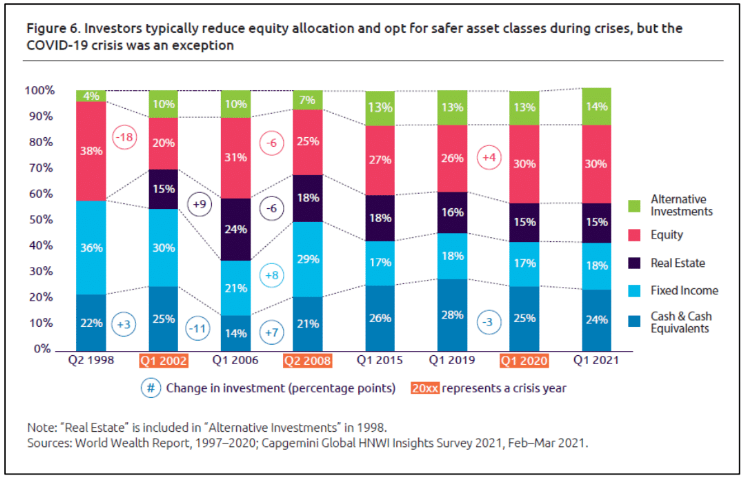
Check out the asset allocation chart below. This chart is telling you many things, but among them is that in the first quarter of 2021, the high-net-worth individuals (HNWIs) surveyed were holding 24% of all of their wealth in cash and cash equivalents. A cash equivalent is something like a certificate of deposit (CD) or money market account–things that you can very easily turn into cash.

When you ask your donor prospect for a gift, do you want her to think:

“Gosh, they want me to give $50,000 out of my $250,000 cash. That feels a bit steep. The kids private school tuition went up a lot this year.”

Or would you rather ask for a gift of appreciated stock and have her think:

“If I give $50,000 of appreciated stock out of my $750,000 investment account, I can take a charitable gift tax deduction for the full amount and offset the capital gains taxes. I’ve always wanted to have this kind of impact on this cause.”

But you shouldn’t just believe me.

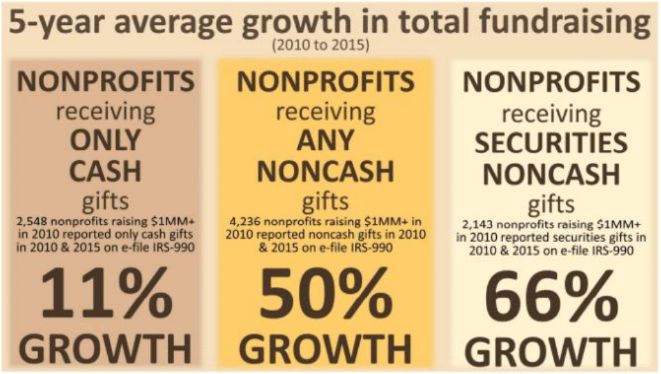
What do I know? Instead, you should believe Dr. Russell James who took the time to review a million nonprofit tax returns filed between 2010 and 2015. Numbers don’t lie. Dr. James discovered that nonprofits that received asset gifts raised more money. Check out the figure below for a snapshot of his findings.

Source: Cash is Not King in Fundraising: Results from 1 Million Nonprofit Tax Returns, Professor Russell James III, J.D., Ph.D., CFP®

Note: If you want to find whether your organization has a history of accepting asset gifts, you can check Schedule Min its public IRS Form 990.

Evaluating your donor prospects for wealth

If you want to grow your fundraising in major gifts, a key strategy is to ask for non-cash gifts. Understanding the asset allocation model from Capgemini featured above allows us to quantify this shift in thinking. We can now estimate the relative size of the cash vs. non-cash wealth held by our donor prospect.

Once you have estimated the value of the cash and non-cash wealth of your prospect, you can better understand how your prospect might view your ask amount relative to those values.

Below is an example of what this allocation looks like if we use the Capgemini asset allocation percentages on someone research has determined has an estimated net worth of $5 million.

Assets Value
Cash and Cash Equivalents $850,000
Non-Cash $4,150,000
Total $5,000,000

Imagine for a moment that you want to ask the prospect for $250,000. How does that stack up against each of the two categories, cash or non-cash?

Lean-in to the psychology of giving

Why would you want to fight against human nature and continue asking very wealthy donors for cash gifts when you could switch to asking for non-cash and raise more money overall? Lots of reasons. Maybe you feel much more comfortable asking for cash gifts.

I’m suggesting that it’s time to get comfortable with being uncomfortable.

To help you get more comfortable, check out this collection of work by Dr. James for more insights into the psychology of giving and techniques and tactics you can use in your work:

http://www.protopage.com/prospectresearch#Planned_Giving_(Dr._James)

The Path(s) to Major Gift Fundraising

The Path(s) to Major Gift FundraisingI will admit to being fascinated by, if not obsessed with, the path that leads to a major gift program for smaller nonprofits. What I hear and read about the most are large nonprofits, most of which are in higher education.

This frustrates me. It’s akin to walking into retail stores only to find nearly everything is focused on the top 1% ultra-high-net-worth individual. What about the rest of us 99%?

With the cost of research tools going down and their quality and usefulness going up, the world of major gifts is beginning to tempt the masses of nonprofits serving our communities. Whether it’s a wealth screening, look-up tool, or a database with CRM capabilities and built-in ratings, the small nonprofit can see those major gifts on the horizon.

But what is the path between starting and arriving in a major gift program?

Assuredly there is no single path to a major gift program, but research can provide illumination along the way. Over the past couple of years my consulting practice has become more focused on helping the smaller nonprofit – inside AND outside of a campaign.

The first step to major gifts is having a development officer who embodies relationship fundraising and has experience asking and receiving large gifts. Previous experience where there was access to and good use of research means things will move along much faster.

Start with the Data

The foundation of a sustainable major gift effort, whether that is larger annual solicitations or multi-year leadership gift opportunities, is good data practices. It really doesn’t matter how big or how small the development shop, without good data practices there is no sustainable progress.

Sometimes organizations are ambitious and reach out to hire a prospect research professional hoping that by using research early they will get a head start. But once hired they discover that the researcher must spend the first year or so doing nothing but getting the data practices in order. This can be very frustrating for both parties!

A well-run development office demands good data. Gifts are properly recorded, acknowledged, and thanked. Direct appeals are regularly mailed and emailed. Sponsors and guests are invited to a signature event. Grants are tracked and program results reported. Volunteers are tracked and supported.

Leverage the Data

Once you have good data practices, you can avail yourself of affordable research technologies such as wealth screenings. For quite a while now I’ve been helping nonprofits with wealth screenings in two primary ways:

  1. Screening the active donor base to assess fundraising potential for goal-setting and to prioritize the best prospects.

Many times I get called on by a fundraiser who has taken on a new development officer position. She wants to really organize and grow the nonprofit’s fundraising and puts a high priority on relationship-building with the best donors and prospects.

But working through the screening process is a big distraction. I help her get the screening results and understand the picture painted by those results. We walk through what kind of fundraising potential is there and how she can most effectively apply the results to her existing fundraising program.

  1. Screening all or a portion of the database and verifying the top-rated to identify major gift prospects.

Outside of a campaign, most often I do screenings and verification for newly hired fundraisers who are dedicated full or part-time to raising major gifts. The record count is manageable and I deliver new names monthly while reviewing past outreach.

With a skilled relationship-based fundraiser, this kind of project yields exciting results! Donor connections are made on many levels with leadership, board members, and staff. It’s an intense period of time, but once the list has been worked through I’m usually finished. Strong fundraising results mean staff is often added to assume some research duties.

Create New Procedures

With good data underpinning fundraising efforts, most organizations benefit next from slightly more formalized procedures. For most of the nonprofits I work with, even with some impressive total fundraised dollars each year, they are operating with skeleton staffing and very limited external resources.

Working with nonprofits to develop new procedures is one of my favorite activities. It’s a messy business as they try to figure out how to make things work best inside their organization and also with their constituents. I like to stick with them as they begin really calling on and building relationships with donors and prospects.

We work out what a good prospect looks like, talks like, is motivated by, and where a good prospect engages with the organization. Then I get to translate that into replicable procedures. I outline the way we used multiple data points to segment donors. I document how decisions were made about prospect assignments. And I offer advice and resources whenever appropriate.

Slowly a major gift program takes shape and begins performing.

Inform Cultivation and Solicitation Strategies

By far my favorite activity is researching prospects and having strategy conversations with the development officer. The bigger the gift opportunity and the deeper the research the more fun it is.

Doing this kind of work is like taking a tangled mess of jewelry and carefully and methodically unraveling it and polishing it until a glinting, sparkling necklace is revealed in all its glory!

This is the work and these are the conversations that can’t be completed by algorithm or otherwise mass produced. It’s wonderfully and deeply personal for the development officer, the organization, and most of all, for the donor prospect.

Sometimes the development officer might be intimidated by the prospect, and I can offer validation, encouragement, and confidence. Sometimes the development officer is optimistic and ambitious, and I can offer grounding and multiple scenarios – just in case the biggest number isn’t possible.

It All Starts with a Relationship

Prospect research has been a good career fit for me. There is a wide variety of tasks to perform and being methodical and analytical just makes me happy. But understanding the importance and practice of relationship-building has come more slowly to me.

After being a research consultant for over a decade, I incorporate the tenets of relationship-building into my research approach to the best of my abilities. I have also learned to recognize development professionals and organizations that value relationship-building and those that don’t. These days, I only work with the former.

There are many paths to a sustainable major gift program, but every one of them requires a skilled relationship-builder.

Additional Resources

What is a Major Gift? That is the Question

What is a Major Gift? That is the Question!If you ask a consultant the question “What is a Major Gift?” you will no doubt get the answer that “it depends.” Of course it does! But how does one figure it out? Surely we don’t guess what it is, do we? Lots of people consider $1,000 to be a threshold number. But what if a $100 gift would you give you goosebumps? Is that a major gift for your organization?

“What is a Major Gift?” is a major question worth some deliberation, but let’s set the stage for that discussion with a structure based in actual data upon which we can rely. In fact, you might consider that there is an Actual Major Gift amount and a Strategic Major Gift amount. Allow me to suggest…

Actual Major Gift vs. Strategic Major Gift

In order to have a meaningful conversation about the dollar amount that defines a major gift, we need to know what giving amounts actually happen at our organization.

Once we look at the actual giving data, we can move on to discussing how we might want to lower or raise the bar (we almost always raise the bar!) on that amount based upon our fundraising strategies and goals, to land on a Strategic Major Gift amount.

Actual Major Gift Data

There are so many fun ways to explore your giving data! And if I don’t mention your favorite, it would be nice if you would comment and share here.

Using your most recent one, two, or even three fiscal years of total annual giving by donor, following are a few ways to slice and dice the pie:

  • Calculate the mean, median, and mode. You remember those formulas, right? Excel even has a Data Analysis ToolPak anyone can install that calculates this automatically from your file.
  • Figure out the 80/20 Rule on your donor file. The Pareto Principle or 80/20 Rule suggests that 80% of your fundraised dollars comes from 20% of your donors. Using your list of donors with total annual giving for each, you can figure out the largest gift amounts that total 80% of all giving and then look at how many donors it took to reach that 80% of giving.
  • Subjectively evaluate the top gifts over the past three years. Are you noticing gaps in between the low and high or higher gift amounts? Are there clusters of giving at certain amounts? What do you know about how your organization fundraises that could be causing those results?

Over at the Prospect Research Institute, I develop learning materials. If you need more help exploring data like this, you can find tutorials and practice exercises in the Learning Community Research Connectors members-only section or as part of the Generalist Research on-demand Training.

Once you have the Actual Major Gift data to discuss, you are ready to add your Strategic Major Gift amount. This is the one that will help you achieve your ambitious goals.

Strategic Major Gift Amount

Once you are ready to start a major gift program, whether that is a campaign or simply intentional effort and dedication of resources, or if you are evaluating your major gift program for any reason, there are a few lenses through which you might consider your major gift amount strategically.

Following are three that make the top of my list:

  • Capacity of your donors. If you submit some or all of your donor records for a wealth screening, you will have a big picture view of potential capacity. How does your actual major gift amounts and your actual amount raised from those gifts compare to the capacity of your donor file?
  • Protection against undue influence. Before you get too excited about the prospect of asking for a colossal gift, consider that you don’t want a tiny number of donors to have undue (perceived or real) influence over your organization because of their support. Campaigns are a popular way to leap your major gift amounts to a higher plane because they offer discrete, one-time opportunities for impact. What percent of your annual budget would be too much for a donor to give?
  • Value of gift opportunities at your organization. It’s a “good” problem to have, but if you have donors capable of making transformational gifts, but your organization has no plan for transforming, there’s a dangerous disconnect. Donors need a gift opportunity that matches the level of their gift. It doesn’t have to be naming or endowment or even restricted giving, but it has to further your mission responsibly and meaningfully.

The Value of Thinking it Through – with Data!

There are so many things we take for granted in this world and the definition and meaning of industry words and phrases – including “major gift” – is way up there on the list. Having a conversation about how you define major gifts at your organization is not as simple as at first it might appear.

And hopefully it will lead to important discussions about fundraising and mission strategy. Surely that makes it a worthwhile conversation!

Additional Resources

After the Wealth Screening: Taking a New Direction

Higher education and healthcare dominate the field of prospect research – and for good reason. They have income well above the funds they raise and these big budgets attract correspondingly big gifts. But those industries no longer dominate wealth/prospect screenings. Or at least, they don’t have to.


Prospect research tools such as wealth screenings have become affordable and accessible to the vast number of smaller budget (but not necessarily small) nonprofit organizations serving our communities, nationally and internationally. As I work with three intrepid beta testers in the new Essentials for Successful Fundraising Research course, it’s becoming clear that prospect research is changing shape and diversifying.

We can and should start talking about screenings differently.

It’s about time we recognize that one size does not fit all and the methods and practices of higher education and healthcare do not serve the majority of nonprofit organizations.

Misdirection #1:  Screening results should always be verified before being disseminated to development officers.

The very nature of the constituent records for the majority of nonprofits in the U.S. screams against this guidance. A local food bank has a much different relationship with its constituents than a university or hospital – and usually many fewer constituents overall. They may be attracting more people with mid-level income levels (net worth below $1M), who are local, and who may be very receptive to a phone call.

Screening information combined with a development officer’s knowledge of the community is frequently enough to start making phone calls. The development assistant or prospect researcher, if there is one, can help by looking up contact information as needed and making suggestions about what internal data pieces could be combined with the screening ratings to better prioritize the list.

Misdirection #2: Wealth screenings benefit major gift initiatives the most.

Smaller nonprofits usually know the wealthy people in their community. There might be a few hidden gems in their donor files, especially if the nonprofit is reaching a national audience through social media, but the real value in screenings is often the way the ratings can be used to improve the performance of nearly every fundraising activity.

When development staff numbers from one to ten, everyone in the office multi-tasks, so why should your screening results behave any differently? Your best donors are probably involved with your organization in multiple ways: volunteering, sponsoring, giving, and serving in leadership roles. Your screening ratings can help make your efforts more efficient.

For example, if you can only make phone calls to 50 or so people for a special campaign, or if you need to call people who haven’t RSVP’d for a big event, now you can go beyond past giving and also look at capacity to make a gift. You almost can’t help but raise more money by adding additional filters or prioritization to your efforts!

Misdirection #3: The more in the results file, the better.

A recent conversation with a screening vendor made me examine my own bias about the deliverables for smaller organizations. Overworked and underpaid development professionals take one look at that impenetrable spreadsheet or overwhelming software interface and go hemming and hawing into complete inaction. There is only so much the human brain can absorb in any one day, month, or year.

There are key data points in every screening that are very valuable. The various ratings are top among those. So why are they often buried? Why can’t you get more than one file from your vendor? How about a simple one for import and a more complicated one for your development assistant or prospect researcher to dig into?

If you can identify the key data points from the results and get those imported into your database – well, that’s the only way you are really going to be able to use the screening to improve your fundraising results overall.

Want to get the most bang for your buck out of screenings? Communicate!

Your screening vendors are nimble and eager to hear and listen to how their product could make you more successful. Tell them you want to import the ratings but don’t have dedicated IT staff – can they help? Tell them you need to start making phone calls immediately – can they give you a simple file you can work from?

Even better, your vendor likely has worked with many organizations just like yours. Do they have any success stories to share? Any innovative uses for the screening data? Any common pitfalls to avoid?

Where is Prospect Research in all of this?

Of the three participants in the Essentials for Successful Fundraising Research course, only one has “research” in his title. Nevertheless, these are the intelligent, resourceful individuals tasked with finding and understanding the data. Their organizations are going to have capital campaigns and all sorts of other fundraising initiatives no matter what title they give to these intrepid data explorers.

As part of their training, I created an “After the Screening”reference sheet that you can find in the Prospect Research Institute’s learning community. The reference sheet represents the beginning of the conversation. Once you’ve taken a look, hop into the Everything Prospect Research forum and let me know what you think about it!

Additional Resources

So much wealth in China! So little time!

asiaglobe_smThis past weekend I sat down and listened to frontline fundraisers and prospect researchers talk about how they work efficiently and respectfully to raise money in China. It felt long on a Saturday afternoon, but it was worth every minute. If you can find a viewing, go watch it!

If not, here are some of my top takeaways from NEDRA’s Panel: Inside Chinese Philanthropy recorded from their May 30, 2014 event with researchers from Tufts, Harvard, and MIT, and international frontline officers from Tufts and MIT.

On Teamwork

  • Put in place REALLY skilled fundraisers: the prospecting, cultivating and stewarding I heard talked about was very skillful and effective; this is not the time to practice
  • Teamwork between research and fundraiser MORE important: a constant feedback loop between frontline fundraiser and researcher is necessary to tease information out of sources
  • Develop a network of translators: you may be surprised how many people in your organization are fluent in other languages; these people can turn into keys unlocking the one piece of information that leads to a treasure chest full!
  • Contact information is the most important piece of information and the most difficult to find
  • A story was told about a frontline fundraiser sending cold emails in Southeast Asia and securing three $1M USD gifts for a specific initiative! (back to REALLY skilled fundraisers)
  • Get data collection and entry correct, especially events that are actually attended (back to the importance of contact information)

On Research

  • Create search tip checklists for each prospect: you don’t want to forget or make another researcher re-learn all the clever ways you found information on that prospect
  • Capacity requires country context research: because there are often fewer hard asset numbers to gauge capacity, you need to get a feel for how the prospect stands in her own environment
  • Names are so many different ways that it gets difficult (back to search tip checklists)
  • News is the best source for information: Factiva lets you search multi-languages
  • Access and connection is also key: they almost talked about relationship mapping, but didn’t

On Culture

  • Parents: get them in the first year!
  • This is the first generation of wealth: some may want to enjoy their wealth for a bit; don’t forget they grew up without luxuries like refrigerators; they are just reaching middle-age
  • The wealthy are often followers: showing peer giving is helpful
  • Attitude to U.S.: we appear very wealthy when they still have a lot of poverty; business and local pressures to support home projects; may want to show how their U.S. giving helps Chinese at home or abroad
  • Government: there are restrictions on exchanging USD and a cap on giving; may also want to be anonymous or hide wealth; party members and government dominated firms are not going to give

On Patience

  • Must be committed to cultivation over a long time: philanthropic culture is still transactional and local
  • Some programs started in the late 1980’s/1990’s and just now gaining serious traction

Research Tools Mentioned

Extra:

 Other Articles You Might Like


Is Disruptive Technology Changing Relationship Management?

PrintYes! Relationship mapping is a disruptive technology with the power to change our relationship management process and procedures. But, no worries! Change will probably come slowly.

Disruptive technology makes for great headlines, but most technology slips into our life a little bit at a time. We don’t have small computers; we have smart phones. We don’t have a wired house; we have a phone app to adjust our heating and air conditioning system.

Mapping out the connections between our prospects gives us linkage. This is one of the three pillars of a good prospect: Linkage – Ability – Inclination.

So far the technology has worked best in for-profit situations like the financial management industry. But companies like Prospect Visual and Relationship Science are nimbly adjusting their products to provide value for the nonprofit industry.

How might relationship mapping be disruptive?

Right now, higher education has the biggest opportunity to make relationship mapping a disruptive – and competitive – edge to their fundraising. Why? Because they have a natural prospect pool (their alumni) and an avalanche of data on those prospects.

Data points include degree, club membership, event attendance, birth date, and so much more! And they have year upon year of graduating (and non-graduating) students. All of this means that higher education can deeply analyze relationships between their alumni.

It’s disruptive because that university might discover that the way they have typically assigned prospects to gift officers is counter-productive. Most organizations segment the prospect pool by geography and/or school of study. It all made sense because that was the data that was available to use for segmenting. Throw in relationship maps and you now have a new perspective.

For example, if my prospect is densely connected – has the most connections to other people – why wouldn’t I assign the densely connected prospect *and his connections* to the same gift officer regardless of where they live? That is a game changer!

And that’s just a shallow view. Deeper analysis will likely reveal other more meaningful ways to assign prospects to gift officers based on how they are connected and other data modeling.

But I work for a smaller institution. What about me?

Huge institutions are always on the trending edge. And while it’s exciting to hear about, it’s not terribly applicable to the majority of nonprofit organizations. Or is it?

Recently I have had some thrilling moments using the relationship mapping tool offered by Prospect Visual. We’ve been working with a client who is trying hard to get a fundraising initiative off the ground with corporations and foundations. But it’s new so everyone is a bit unsure about where to start and how to make the cold calls. And then staff turned over. A familiar scenario to most of us!

So when they asked me to do some deeper research on their top prospects I really wanted to give them confidence to approach the prospect. I really wanted my research to persuade them to pick up the telephone. But how? By giving them a name of one of their own that is connected to the prospect, of course.

And I did it!! It didn’t work for every prospect and sometimes the connections seemed tenuous, but I found connections I would never have found otherwise. I delivered an obvious, and much more comfortable, first phone call to make – to one of their own.

Not so very long ago, finding connections was limited in scope and extremely tedious. Now, using Prospect Visual, I can identify possible connections and then dig a little deeper to verify them. It’s as transformative to my work in research as the microwave was to home cooking!

What Should Every Nonprofit Do Right Now?

Maybe you don’t have a prospect researcher on staff, are not in a position to purchase a subscription to a product like Prospect Visual, or don’t have the resources to outsource research. Even that should not stop you from getting on board the data wagon. And make no mistake – success in the game of life has always been about information!

Eventually relationship mapping and other data tools will become incorporated into your donor database or in some other way made easily accessible. When that happens, you need to be ready. Here’s what you can do:

  • Collect Data. It’s not an option anymore. You should be collecting all of the data your prospects give you. Go way beyond contact and gift information: directorships, education, work history, event attendance, phone calls, mailings, conversations. Whatever they tell you, add it!
  • Invest in Data. You should value and invest in data management. Hire smart, talented people. Keep them happy so they stay with you. Listen when they talk about consistency and longevity in recording and maintaining information.
  • Create a Data Culture. Maybe you’ll think I’m getting a little extreme here, but why not allow the love of data to color the glasses you view your human resources through? From board members to janitors, hire people whose behaviors reflect decision-making based on data.

Of course it’s all about the Relationship!

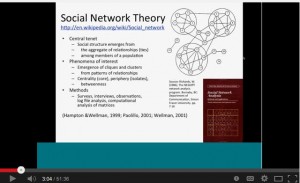
Relationship management, prospect management, or moves management – whatever we call our system of engaging and staying in touch with our supporters and prospective supporters – starts with a connection.

Relationship mapping can give us a whole new perspective on how we are connected to our prospects and donors. First we climbed a tree to get a good view -we used a database to view our donors- and now suddenly we are looking down from a helicopter -with relationship mapping.

At first it can be a bit disorienting to be able to see so many connections, especially because false connections are mixed in with true connections. But best practices are being developed and tested.

If you are interested to learn more about how relationship mapping can add new perspective to your prospect management efforts, contact Aspire Research Group, sign-up for the relationship mapping work group, or check out the resources and videos below.

Other Resources You Might Like


Prospect Visual
Prospect Visual

Melody Song on NodeXL

Marc Smith on NodeXL

Relationship Science