Category Archives: Prospect Identification

The A.I. Tug of War in Fundraising—And How to Find Your Footing

Let me ask you something: How many times has a piece of technology promised to change everything… and then promptly driven you absolutely crazy?

You know the scenarios. It can do all the things, but only after you’ve configured everything yourself. “Integration” turned out to mean something very different from what you imagined. The upgrade wiped out every custom setting you spent hours building. And whenever you try to do something just slightly outside the norm, the software fights you like a toddler at bedtime.

I could go on. We have all been there.

And yet—here’s the tension—technology genuinely has made our lives easier. Microsoft Word may not make complex formatting a walk in the park, but it has transformed how we create documents. And because it plays nicely with the rest of the MS Office suite, whole categories of headaches have simply disappeared.

Welcome to the tug of war.

The Two Ends of the Rope

When it comes to A.I. in fundraising, this same push and pull is playing out in real time. On one end of the rope are the people who believe A.I. is too messy, too risky, and too unreliable to touch. On the other end are the people who believe A.I. has ushered in such a leap in accuracy that we can use machine-generated information as-is, no human review required.

New technologies that arrive with enormous hype—and A.I. certainly arrived with enormous hype—have a way of polarizing us. But is there something useful to be found in the middle of that rope?

Spoiler alert: There is.

Yes, A.I. Has Been Around. But This Feels Different.

A.I. has been woven into our digital experience for years. Recommendation engines. Spam filters. Autocomplete. But when OpenAI released ChatGPT in 2022, it felt less like a product launch and more like a digital eruption. Things are moving fast. New and genuinely exciting capabilities are emerging. And yes, things are getting broken along the way.

For many in our field, the speed of that change feels dangerous. Whatever you do, don’t ask A.I.

But much like the anxiety that greeted Google’s debut—remember when people worried that nobody would learn anything anymore?—there is real and practical value here, if you know how to use it.

One of the most useful features of a generative A.I. chatbot is that you can ask it to show its work. Where did that information come from? What sources support that conclusion? What transactions were used to build that summary? That transparency is actually a significant feature, not a quirk.

Where A.I. Is Changing the Game for Prospect Research

At Aspire Research Group, one of the most dramatic shifts A.I. has made in our day-to-day work is in writing bios. Even setting aside the time required to gather information, writing a few well-crafted paragraphs about a prospect has always been time-intensive. Using DonorAtlas, we now have well-written bios and the underlying sources for verification—almost instantly. We can deliver a significantly stronger product at the low end, in far less time.

Until, of course, A.I. fails us. And it does fail us.

People in the arts, for example, seem to get misrepresented by A.I. with striking frequency. What is their “job,” exactly? They don’t fit the pattern that it expects. In those cases, we take over the steering wheel and drive that one ourselves.

This is not a reason to abandon A.I. It’s a reason to understand it.

Algorithms Are Only as Good as the Data Behind Them

Remember when Netflix’s recommendations felt almost eerily accurate—until they didn’t? If you shared an account with someone whose taste was wildly different from yours, the algorithm got confused. It was doing its best with messy inputs.

The same principle applies to your fundraising database. If your data is a hot mess, A.I. is going to struggle to give you reliable scores or meaningful analysis. But here’s the thing: it might still give you better results than statistical modeling did. And if better-than-before scores get gift officers out the door and into conversations with donors faster, that’s not nothing. Something is better than nothing.

But that raises the next question—and it’s an important one.

If A.I. Is Better Than What Came Before, Why Not Just Trust It?

If A.I. analysis outperforms statistical modeling, why shouldn’t we lean on it entirely? Why not let it drive portfolio assignments, staffing decisions, campaign planning?

I recently interviewed Vered Siegel on the Prospect Research #ChatBytes podcast, and she said something that I keep coming back to:

“One of the biggest shifts generative AI has introduced in our industry is that information is no longer the scarce resource. Judgment is now the scarce resource. We can generate lists and summaries and signals faster than ever, but that doesn’t automatically make our decisions better. One key aspect of being a strategic partner right now means helping the room slow down just enough to ask the right questions.”

Read that again. Judgment is now the scarce resource.

Finding the Balance

The key to leveraging A.I. well is knowing where human judgment needs to enter the picture—and deciding what level of risk is acceptable for you and your organization.

I’m not suggesting that every single name assigned to a portfolio requires a human review. Not anymore. But what if a feedback loop was built into the prospect assignment process? What if gift officers had a routine way to tell your analytics team when things are working—and when they’re not. That loop is human judgment at scale.

Here’s what breaks down when human judgment is undervalued or eliminated altogether: efficiencies go down. Not up. The risk of an error that could damage donor trust or cause your organization harm goes up. The promise of A.I. is efficiency, but that promise only delivers when the humans in the process are engaged at the right moments.

Get the balance right, and productivity goes up. New opportunities surface. Gift officers work with better information. Researchers spend their energy where it actually matters.

Get it wrong—either by refusing to use A.I. at all or by outsourcing your judgment to it entirely—and you’re just holding a rope with nobody on your end.

This Is Your Moment to Lead

Here’s what I want you to take away from all of this: the disruption that A.I. is causing in our field is real. But it’s also creating space for researchers and prospect management professionals to step into a more strategic role.

A.I. can generate the bio. It can surface the signal. It can produce the list. But it cannot decide which signals matter for your organization’s specific mission and relationships. It cannot make the judgment call about when a score doesn’t pass the smell test. It cannot be the strategic partner in the room who helps leadership slow down and ask the right questions.

Only you can do that.

The question—as always—is whether you’re ready to step up and do it.

Additional Resources

Beyond Episodic Wealth Screenings: Major Gift Prospect Identification That Hums

Let me ask you something: When was the last time a wealth screening rating automatically translated into an engaged prospect?

If you’re laughing right now, we’re on the same page. We all know the drill—trust but verify, capacity doesn’t equal inclination, wealth doesn’t equal relationship. But here’s what keeps me up at night: If wealth screenings have such obvious limitations, why are so many research shops still treating them as the primary engine for major gift prospect identification?

Spoiler alert: They shouldn’t be.

The Statistic That Changes Everything

 According to a CASE study of principal gifts to U.S. colleges and universities, half of these transformational gifts came from non-alumni. Read that again. Half.

We’re not talking about modest annual fund gifts here. We’re talking principal gifts—the naming opportunities, the program-changing investments, the gifts that get announced with press releases and champagne.

And half of them came from people who weren’t in the alumni database waiting to be wealth-screened.

Now, the study didn’t break down how many were parents versus community members. But that ambiguity makes the statistic even more powerful. These prospects exist in multiple spheres around your organization, and they’re making gifts that matter.

So the question isn’t whether we should be prospecting outside the database. We already know the answer is yes.

The real question is: How do we build a prospect identification process that actually works?

Let’s Start at the Very Beginning

Here’s what we know to be true: Relationships drive gifts. Not wealth. Not capacity. Not even inclination, really. Relationships.

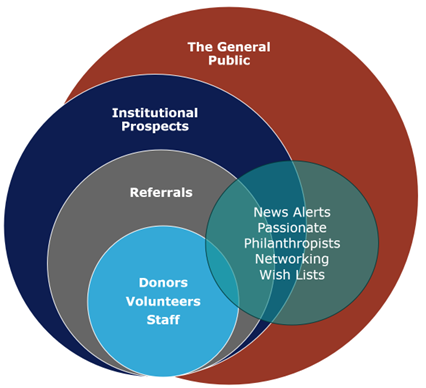
And relationships exist in concentric circles radiating out from your organization’s core. The closer someone is to your mission, the more likely they are to give significantly. This isn’t revolutionary—it’s fundraising 101.

But here’s where it gets interesting. Once you and your development team really internalize this principle, you can start mapping out all the ways major gift prospects actually enter your pipeline. And I promise you, many of them aren’t entering via your annual wealth screening.

Think about it:

  • The grateful patient whose care team mentions a giving opportunity during recovery
  • The board member who brings a business colleague to your gala
  • The parent who gets involved with the advisory committee
  • The foundation executive who hears your CEO speak at a conference
  • The corporate partner whose VP falls in love with your program

These aren’t hypothetical scenarios. These are the everyday ways that million-dollar prospects walk through your door. And most organizations have no systematic way of capturing, vetting, and reporting on these individuals.

Your development team is probably already doing this work—identifying prospects through organic relationship-building, event attendance, and word-of-mouth referrals. The problem is, they’re doing it in isolation. Without your input. Without a process. Without documentation.

And that means opportunities are being missed, expectations aren’t managed, and you’re probably spending way too much time researching people with zero connection to your organization while high-potential prospects languish in the “someone should probably look into this person” pile.

Why Documentation Is Your Secret Weapon

I can already hear some of you groaning. Documentation? Really? You want me to document our prospect ID process when I can barely keep up with the profile requests I have now?

Yes. I do. And here’s why.

Documentation isn’t bureaucracy—it’s strategy in writing. Once you put your prospect identification framework on paper, something magical happens:

  • Leadership suddenly has opinions. And that’s exactly what you want. Because leadership has the authority to make decisions about how prospect identification actually works at your organization. Once they’re engaged, you have a powerful ally who can say “no, we’re not going to ask the researcher to find us 50 wealthy strangers with no connection to our mission” or “yes, we’re going to prioritize event attendees and board referrals over cold prospecting.”
  • You can make the case for what actually works. When you’re writing the documentation, you get to remind everyone that relationships drive fundraising. You get to frame prospect identification through that lens. And you get to set expectations—when leadership commands you to prospect outside the relationship sphere, you can point to your documented framework and say “absolutely, but our engagement ratio is going to be around 5% instead of 30%.”
  • Everyone agrees on what counts as prospect identification. This might be the biggest win of all. Once you document that event attendees require research vetting, that board referrals follow a specific qualification process, that news article mentions get the same treatment as wealth screening hits—suddenly all of these activities fall under the same umbrella. Which means they can be tracked, measured, and resourced appropriately.

But What If Your Culture Is Broken?

 I can hear you. Some of you are thinking: “This is great in theory, Jen, but you don’t understand my organization. The culture here is completely entrenched. I spend all my time researching deep profiles on people who will never be contacted. I’m not even allowed to talk directly with leadership. Documentation isn’t going to fix that.”

I’m here to tell you something that might sound harsh at first, but I promise it comes from a place of deep respect for what you do: You can do your best work anywhere.

No, really. Stay with me.

You can write your documentation and share it with team members who will talk to you. You’ll learn so much from those conversations, especially if you’re willing to listen to the frontline fundraisers who are actually in the trenches. They know which prospects have potential and which are pipe dreams. They know what information helps them and what just clutters their inbox. They’ll tell you the truth—if you ask and if you listen.

You can begin socializing your framework by giving your services marketing names that describe your actual process. This is where you get to be creative. Deliver a list of no-connection prospects under the service name “Cold Outreach Research-Wish List” and suddenly everyone understands what they’re getting.

Call your event attendee research “Hot Lead Vetting” and watch how much more enthusiastic people are about those prospects. Words are powerful. Use them strategically.

You can introduce innovations wherever you have authority to do so. For example, when you deliver a new prospect, include a brief “relationship statement” or “reasoning note” explaining why they’re a good prospect. This does two things: It educates your development team about what makes a quality prospect, and it invites feedback that helps you refine your process over time.

Here’s the bottom line: If you don’t practice your best work now—in whatever imperfect environment you’re currently in—you won’t be prepared when that golden job opportunity finally manifests itself.

The researcher who gets hired into that dream role isn’t the one who spent three years complaining about their dysfunctional shop. It’s the one who built innovative processes, documented their framework, and can articulate in an interview exactly how they would set up prospect identification at a new organization.

Practice your best work now so you’re ready for what comes next.

AI Is Here, and It’s Time to Step Up and Lead

Let’s talk about the elephant in the room: artificial intelligence.

AI has already begun disrupting our work. For some of you, that’s terrifying. For others, it’s exciting. But here’s what I know for sure—AI is poised to help you unleash your inner leader, whether you’re ready or not.

Think about everything we just discussed:

  • Writing that prospect identification framework? AI can help you draft it.
  • Coming up with creative service names that catch people’s attention? AI is brilliant at brainstorming.
  • Communicating differently with different personalities on your development team? AI can help you adapt your tone and approach.
  • Building a major gift prospect ID process that hums? AI can help you design it, refine it, and evolve it.

But here’s the thing AI can’t do: AI can’t be a leader. It can’t build relationships with your development team. It can’t advocate for resources. It can’t make the strategic decision about whether to prioritize board referrals or cold prospects. It can’t look a gift officer in the eye and say “I know you want me to research this person, but I think we’d get better results if we focused here instead.”

Only you can do that.

AI is a tool—an incredibly powerful one—but it’s still just a tool. The prospect researchers who will thrive in this new landscape aren’t the ones with the best technical skills or the fanciest databases. They’re the ones who step up and lead.

The ones who build frameworks, communicate strategy, and help their organizations make smart decisions about where to invest their prospecting energy.

This is your moment. The disruption that AI brings creates space for you to redefine your role. You can be the researcher who just finds information, or you can be the strategist who shapes how prospect identification works at your organization.

Which one do you want to be?

The Prospect ID Process That Hums

So what does a major gift prospect ID process that actually hums look like?

  • It’s documented, so everyone knows how it works and what to expect.
  • It’s relationship-focused, starting with your organization’s closest connections and working outward strategically.
  • It’s collaborative, with researchers and development officers working together to identify, vet, and qualify prospects through multiple channels.
  • It’s adaptive, using AI and other tools to increase efficiency without losing the human judgment that makes research valuable.
  • It’s communicated clearly, with service names and frameworks that help your development team understand what they’re getting and why.

And most importantly, it’s led by you—the prospect researcher who understands that wealth screenings are just one tool in a much larger toolkit, and who has the confidence to advocate for a better way forward.

The question is: Are you ready to build it?

Additional Resources

Wish you had access to more resources on prospecting? You do! The Prospect Research Institute has lots of resources to help you with prospecting:

  • Join Jen Filla for a free Backstage Tour of the Institute on 1/9/2026 at 12pm ET where you’ll learn about upcoming workshops such as: Strategic Prospect Identification – Smart Verification Framework – Solo Researcher Survival Kit
  • Connect with other prospect research professionals tackling these same challenges in the FREE Forums at the Prospect Research Institute.
  • Buy the Approach to Prospecting book or the course. This teaches you how to build a score card, which you can use for internal or external prospecting.
  • Check out our prospecting category on Prospect Research#ChatBytes the Institute’s podcast.

Unlock the Power of Due Diligence: Tips and Insights for Prospect Researchers

Are you a fundraising prospect research professional gearing up for a major naming gift or an upcoming honor or award? If so, you know that due diligence isn’t just a box to check—it’s the foundation for trust, transparency, and lasting donor relationships. But how do you navigate the nuances of philanthropic due diligence and deliver clear, actionable insights to your development officers and leadership team? You know how to find information, so let’s talk about how due diligence is different from our usual profile research.

The High-Stakes Reality of Due Diligence

In an era where a single tweet can resurrect a decades-old scandal, where investigative journalists are actively mining nonprofit IRS filings, and where “cancel culture” is a real phenomenon regardless of how you feel about it, due diligence is no longer optional. It’s existential.

And yet, here’s the paradox: We can’t spend 100% of our time on due diligence. We still have capacity research, portfolio management, and strategic briefings to handle. So what’s the right balance?

The answer isn’t about allocating a specific percentage of your time. It’s about building due diligence thinking into everything you do, so you’re never starting from scratch when that Friday afternoon email arrives asking for due diligence.

Why Due Diligence Research Is Fundamentally Different

Here’s the thing people don’t talk about much: Due diligence work requires a completely different mindset than capacity research.

When you’re researching giving capacity, you’re hunting for evidence of wealth and big philanthropy. You want to find things. Big houses, impressive portfolios, generous gifts to other organizations.

Due diligence flips that script entirely. Often, you are hunting for the absence of problems. You’re looking for what isn’t there, which is infinitely harder than finding what is. And when you do find something concerning, you’re often working in gray areas where “troubling” and “disqualifying” aren’t clearly defined.

It’s the difference between being a talent scout and being a background investigator. Same data sources, completely different questions.

But here’s what makes this work meaningful: Philanthropic due diligence isn’t just about avoiding negative press. It’s about honoring your donors and safeguarding your mission. It’s about ensuring that the partnerships you build can withstand scrutiny and the test of time.

Effective Information Gathering: Where to Actually Look

Your wealth screening tool isn’t going to flag reputational red flags. Neither is your CRM. These tools were built to manage information, not controversy.

So where do you actually look? Here’s what works:

  • Legal databases are your best friend. PACER for federal court records, state court systems for civil litigation, and bankruptcy filings. Yes, it’s tedious. Yes, you’ll wade through dozens of unrelated John Smiths. But this is where you find the lawsuits, the restraining orders, the business disputes that never made the news.
  • Industry-specific searches matter more than general news. If your donor made their fortune in pharmaceuticals, you need to be searching FDA warning letters and medical journals, not just the Wall Street Journal. Real estate developer? Check local zoning board meetings and community opposition groups. Every industry has its own ecosystem of accountability, and Google News won’t find it.
  • International donors require international searching. This can be really challenging. If you can’t read the language or navigate the legal system where your donor made their wealth, you’re flying blind. At a minimum, you need to know how to use Google Translate on foreign news sources and understand the basics of international sanctions lists (OFAC, UN, EU, UK).
  • Social media is both goldmine and minefield. Yes, check their Twitter history. But also check what people say about them on LinkedIn, industry forums, and comment sections. The absence of an online presence can be as telling as a problematic one.
  • Don’t ignore the soft signals. Multiple short tenures at different organizations. A pattern of deleted social media accounts. Lots of shell companies. These aren’t smoking guns, but they’re worth noting.
  • Network with your peers. Connect with colleagues through professional forums (like the online learning forum at the Prospect Research Institute) to share industry practices and get recommendations on tricky cases.
  • Document Everything. Keep a clear record of your sources and findings. This not only increases credibility but also helps when leadership has questions or you need to update your research.

The Communication Challenge: Walking the Tightrope

This is where prospect researchers either become trusted advisors or get cut out of the conversation. You’ve gathered the facts—now it’s time to share them. Effective communication makes all the difference.

  • Lead with facts, not judgment. “The donor was named as a defendant in a 2019 breach of contract lawsuit that was settled for an undisclosed amount” is good. “The donor has a questionable business history” is not.
  • Provide context without spin. A single lawsuit in thirty years of business is different from five lawsuits in five years. Help your leadership understand what’s normal for that industry and what’s unusual.
  • Separate findings into categories: Clear red flags (criminal convictions, sanctions lists, credible abuse allegations), yellow flags (civil litigation, controversial business practices, negative press), and contextual information (political donations, family disputes that became public, social media controversies).
  • Always include a confidence level. Are you certain this is the right person? Or are you 80% sure based on matching biography details? This matters enormously when the information is sensitive.
  • Be Clear and Concise. Use straightforward language and avoid jargon. Focus on what matters most to your development officers. Share the risks, opportunities, and recommendations.
  • Tailor Your Message. Present information in a format that fits your audience. Leadership may want a high-level summary, while gift officers might appreciate more detail.
  • Stay Supportive. Position yourself as a resource, not a gatekeeper. Your work enables success and protects your organization’s future.

Also, keep in mind that your communication doesn’t start or end with the formal due diligence report. Even when there’s no big naming gift on the horizon, your usual research activities might surface some sensitive information.

Communicate early and frequently with your development officers to help them steer donor relationships appropriately. A heads-up about potentially problematic social media posts or a concerning lawsuit gives your gift officer time to ask thoughtful questions and assess the situation naturally, rather than scrambling when a major gift is already on the table.

When to Say “We Need Outside Help”

Sometimes the best information you can deliver is this: This is beyond my expertise and available tools.

High-net-worth international donors often require specialized international research firms with access to foreign databases and native language researchers. Complex business histories might need forensic accounting expertise to untangle shell companies and follow money trails. Potential ties to organized crime or corruption require investigators with law enforcement backgrounds and access to databases you’ll never see.

Knowing when to recommend outside help isn’t admitting defeat—it’s protecting your institution. A $25,000 investigation is cheap insurance against a $10 million reputational disaster.

And here’s the thing: Recommending outside expertise actually strengthens your position as a trusted advisor. It shows you understand the limits of your resources and are willing to escalate when the stakes warrant it.

The Part That Matters Most

Due diligence research isn’t about being the “no” person. It’s not about finding reasons to reject gifts or creating paranoia.

It’s about honoring and nurturing the donor prospect relationship.

Your job isn’t to protect the institution from all risk—some risk is inherent in fundraising. Your job is to ensure that when leadership accepts that $10 million naming gift, they do so with their eyes open. They’ve had the opportunity to explore the risks in the relationship building stage and know what they’re getting into. They’ve weighed the reputational risk against the institutional benefit. They’ve made a strategic choice, not a naive one.

Sometimes that means you deliver findings and they move forward anyway. That’s okay. You’ve done your job.

Other times, your research will save your institution from a scandal that would have haunted it for decades. You’ll probably never get credit for those saves, but you’ll know. And you’ll sleep better on Friday nights.

The Conversation You Need to Have Now

If you’re waiting until you have a specific due diligence situation to figure out your process, you’re already behind.

Here are some questions you want to answer before that urgent Friday afternoon email arrives:

  • At what gift threshold does due diligence become mandatory?
  • Who makes the final call on whether a reputational risk is acceptable?
  • How do we handle information that’s concerning but not disqualifying?
  • What’s our process when the donor is from a country where we don’t speak the language?
  • Do we have budget for outside investigators when needed?
  • How do we document sensitive findings securely?
  • What’s our policy on anonymous allegations?

These can be uncomfortable conversations. Have them anyway.

Because here’s what I know after years in this field: The institutions that treat due diligence as an afterthought are the ones that end up on the front page of the newspapers for all the wrong reasons.

The researchers who build expertise in this specialized, high-stakes work? They become indispensable.

They are the ones leadership listens to. They’re in the room when decisions get made. They are trusted advisors, not just data providers.

And when that urgent Friday email inevitably arrives? They are ready.

Are you?

Ready to Build Your Due Diligence Expertise?

Join the Prospect Research Institute for Due Diligence: Practice to Policy workshop on Thursday, November 13, 2025 at 12pm-1pm ET.

This workshop equips you with frameworks and practical tools to elevate your due diligence process, leverage research effectively, and influence organizational change from any level—so you’re prepared when the stakes are highest.

Register now and join a community of researchers who are shaping the future of philanthropic due diligence

That Familiar Ask: ‘Can You Find Rich People?’ Here’s What to Do Instead

You know that feeling, don’t you? The development team walks into your office (or slides into your DMs) with a sparkle in their eyes. They’ve been strategizing. They’ve been planning. And they have a shiny new idea: “Can you get a list of wealthy people in the community who might be interested in our new program?”

Your heart sinks a little because you know what comes next. Hours of research on strangers. Cold prospect lists. Fundraisers making awkward cold calls to people who’ve never heard of your organization. And then, when the gifts never materialize, they come back with new strategies for more places to look out in the community.

I’ve been there. We’ve all been there. But here’s what I’ve learned after years of watching this play out: We have more power in this conversation than we think we do.

The Uncomfortable Truth About Stranger Danger

The truth is that asking for money, especially larger investments, requires relationships. Typically, the colder the relationships the more prospects it takes over a longer period of time to get the gifts your organization needs.

The uncomfortable truth is that your frontline fundraisers know they should focus on building existing relationships before chasing down strangers, but when they’re in the moment and feeling the pressure to fund the program, your organization’s database full of donors is a software program and strangers are people.

But we researchers know that the database is full of people. People who know us and support our organization.

Becoming a Trusted Partner

You could point out to the frontline fundraiser how ridiculous it is to chase strangers instead of mining your own database of existing relationships, but how well do you think that will go down?

In most development departments, research does not hold a lot of political power. What we can have is influence over our colleagues. And influence requires trust.

Instead of making your fundraiser feel stupid, you could try an approach along the lines of the following:

“That’s a great idea, and I can definitely help you find prospects from our community. But it might take a year or even a few years for gifts to come in from people with no connection to us. What if I also do some datamining on our existing donors? I might find some good prospects who already know and trust us—those gifts could come in much faster.”


This isn’t about saying no. It’s about saying “yes and.” Yes, you can do the research they have requested AND you also have a stellar idea to bring good prospects to the table.

Sometimes You Do Need to Look Outside

There are times when it totally makes sense to search for prospects out in your community.

Consider the following scenarios:

  • Maybe you really don’t have the internal prospects to support something new.
  • It might be time for your board members to step up and start introducing your organization to their networks.
  • If it is a new initiative, you might want to tap into foundations. They often prefer new projects.
  • You may want to deliberately diversify your funding sources!
  • Engaging the community through businesses, civic groups, or government could be an important complementary strategy to individual giving.

The Power of Reframing

I used to think my job was to say yes to whatever research request came my way. But I learned that our real value as researchers isn’t in being order-takers—it’s in being strategic thinking partners.

When development teams come to us with the “research rich strangers” request, they’re not wrong to want to expand their prospect pool. But they might not be choosing the best research technique to source the prospects they need.

If you become the trusted partner that listens to the need and delivers great prospects, what do you think will happen next time they are under pressure to raise funds for a project? They will RUN to you asking you to do it again! Or even better, they will ask you for advice.

A Challenge for All of Us

Next time you get that familiar request to research wealthy community members, I challenge you to pause and ask questions such as:

  • Could you tell me more about what a BEST prospect for this project looks like?
  • If you don’t want formal institutional funding, how would you feel about a family foundation that is local and has funded similar projects?
  • Before I search externally, would you mind if I checked to see if we have any existing donors that might be a good fit and run that by you first?

You might be surprised by what you learn from the conversations. More importantly, your fundraisers might be surprised by how much faster those gifts come in when they’re using the best strategy and especially if they are building on existing relationships instead of starting from scratch.

Because you and I both know: The best prospecting doesn’t just find people with money. It finds people with money who are connected to and care about your mission.

And most of the time, those people are already in your database.

Additional Resources

Wish you had access to more resources on prospecting? You do! The Prospect Research Institute has lots of resources to help you with prospecting:

  • Connect with other prospect research professionals tackling these same challenges in the FREE Forums at the Prospect Research Institute.
  • Buy the Approach to Prospecting book or the course. This teaches you how to build a score card, which you can use for internal or external prospecting.
  • Check out our prospecting category on Prospect Research#ChatBytes the Institute’s podcast.

Top 5 Capacity Rating Insights for Research Professionals

We’ve all been there. The gift officer needs a capacity rating “super quick” before meeting with someone. The electronic screening shows a low number, but the prospect’s occupation suggests there’s more. Sound familiar?

After years of calculating ratings, fielding anxious questions from researchers and fundraisers, and watching the gap between promise and reality, following are the top 5 capacity rating insights for research and prospect management.

1.No Matter What Rating You Choose – You Will be Wrong! (And That’s OK)

Surrender your anxiety! Capacity ratings can never be 100% accurate because too much of the information is private. Capacity ratings are directional, not definitive.

Your job is to provide the best assessment possible with available data. But if you want to feel anxious, get worried about under-rating the prospect not over-rating them. You want build your development officer’s confidence to ask boldly.

 2. HNWIs Are Your Blind Spot

The wealthier the prospect, the more likely their wealth is hidden. Private equity, angel investments, Delaware LLCs, family offices – none of this shows up cleanly in databases. Machine-generated ratings consistently undervalue HNWIs because the data needed to identify “whales” isn’t available for algorithms to process.

Accept that spotting transformative wealth still requires human intelligence and industry knowledge.

 3.  Estimated Net Worth vs. Gift Capacity: Know When Each Matters

Gift capacity ratings provide an assessment of a stretch gift amount from the prospect and the approach to calculating depends on the prospect. At Aspire, if someone appears to be below $1M in estimated net worth, we use the old-fashioned general calculations based on visible assets.

But if they are $1M or above, we place them in a net worth tier based on quantitative and qualitative data points and then take a percentage (typically 5%) of estimated net worth to create the capacity range.

 4. Data Isn’t the Strategy

Technology keeps promising instant major gift identification, but it’s not delivering for everyone, especially wealthy minorities such as women, people of color, and others. And we know that the best data is locked inside the donor’s head and heart.

As a researcher, you can go beyond gathering information and become the fundraising partner who translates pages of information into ways the development officer might take action with the prospect.

 5. Inclusive Research Pays Off

Traditional approaches miss wealthy minorities. But identifying prospects by demographic characteristics such as ethnicity can be ineffective and uncomfortable.

Instead, research with inclusive assumptions. Question your own biases when two similar prospects get different ratings. Check if you’re undervaluing first-generation wealth creators or making assumptions about giving patterns.

Moving Forward

Capacity ratings aren’t perfect, but they probably are not going anywhere. As A.I. creeps into our tools and makes all of our scores and ratings even better, we might find them eventually replaced or perhaps renamed and improved. But for now, you can make them as useful as possible while managing expectations about their limitations.

We all struggle with the same capacity rating anxieties. The most successful researchers combine data analysis with relationship intelligence, inclusive practices, and clear communication about what they know and don’t know.

Engage gift officers in conversations about how you arrive at ratings. Some of your best collaborations will come from fundraisers who want to understand your methodology. Join professional forums, attend APRA sessions, and don’t be afraid to ask for input from colleagues. Capacity rating is as much art as science.

And of course, the Prospect Research Institute has lots of resources to help you with capacity ratings!

  • Connect with other prospect research professionals tackling these same challenges in the FREE Forums at the Prospect Research Institute.
  • Invest in your education and buy the Capacity Ratings book or the course.
  • Check out the Institute’s Capacity Rating Section in our Free Library, which includes a capacity rating calculator download.

Money and Messages: The Missing Major Gift Donors

Did you know that your organization might be missing major gift donors? There is a major gifts trend happening in organizations across the United States and it may well apply enough pressure to burst through outdated thinking and unleash the power of the missing major gift donors. Will you and your organization be among the early innovators and adopters?

Fundraising leadership is waking up to the reality that technology keeps promising instant identification of major gift prospects, but is not delivering, especially when it comes to wealthy women and people of color. And some of the best, most transformative donors are missing – hidden among all the other donors.

Why can’t the tech companies wave their magic rating wands and deliver the prospects?

Because the very best data is locked up inside the donor. Because technology can’t create messaging and relationships with donors that will unlock the mega gift.

Who can’t help but love the story in the Chronicle of Philanthropy about the retired clarinetist, Edward Avedisian, who gave $100M to his alma mater, Boston University? The only meaningful data points were Avedisian’s giving history to the organization and his desire to give that he expressed to the development officer – who listened and acted. Is she ever glad she did!

But if the data can’t find and rate the next best megadonor from your organization’s donor list, what is a savvy development professional to do?

Remember that data supports fundraising relationship strategies – it is NOT the strategy.

Back in 2015, research professional, Preeti Gill, challenged me to research the woman first when profiling. It was a simple demand and it shook me out of my routine enough to realize how biased Aspire had been in its approach to researching households!

Read Preeti Gill’s story in “What About Women?” a free PDF download.

Preeti argued that there was a huge transition of wealth to women and fundraising was ignoring these women. And she was right. Conversations with researchers in the next few years were fascinating.

They expressed problems such as:

  • Sure, I can find women who look like good major gift prospects, but the fundraiser is asking for hard asset amounts and I don’t have them.
  • Our organization tried inviting women to a fundraising program that has been successful for us, but they didn’t come. Maybe women don’t really want to give?
  • We have so many records in the database and none of them are coded for gender. How am I supposed to even run a report to find women?

And slowly, things began to change. Organizations became aware of women as philanthropists through many channels, including the Women’s Philanthropy Institute at Indiana University and the “Women Give” research series with accessible infographics and presentations. Female prospects were encouraged to make naming gifts and to publicize their giving as a model for other women.

Most importantly, the messages to women donors began to change. Now we hear about a university’s women’s leadership group or an organization’s women’s giving circle that are successfully raising money and cultivating major gift prospects. Now, when a development officer visits a prospect, it’s a known strategy to include the spouse who likely influences and sometimes directs the household philanthropy.

These are not data strategies — they are fundraising messages and strategies – and they raise more money. Have data practices evolved? Of course! To support the fundraising strategy, but not to be the fundraising strategy.

Prospect Research Professionals can be prepared and share.

I was feeling BIG imposter syndrome when Yolanda Johnson asked me to be a panelist at the WOC Symposium this year. As a white woman, what could I know about inclusion in prospecting and research practices?

It turns out that I could add to the conversation. I have been learning and testing and caring about inclusion for a long time. Inclusion is a value and success story for the ages. As a research professional and a human being, I can continuously learn and share.

One of my favorite characteristics of inclusion is that even when the focus is on a subgroup, inclusive actions and messaging means everyone gets pulled in. I can include the spouse in my meeting and I have the opportunity to get the big splash naming gift and a program gift.

Spotlight on a Resource

One of the speakers at the WOC Symposium I attended was Doria Josma, Development & Fundraising Specialist at Cool Culture Inc. The panelists were clearly stating things that needed to be spoken: yes, there are very wealthy donors of color and yes, they are philanthropic and want to give big.

Doria told us about the Donors of Color Network and their newest report, Philanthropy Always Sounds Like Someone Else: A Portrait of HNW Donors of Color.

So many gems in this report for strategy, messaging, and research!

Philanthropy Always Sounds Like Someone Else: A Portrait of HNW Donors of Color

The Study:

The study conducted research interviews with 113 individual people of color with high or ultra-high net worth. Nearly a quarter of the sample reported they had net liquid assets of $30M or higher.

Some Gems:

(Quoted directly from the report with my notes added in parenthesis)

  • The universality of the experience of racism, discrimination, and bias reported by each interviewee is a striking finding of this project. (You have to be mindful with strategies and messaging for this group.)
  • Many shared a visceral contempt for the idea that people “pull themselves up by their bootstraps,” and did not see their prosperity as the result of individual effort alone. For many interviewees giving was an expression of gratitude. (Messaging opportunity!)
  • All donors expressed a desire to be more effective as donors, but very few had worked with professional philanthropic advisors. (Your organization could offer networking and educational options.)
  • They expressed great excitement about the possibility of new networks that could connect them to other HNW donors and donors of color. The overwhelming support for the formation of a new donors of color network was striking — support that has translated into the successful launch and formation of the Donors of Color Network.
  • Donors gave most often to educational institutions which many credited as critical to their success, and to racial and social justice causes. (Hello researchers! Data point.)
  • Their giving styles, priorities, and vehicles were diverse: they gave through giving circles, donor advised funds, community foundations, or other pooled strategies, occasionally through their own foundations, and often, directly through their checkbooks. (Research and find and share how we see prospects giving.)
  • However, they belong to an impressive array of civic, professional, and other civil society organizations. (You can usually find this easily online and in bios.)
  • HNW donors of color interviewed were mostly first-generation wealth creators, and often the people in their families of origin who had crossed into a new socio-economic class. (This speaks to messaging and the psyche of many first-generation wealth creators as well as data point to find in occupation.)

How can Prospect Research support finding the next layer of missing major gift prospects? Work smarter AND harder.

When data is the fundraising strategy, the urge is to collect, collect, and collect more data. If only we knew who was a person of color! If only we knew the gender! If only we knew…the clarinetists? Chasing the data points first is a mistake.

In past misguided attempts, I have tried looking for people based on their identity and it is a truly humiliating experience! Trying to define what makes someone Black vs. African American vs. immigrant vs. refugee vs. white vs. European American vs. all the ways a person might identify does not build a better list.

I’m suggesting a prospect approach like this:

  1. Identify the fundraising strategy. Do you want a more robust major gift pipeline overall? Do you want to broaden your donor base specifically to include a certain type of donor? Do you need billionaires? Once the strategy is crystal clear and the activities are sketched out, then research can…
  2. Begin testing the data. Can you pull reports and manually research key points to yield lists that respond to development officer outreach? This is iterative and takes many, many months overall. You may need some data enhancement/appends. Maybe not.
  3. Repeat and evolve your prospect sourcing strategies. Sometimes a report that worked well for the first three rounds dries up. Can you change the list-building criteria? Is there a messaging problem with the organization’s donor acquisition activities? Can you try a new source? Do you need to go outside the donor database?

The tried and true approach to prospecting, when it follows the fundraising strategy and when the organization is engaging and messaging in ways that appeal to the desired audience, works well. It’s a long-term strategy, but it works. But remember that Research and data are not in control of fundraising strategy or messaging. If the strategy and the messaging ignore the needs of the intended audience, that is a problem that no amount of data collection can solve.

Don’t Misfile your Major Donors!

It is not easy to be inclusive – for anyone. Our brains are hardwired to categorize and find patterns. This generates implicit bias, which is what happens when we automatically assume someone works at a store even though their attire or behavior should clue us in otherwise, for example.

As you seek to qualify prospects for wealth and giving, ask yourself critical questions all the time, such as:

  • These two donors have a similar career path but I gave them very different wealth ratings. Am I missing something?
  • First-time wealth-creators might live modestly. Did I check on the size and scope of the company my prospect founded? For example, a trash hauling company isn’t glamorous work, but when that company has a multi-state presence it could be a recession-proof wealth catalyst!
  • What assumptions am I making about the lack of data found? No giving found doesn’t mean the prospect doesn’t give. No second home doesn’t mean a person in a high-income occupation isn’t making a high income.

When research and fundraising leadership partner together, so many good and inclusive things can happen that result in higher fundraising support – regardless of how a major gift gets defined.

Additional Resources


A Screening By Any Other Name Would Read As Rich

Apologies to Shakespeare, but when it comes to the communication between major gift officers and prospect researchers, “What’s in a name?” is an important question worth paying attention to!

“What’s in a name? That which we call a rose by any other name would smell as sweet…” -William Shakespeare in Romeo and Juliet

I didn’t realize how important words are until I became a consultant and needed to clarify what services we offer our customers. If I fail in that communication, the consequence is either no work or an unhappy customer.

As it happens, wealth screenings are one of the most frequently misunderstood tools – and words – we use for major gift prospect identification at Aspire.

Notice how I defined that?

A wealth screening is a tool for major gift prospect identification.

However, all too frequently Aspire Research Group’s potential customers and current clients define it more like: Wealth screenings provide accurately matched profiles on prospects.

Why is there such a discrepancy in the definitions?

As much as I am indebted to the big vendors for flooding the nonprofit market with advertising and education on using wealth screenings, they have also perpetuated the myth of accurate electronic data matching and scoring. It makes for healthy sales revenue!

As a business owner I respect that simple marketing messages make sales. But as a prospect research professional it drives me nuts because you can have the very best, most amazing data-matching algorithms and scores and ratings and all things analytics – but it will not be enough!

It will not be enough because ultimately we are dealing with humans, not data.

Do any of these kinds of scenarios sound familiar?

  • Visits with donors that are recorded in the database as actions with text, but no specific coding to know they were qualified or disqualified.
  • Donors with common names, such as Robert Smith, but is it the billionaire or not?
  • Researchers wanting to preserve data and not deleting things like gift opportunities on records when there was never a single two-way exchange.
  • A great structure for coding prospect management in the database – that has old or just completely wrong information.
  • Contact reports that indicate the prospect is ready for a solicitation, but no gift opportunity or prospect status was ever entered or updated, and in the hundreds of names in portfolio the prospect was unwittingly dropped like a hot potato.
  • The data integrity team won’t allow development officers to update contact information on the record and now actively engaged prospects lack the basics such as current addresses or working telephone numbers.

I could go on and on. It’s all so human!

So, what now? Are wealth screenings worthless?

Heck no! Wealth screenings are an important and economical tool for major gift prospect identification. They are designed to help you segment and prioritize large groups of records and they perform better and better as the matching algorithms and accessible data improve.

The auto-matched profiles available with most wealth screenings are also really good. It’s just that they are not anywhere near 100% accurate. They were never meant to be! Matching algorithms keep getting better, but they can’t be perfect. They are good enough to get a great segment to focus on.

Because once you have a top major gift prospect segment, research can prioritize that much smaller list with quick research to confirm the information, and can deliver prospects to the development officer that have current, actionable data.

A screening by any other name would read as rich.

It doesn’t matter if you define a screening as an electronically matched algorithm or a researcher quickly scanning sources to confirm the algorithm’s findings — or both. Bottom line is that screenings help identify new major gift prospects.

One way to avoid confusion over the choices of words used is to describe the desired outcome.  If you are a development officer and want to identify new major gift prospects, say that. If you say “I need a wealth screening” but a different technique would work better, you may not get the best outcome.

As Elisa Shoenberger describes in Top 5 Misconceptions of Prospect Identification, prospect identification is “using the knowledge of an organization, its best prospects, as well as an understanding of wealth and philanthropy to determine which prospects are the best ones.”

This goes for prospect research professionals, too! When someone wants new prospects identified, it’s not always wise to assume a wealth screening will be the best technique. Instead of focusing on a tool or technique, start asking questions about what they will do with the names, or how many names do they need, or other questions to widen the conversation.

And once everyone knows what is desired, then the discussion can progress to the tools and techniques that would best deliver the outcome of identifying major gift prospects.

Are you tasked with doing the work of major gift prospect identification? Check out the Prospect Research Institute’s workshop, Profiles vs. Screenings, where we dive into the difference and research for the desired outcome!

Profiles v Screening 14 Nov 2024 workshop

Top Secret! How to Bulk up your Prospect Pool

HappyKeySMIn this article I’m going to share the secrets of finding great prospects. Maybe you’re one of those fundraisers who is always reading the Business Journal scouting for a lead, but they don’t pan out. Do you wonder how those other organizations pull in the big gifts? Or maybe you’re new and all the best prospects are assigned to senior fundraisers. You can get great prospects too!

If you read a lot of blogs (like I do) now is where you get skeptical. Is she just going to give me theory I already know (and hasn’t yet helped me find good prospects) or will I get at least a couple of nuggets I can actually use? I’m aiming for the latter. The “trick” is that you still have to work hard!

Fundraising research theory tells us that you need to know who you are looking for so you can spot them. We use jargon like linkage, ability and affinity. And there are tools that give you a competitive edge with that. But you can do it even without bright, shiny tools.

The First Thing…

The first thing any good fundraiser (and prospect researcher) needs to do is learn what it looks like to be wealthy. Watching soap operas may seem like a good education here, but much better is reading through some of the wealth reports like the Knight Frank Wealth Report 2014. You’ll find links for other reports in the sidebar on your right.

And the second first-thing-any-good-fundraiser-needs -to-do is get in front of people, especially donors. You should read and get in front of donors at the same time. Start with known donors because they are the most likely to give (again) and it’s always better to get a gift, right?

Call, visit, and read.

When you are reading about the wealthy at the same time as you visit prospects you’ll start making the connections. When the prospect talks about how he and his wife are taking classes in gemology and he has a watch collection, you’ll remember what you read about this being an investment hobby for the very wealthy. And when a different prospect brags about taking regular trips to Europe on mileage points you’ll recognize that what you thought were luxury vacations probably aren’t.

You can do that without any tools except your eyes and ears. Well, I guess you need to use your mouth to place the phone call…and, okay, guide the conversation. But you get it, right? Recognizing the wealthy – the truly wealthy – takes an education.

Get Your Toolbox Dirty

Getting an education on spotting the wealthy still isn’t likely to fill your prospect pool with GREAT donors – those with linkage, ability and affinity. If you have tools that assign ratings to the prospects in your database, use them! Don’t be discouraged if it doesn’t work out perfectly the first few times.

For example, you might pull a report of people who rate high for ability and likelihood to make a gift, but find most won’t take your phone call. You may need to add additional criteria depending on your organization. Maybe it’s “donor within the past two years” or “attended an event in the past two years” or some other criteria that makes it more likely they will let you visit with them.

Keep track of your efforts so you can repeat what works best. And, yes, this does mean you will have to make a lot of phone calls that end in “no thank you I don’t want a visit”.

It’s the same even if you don’t have tools that provide ratings. Without tools you have to get more of an education. You might use a free tool like the Washington Post’s interactive map** of the nation’s super zips to identify wealthy zip codes to search for in your donor database and combine that with “donor within the past two years” or other criteria that suggest a “warmness” toward your organization.

The Secret Weapon

If you are really lucky, you have a trained prospect researcher on staff. Use all your fundraising powers of relationship building to get this prospect research wizard on your side!

HOT TIP: your researcher is likely to get the most excited about searching out top prospects if you reward her with feedback from your calls and face-to-face visits.

With a prospect researcher on your team you are more likely to out-produce even seasoned professionals in the race for fundraised dollars. Really, really!

…and if you can’t support a trained prospect researcher full-time, you can always outsource. Just sayin’!

**Julie, Prospect Research Analyst in Pennsylvania and Groundbreaking Student at the Prospect Research Institute, shared this fantastic resource with the class!

Did you get a nugget or two?

I hope you found a useful tip you can apply in your office. Maybe you have great suggestions you’d like to share with others. Please comment and share!

Jenz Favorite Wealth Reports