Tag Archives: estimated net worth

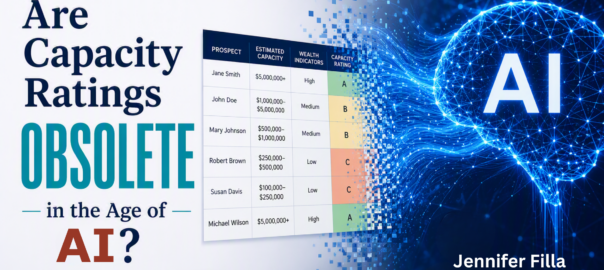
Are Capacity Ratings Obsolete in the Age of AI?

The short answer: not yet. Capacity ratings built from public records wealth screenings still do their job, helping organizations prioritize prospects. But they’re facing real pressure from newer, AI-generated wealth ratings that weigh many kinds of wealth signals — not just hard assets.

From Magic to Ho Hum

Capacity ratings arrived in the late 1990s, when real estate records, SEC filings, and other public data started going digital. Suddenly it was possible to match those wealth markers to individual names — at scale. It felt like magic.

Before digital records, researchers had to dig up wealth markers one name at a time. What used to take a team of researchers months, wealth screenings could do in hours.

The early versions were rough — counting multiple assessments on the same property as multiple properties, for instance. But the technology matured, and today wealth screenings and the capacity ratings they generate have surfaced countless prospects who otherwise would have gone unnoticed.

But calculating capacity from asset values alone has always had a ceiling. And that ceiling has gotten a lot more confining as wealth has exploded among the ultra-wealthy.

From Assets to Signals

The term “capacity rating” grew up alongside wealth screenings, but any wealth rating can do the same job: filtering prospects by wealth. Windfall entered the fundraising research market with AI-generated “precise net worth” values. More recently, DonorAtlas, built entirely on AI, pulls a wide range of wealth signals from the internet, translates them into Estimated Net Worth, and shows its reasoning along the way.

Does AI’s ability to crunch huge datasets and weigh all kinds of wealth signals make its ratings more accurate?

Yes — and the higher the net worth, the bigger the gap. This is exactly where wealth-screening capacity ratings hit a wall. They can land someone in the top range and still badly underestimate the ultra-wealthy, because how many houses is one person really going to buy? The ultra-wealthy carry more signals that aren’t hard assets at all — but point to far greater wealth.

What Happens Next for Capacity Ratings?

Capacity ratings have never been just one thing. Like prospect profiles, they come in a lot of variations. And they were never meant to stand alone — a capacity rating is one filter, one criterion, for mining major gift prospects who also show other signs of caring about your organization, aligning with your mission, or otherwise being engaged with you.

Capacity ratings from wealth screenings remain a trusted, proven technique for organizations in campaign or building out a major gift program. And prices have dropped over the decades, putting wealth screenings and capacity ratings within reach of a much longer tail of nonprofit organizations across the US.

AI is certainly disrupting the status quo. But the most likely outcome isn’t replacement — it’s convergence. Public records will get folded into AI approaches and evolve into new, better, more accurate wealth ratings.

How can you get help if the pressure to raise major gifts is outpacing your capacity ratings?

From private team trainings to RPM (Research and Prospect Management) Assessments, Aspire has been helping organizations articulate their goals and focus on their strengths to create a roadmap to their desired destination.

And capacity ratings are one of the hot issues right now!

Your Vice President of Development wants the wealthiest prospects in portfolio yesterday. You need to work consistently, methodically, and accurately. Those two positions can feel out of sync — and that tension is real.

It doesn’t have to be that way. When Aspire performs an RPM Assessment, organizations typically begin developing consensus and start working toward a shared destination before we even deliver the final results!

Curious if Aspire can help your team? Schedule a discovery call today: https://aspireresearchgroup.com/contact-form
Top 5 Capacity Rating Insights for Research Professionals

We’ve all been there. The gift officer needs a capacity rating “super quick” before meeting with someone. The electronic screening shows a low number, but the prospect’s occupation suggests there’s more. Sound familiar?

After years of calculating ratings, fielding anxious questions from researchers and fundraisers, and watching the gap between promise and reality, following are the top 5 capacity rating insights for research and prospect management.

1.No Matter What Rating You Choose – You Will be Wrong! (And That’s OK)

Surrender your anxiety! Capacity ratings can never be 100% accurate because too much of the information is private. Capacity ratings are directional, not definitive.

Your job is to provide the best assessment possible with available data. But if you want to feel anxious, get worried about under-rating the prospect not over-rating them. You want build your development officer’s confidence to ask boldly.

 2. HNWIs Are Your Blind Spot

The wealthier the prospect, the more likely their wealth is hidden. Private equity, angel investments, Delaware LLCs, family offices – none of this shows up cleanly in databases. Machine-generated ratings consistently undervalue HNWIs because the data needed to identify “whales” isn’t available for algorithms to process.

Accept that spotting transformative wealth still requires human intelligence and industry knowledge.

 3.  Estimated Net Worth vs. Gift Capacity: Know When Each Matters

Gift capacity ratings provide an assessment of a stretch gift amount from the prospect and the approach to calculating depends on the prospect. At Aspire, if someone appears to be below $1M in estimated net worth, we use the old-fashioned general calculations based on visible assets.

But if they are $1M or above, we place them in a net worth tier based on quantitative and qualitative data points and then take a percentage (typically 5%) of estimated net worth to create the capacity range.

 4. Data Isn’t the Strategy

Technology keeps promising instant major gift identification, but it’s not delivering for everyone, especially wealthy minorities such as women, people of color, and others. And we know that the best data is locked inside the donor’s head and heart.

As a researcher, you can go beyond gathering information and become the fundraising partner who translates pages of information into ways the development officer might take action with the prospect.

 5. Inclusive Research Pays Off

Traditional approaches miss wealthy minorities. But identifying prospects by demographic characteristics such as ethnicity can be ineffective and uncomfortable.

Instead, research with inclusive assumptions. Question your own biases when two similar prospects get different ratings. Check if you’re undervaluing first-generation wealth creators or making assumptions about giving patterns.

Moving Forward

Capacity ratings aren’t perfect, but they probably are not going anywhere. As A.I. creeps into our tools and makes all of our scores and ratings even better, we might find them eventually replaced or perhaps renamed and improved. But for now, you can make them as useful as possible while managing expectations about their limitations.

We all struggle with the same capacity rating anxieties. The most successful researchers combine data analysis with relationship intelligence, inclusive practices, and clear communication about what they know and don’t know.

Engage gift officers in conversations about how you arrive at ratings. Some of your best collaborations will come from fundraisers who want to understand your methodology. Join professional forums, attend APRA sessions, and don’t be afraid to ask for input from colleagues. Capacity rating is as much art as science.

And of course, the Prospect Research Institute has lots of resources to help you with capacity ratings!

  • Connect with other prospect research professionals tackling these same challenges in the FREE Forums at the Prospect Research Institute.
  • Invest in your education and buy the Capacity Ratings book or the course.
  • Check out the Institute’s Capacity Rating Section in our Free Library, which includes a capacity rating calculator download.