Everyone loves online research, right? You can find out so much about a person online! But is all that information helping you in your donor prospect meetings?
Whether you are a frontline fundraiser prepping for your next meeting or a prospect researcher preparing a donor prospect profile, you need a plan *before* you start looking for information.
Ask yourself these questions:
* Where is this prospect in the gift cycle? How close is she to making a gift?
* Do I know what her passions are?
* What is my best guess on likely capacity given what I know right now?
* Do I know how she is connected to our organization?
Once you have answered these questions you are ready to do some research! Or are you? At this point you should know what you want to accomplish during your next contact with the donor prospect.Do you? I encourage you to be very specific about it. Here are some examples of specific goals:
At the next visit I want to…
Discover whether the prospect has an interest in our organization and is otherwise a good major gift candidate.
Confirm the information we know and solidify the next step.
Deepen the prospect’s engagement with a special invitation that matches her interest.
Ask her for a transformational gift!
If you are a prospect researcher you will want to have a conversation with the frontline fundraiser that exposes the motive for the visit and the research request. You can try to get the person to be specific by repeating what she says to you. For example, you might say things like:
Oh, so you are trying to find out what the prospect is passionate about so you can figure out which program to talk about?
Aha, her secretary is blocking your calls and you need to find another way to connect with the prospect. I can help with that.
Now you really are ready to do some research! But you are still in danger of being ill-prepared for your donor prospect meeting. How is that? Because online research is like visiting the witch’s house that Hansel and Gretel happened upon in the woods. Everything is so yummy you might crawl right into the oven without even thinking about it. You might follow so many different trails of fascinating information that you sit down with your donor prospect and lack the vital information you need. Yikes!
Maybe you have been diligent and answered the questions mentioned above. You also know specifically what you are trying to accomplish at the next visit. Here are three research pitfalls to avoid as you embark on your online research journey:
(1) Not documenting the information you collect. If you don’t have a template or a spot in the database for the things you learn, you assume the risk of selective memory. As humans we remember what we hoped to learn instead of what we really found out. And worse, we completely forget everything the next time round.
(2) Spending too much time on the wrong things. Let’s face it. Our prospects are fascinating people. But we need to find specific answers and then move on. Once again, templates help to keep us focused. Your job is either to get away from your desk and raise money or help your frontline fundraiser get away from her desk and raise money. Period.
(3) Not answering important questions thoroughly. Once you have collected your information and feel you are finished and ready for the visit, take a few minutes to imagine yourself at the visit. This goes for prospect researchers too. Pretend you will be on that visit. Now look at the information you collected again. What is missing? Are you wondering if she still sits on that board? Go back and answer the (now) obvious questions.
Online research is a powerful tool. As we apply our research prowess to fundraising we need to keep a razor-sharp focus on our donor prospects. We are not playing Jeopardy, we are playing Family Feud and it is up to your development shop to work as a team to effectively and efficiently answer the fundraising questions that will lead to more and larger gifts.
I met a guy who was previously a Vice President of Development at a decent-sized higher education institution. When he found out I was a prospect researcher he admitted that he never really did know what those prospect researchers did in his office. He was in charge, and he didn’t want to fire them, but there was a perception of zero value to him.
Since then I have met accomplished consultants and other nice fundraisers who are completely ignorant of what prospect research does – even though it is a critical piece of their success. Pretty wild, huh?
That’s like suggesting you know you need your cell phone, but you’re not sure why. You don’t have to know how to use every bell and whistle on the new phones, but you would be seriously limited if you didn’t have a cell phone at all. Why? Because you make phone calls with it!! Prospect research helps you focus on your best donor prospects. That’s pretty important!
I’m not exactly sure why the words “prospect research” make so many fundraising folks uncomfortable, but I’d like to do what I can to change that. As I was sitting at a conference contemplating this surprisingly common resistance to prospect research, I thought I might break it down with journalist questions. Here’s what I came up with:
Who?
Identifying. Prospect research identifies which donors to spend time with. You wouldn’t start with “A” and go to “Z” for 10,000+ records, would you? (not even for 1,000 records!)
What?
Tracking. Prospect research creates tracking systems to ensure you know what actions you must accomplish to keep your prospects cultivated and eventually solicited. Can you keep up with 100+ prospects in your head? I think not.
Where?
Reporting. Prospect research helps you keep track of where you are in reaching your goals. Reporting on things like the number of proposals likely to close before fiscal year-end is critical for planning!
When?
Strategy. Want to know when you should send out those appeal letters? Want to know if you have capacity in your donor pool for a campaign goal? Prospect research informs strategies with your own donor data.
Why?
Money. To raise more money for your mission! Prospect research answers the strategic fundraising questions that lead to wildly successful fundraising programs. Period.
So the next time you or I run into someone who claims ignorance of prospect research, we can say to them: “It’s so easy! Prospect research helps you focus on your best donor prospects.” And then when we get back to our offices and send the “nice to meet you” networking email, we can direct them to this blog post, which (I hope) quickly and easily explains the value prospect research has in any serious fundraising endeavor.
Whether you are a prospect researcher or a front-line fundraiser, you need to find accurate and relevant information about your donor prospects. As an individual living in the information-age, you need to avoid data pitfalls. How well are you doing this? Check out these five donor profiling mistakes to find out.
1. Misleading Estimates We often use estimates when reporting on our prospect’s assets. Zillow.com gives us a Z-estimate on the value of residential real estate. Dun & Bradstreet gives us an estimate of private company earnings. The Forbes’ Rich Lists provide estimates of net worth. Don’t make the mistake of presenting these figures as true or exact. Be sure to round your numbers. For example, use $433,000 instead of $432,951. Exact numbers often mislead people to believe they are true, even when you state them as estimates. And Forbes cannot know Bill Gates’ true net worth (net worth = all assets minus all liabilities) unless Bill personally discloses that information.
2. Portraying a Secondary Source as Primary A primary source is the original producer of the information, like the tax-assessor’s office for real estate ownership or the university that bestowed a degree. A secondary source is someone else who tells you about the information, like an online website reporting on real estate sales or an online data aggregator listing an honorary degree for your prospect. As you might imagine, newspapers and magazines are usually secondary sources as well. Be suspicious of secondary sources. When you record the information, especially if you only found it in one place, cite the source so everyone knows it is not primary. For example, you might lead the sentence with the following: In 2004 The New York Times reported that Pauline Prospect…
3. Not Checking Self-Reported Information Who’s Who has been a fabulous source of information for decades, and it is all self-reported information not verified by an independent source. With the popularity of social media and the ease of online publication, our prospects often create a lot of public information about themselves. Be careful to disclose the source of your information if you cannot verify the information elsewhere. Use an asterisk (*) or quote within the text to alert the reader the information is not confirmed. For example, sometimes the data is just too dated to be confirmed online. You might provide a footnote like this one: *These volunteer leadership positions were provided in various biographies, but were not otherwise able to be confirmed.
4. Overlooking the Deep Web The majority of the public uses search engines to find information online, but sometimes we need to visit a specific website to access the information in the “deep web”. For example, if you want to check that your airplane flight is on time and that you are still on it, you must visit the airline website and search its database. You cannot search on Google to find this information. As prospect researchers, we need to know when to visit a website directly, especially to find primary or original sources of information. Examples include political contributions, real estate data, incorporation records, and public company filings. Start collecting key links and link lists.
5. Omitting Dates We scan through hundreds of data sources to extract relevant information about our donor prospects. It can be easy to forget to check the date of the source. Keeping track of the chronology of the data you are collecting is critical to providing an accurate picture. For example, you might come across information confirming your prospect’s occupation only to discover the source is dated five years ago. It can also be critical to know that the multi-million dollar named endowment was only last year.
Online search sources and methods change swiftly. Stay curious and keep reading!
If you know what type of consultant relationship you want before you hire, you will be better able to evaluate the skills, approach, and personality of the consultant. Better evaluation means you will be much more likely to achieve your desired outcomes. Never underestimate the human element! Here are three fundamental relationship types to consider:
#1 – Restaurant Menu: Just Do It For Me! Imagine it is a Friday night. You are tired after a long work-week and decide to take the family out to dinner at a local restaurant. You order pecan-crusted grouper on a bed of spinach and just as you are about to sip your glass of wine the chef appears at your side. He asks you, “Do you know how to get the pecans to stay encrusted? No? Do not worry! Come back to the kitchen in five minutes and I will show you.” Ummm. Not exactly what you had in mind. In fact, it would be irritating and awkward.
If you need a problem solved and you do not have the staff or resources to tackle it, you want a consultant to come in and do it for you. This consulting relationship is not unreasonable and can be a great way to get your organization moving forward.
As an example, you may need your donor database analyzed to determine best prospects for major gift and/or annual appeals. You know that there are consultants who can examine your database and make effective recommendations. You receive the ratings imported into your database and review the suggested prospect segments or groupings with the consultant. Then it is up to you to “eat” your “meal” – you need to engage and ask your donor prospects for gifts.
#2 – Cooking Class: Teach Me How To Do It Myself! Now let’s imagine it is a Saturday morning and you arrive with your coffee in hand, ready for your cooking class. As you enter the classroom you discover the morning meal completely prepped and ready to go into the oven. You wonder, “How am I going to get my egg mixture fluffy like that next week when my in-laws are visiting?” And then, “Why did I pay for this class if I don’t learn how to make the dishes on my own?”
If you need to solve a problem that requires you to implement the solution on a regular basis, you want a consultant to walk you through how it works, using her expertise to shorten the time between learning and using your new skills. This kind of consulting builds your organization’s internal capacity by teaching staff valuable new skills.
As an example, you may be preparing for a campaign and want to be able to qualify major gift prospects as needed. The consultant trains your staff member how to do the research herself and creates a worksheet so that she can methodically establish a capacity rating and inclination rating to be entered in the donor database. Now the staff member can “cook” the “meal” with the same great results every time – she can prioritize new prospects quickly and effectively.
#3- Catering Instruction: Do It For Me and…Coach Me on Implementing! Continuing with our food analogy, imagine you are hosting a big dinner party – your first ever! You hire a catering company. They arrive with all of the different courses cooked and ready. You and your spouse are given a list of all the foods and when they need to be served. But the best part is that they dress all the tables with linens and leave you with a server. She makes sure everything happens on time, prompting and reminding you along the way. Her expertise ensures all goes smoothly. Your party is a smashing hit!
Experienced fundraisers and managers know that having a consultant who can deliver a finished package and continue to coach on effective implementation can be the perfect solution. This kind of consulting gets the initiative up and running quickly, building the skills of the entire team along the way.
As an example, you need to transition from haphazardly securing major gifts to a major gifts program. The consultant analyzes your donor database, imports the ratings and works with you to develop a complete moves management system – rating, moves and reporting. Then she coaches you through the first year, tweaking the system and making suggestions to keep you on track. Your team has the “food cooked” and can efficiently “serve” it – your team has prospect management tools and they are methodically moving major gift prospects toward gifts.
Be aware of the kind of relationship you need and want to reach your goals. Then communicate that clearly as you interview a prospective consultant. It is the first step toward hiring the right person for you and your organization – someone you like and trust with the skills to get you to your destination.
Aspire Research Group has worked in all three types of relationships with clients, depending upon the problem to be solved. Do you have a prospect research problem and aren’t sure how to solve it? We would be happy to discuss it with you. Call 727 231 0516 or email jen at AspireResearchGroup.com.
Did you know that a prospect research consultant isn’t successful unless you, the front-line fundraisers, are successful? Shocking, but true! If I provide you with irrelevant data, or too much data, then you are less prepared and less strategic in your fundraising. You won’t raise as much money for your mission. I won’t get re-hired. And you won’t tell your friends good things about me.
I was reading an article in an excellent research magazine, Connections, published by the Association of Professional Researchers for Advancement. The provocative suggestion was that prospect researchers must move from “pushers to partners”. I never felt like I was an information pusher. But I have had front-line fundraisers tell me about their disappointing experiences with “pushers”.
When I founded Aspire Research Group, my goal was to bring professional prospect research to all sizes of organizations. We have been reaching that goal! And whenever I work with a client there is always some level of back and forth communication going on.
Whether it’s donor profiles, data mining, or prospect tracking, I need to understand who you are and what you want to achieve before I can provide you with information solutions that get you to your destination.
When you work with a prospect research consultant, be sure to make time for questions on both sides and for feedback after the work is delivered. If you do this, your consultant will be able to provide continually better services to you.
Consider the donor prospect profile as an example. You need more than house values and occupational titles. You need to understand what makes your prospect tick, why she has made gifts, and how her assets translate into wealth and possible gift opportunities. You need more than data – you need the information that will inform your fundraising.
Want to hear some shocking success stories? Want to find out how to improve your fundraising strategy with prospect research? Call Jen Filla at 727 231 0516 or email jen at aspireresearchgroup.com.
The majority of nonprofit organizations in the country do not have dedicated prospect research staff. So how can you still leverage prospect research to raise more money?
The biggest hurdle is recognizing that prospect research can be accomplished by everyone in your organization. Here are three shortcuts any fundraiser can implement to begin using prospect research techniques to boost giving:
(1) Identify people with linkage, ability and inclination
Everyone in your organization can identify people who are connected in some way to you, appear to have some money to give away and, if not outright passionate about your mission, are likely to be philanthropic. Have a team meeting and educate everyone in your organization about what a good prospect looks and sounds like. Arm them with the kinds of easy conversational questions that will help qualify a good donor prospect. Then listen when they tell you about people and share the outcome with them.
(2) Get to know the people closest to your organization
From the gift entry clerk who starts her call to a donor with “thank you” before asking her question, to the janitor who gives people directions on the campus, to the president who meets with local companies – everyone in your organization has a chance to treat your constituents as the friends and family they are. As the fundraiser, you need to ask staff about people frequently and listen and record what they say.
(3) Decide on a tracking system and stick to it!
Working with the people in your office who understand your database best (which could also be the vendor), decide what you want to keep track of and the best way to do it. Then make sure everyone entering data does it the same way so you can pull accurate reports. For more ideas, read Three Simple Steps to a Prospect Management System.
At first it may seem like a lot of work to involve other staff members in identifying and cultivating your constituents, but once you learn to balance all of the chance meetings you have with staff with a few added formal encounters, you might find that you will gather more face-to-face intelligence with donor prospects than you ever could have accomplished on your own.
It takes time to implement anything new, but with all this information being gathered you will soon be in the enviable position of prioritizing well-informed prospect lists!
Still need help identifying prospects? Are you lost in your database full of donor records? Need deep research before a solicitation? Call Aspire Research Group at (727) 231-0516. We can help.
In just two decades there have been huge shifts in how women and men earn and give away their money. As responsible financial stewards, fundraisers need to be sure that their efforts reflect the needs of women as well as men. This post analyzes and highlights information primarily from a new study of high net worth women from The Center on Philanthropy at Indiana University. Heck, I might just convince you to make it easy for women to give to you by creating a women-only giving group!
I say that in *just* two decades there have been huge shifts, because twenty years is a relatively short period of time. From the time I started working in 1988 until now a tsunami of changes have transformed how women are treated at university and at work. My first boss, who had porn tapes delivered to the office and carried around a loaded gun, would be considered an anachronism today – and a dangerous one! And that was only twenty-three years ago.
Because such dramatic change has occurred in such a short amount of time, many of us fundraisers may still be clinging to outdated myths about women’s giving potential. These myths could cost your organization, but worse, they could cost the people who rely upon your organization to serve them.
*Women are Earning More Money* You probably know this, but remember that women did not enter the workforce in significant numbers until about forty years ago in the 1970s. According to the Bureau of Labor Statistics (2011), women were 40% of the labor force in the 1970s and are now at about 60%. But how do those numbers translate into earning power?
The Pew Research Center published a study in 2010 that may surprise you. It demonstrated that the percentage of working women earning more than their working husbands has grown from 8% to 26% in the past two decades. A quarter of working women in a two income household are the primary breadwinner. Nice. And that is in the face of the fact that, according to the Bureau of Labor Statistics (2010), women earn about 80% of what men earn.
But the real eye-popping news is that in nearly 90% of high net worth individuals surveyed in a study by the Center on Philanthropy at Indiana University (2011), women are either the sole decision-maker or at least an equal partner in charitable decision-making. In non-research language that translates to: women decide how to give away the household dollars. How’s that for a myth-buster? Ignore women at your peril!
*Women are (Finally) Leveraging Networks* When I was in Prague in 2009 I was invited to a lunch by another business woman. What I found was a long-standing network of women who encourage and help build each other’s success in what can still be a hostile environment for women. These women were the movers and shakers, creating new institutions and fantastic business success. It was women helping women. I have not found this kind of tight-knit camaraderie here in the U.S. But I know it exists as can be attested to by the rise of women’s giving networks.
What I find so interesting about their choice to use The Tiffany Circle of the American Red Cross is that this giving network was created by the American Red Cross. In the past I have read numerous articles about women creating their own giving circles, but clearly some nonprofits have seen the “dollars written on the wall” and proactively created environments where women can thrive in philanthropy. Yes, you can do this too!
*What do Women in Giving Networks Expect Most?* Before we go into what The Center on Philanthropy found out when questioning these high net worth networked givers (try saying that quickly!), I feel it is very important to note that in their 2010 study they discovered that 60.2% of women and 55.7% of men gave for general operating support. Really, really. In fact, only 15.9% of men and 10.8% of women were likely to donate for capital, construction or equipment. So it’s safe to say that at least HALF of high net worth donors will give general operating dollars. That’s HUGE! Living up to their expectations now takes on a whole new level of importance, doesn’t it?
The Center on Philanthropy found gender differences in these top indicators of donor expectations:
W=women M=men WIN=women in a network
Honor request for use of gift: W-80.4% M-68.4% WIN-89.3%
Send thank you note: W-60.4% M-52.1% WIN-66.1%
Communicate the impact of the gift: W-45.3 M-26.4% WIN-55.6%
Provide ongoing communication: W-45.1% M-34.5% WIN-49.6
Notice that men differ dramatically in two of these expectations (underlined for emphasis) and that women in a network have higher expectations for these items across the board. If you are going to create a woman’s giving network at your nonprofit, these are key items to take note of as you plan how to communicate with your new group.
*What Motivates Women in Giving Networks to Give* We know from the Center on Philanthropy’s 2010 study that the more high net worth donors volunteered, the more they gave. However, personal experiences with an organization are more important to women. In the world of statistics this number is a big one: 90.8% of The Tiffany Circle women reported that they volunteered.
The study doesn’t attempt to find causes for this behavior, but it is reassuring to hear that women are more likely to have confidence in the ability of nonprofits to solve domestic or global problems (50.4% of women vs. 33.8% of men).
The Center on Philanthropy found gender differences in these top indicators of donor motivations:
W=women M=men WIN=women in a network
Moved at how gift can make a difference*: W-81.7% M-70.9% WIN-86.9%
Can give back to the community: W-78.2% M-63.3% WIN-87%
When a nonprofit is efficient in its use of donations: W-80.5% M-69.2% WIN-86%
Volunteer at an organization: W-65.7 M-49.8% WIN-73.1%
(*This was THE top motivator for men and women. Yes, we all know this, but validation from a study feels good too.)
Here we notice that men differ dramatically in one of these expectations (underlined for emphasis) and that again women in a network are more motivated by these items across the board. If you are going to create a woman’s giving network at your nonprofit, all of the above motivators should be emphasized.
Remember to bury those entrenched donor myths! Yes, these donors are motivated when you demonstrate efficient use of funds. And YES, they will give to general operating too. This study says at least half will. Make a strong case for general operating and they will give.
*Why do Women in Giving Networks STOP Giving?* The top reason for women and men to stop giving is because they were solicited too frequently or were asked for an inappropriate amount. The big news? It’s not as important to women as it is to men. Only 49.3% of women cite this reason, but 61.2% of men do.
This is where I get to emphasize how important it is to methodically approach your annual fund appeals and test to discover the right message and the right number of appeals. And if you are going to ask one of your close donor friends to step up and make a stretch gift, it is only respectful to get an in-depth, researched donor profile. Nearly half of your women donors and more than half of your male donors are offended when you don’t care enough to do your homework before asking for a gift.
*Summing it All Up* More women are working, more of these women are earning more, and women are organizing together to give. The big myth busters?
A quarter of working women in a two income household are the primary breadwinner.
Women are either the sole or equal decision maker on how to give away household dollars.
At least HALF of high net worth donors (female and male) will give general operating dollars.
Key takeaways from the Center on Philanthropy study:
Honoring your donor’s request for use of a gift is important for women and men, but much more important for women.
Women and men are most likely to be moved by how a gift can make a difference, but it is more important for women.
Volunteering and other personal experiences of a nonprofit are more important to women than men.
Nearly half of your women donors and more than half of your male donors are offended when you don’t care enough to do your homework before asking for a gift. Asking for an inappropriate size gift could cost you a donor.
Women are steadily becoming a financial force to be reckoned with and even more than men they like to be strategic and collaborative in their giving. Providing women with a way to organize their giving to you that recognizes their needs and preferences will help your organization gain access to this growing population of high net worth individuals. Don’t the people you serve deserve this?
*About Aspire Research Group* Aspire Research Group was founded so that every development office could have the benefits of professional prospect research. We analyze donor databases to help fundraisers understand their donors better, create systems to help them reach major gift and campaign goals, and provide comprehensive profiles to empower fundraisers to qualify and ask donors for the “right” gift. We use our direct fundraising experience to craft research solutions that answer the questions that lead to more and higher gifts, guiding fundraisers comfortably every step of the way. Contact us for more information or visit us at www.AspireResearchGroup.com
*About the Study* The 2011 Study of High Net Worth Women’s Philanthropy and the Impact of Women’s Giving Networks was written and researched by The Center on Philanthropy at Indiana University and sponsored by Bank of America Merrill Lynch. It can be accessed online here:
http://tinyurl.com/HNWwomen
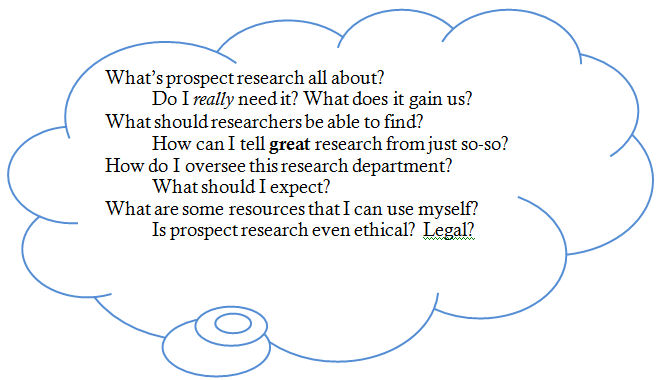
This book is going to be handy for every single front-line development officer, from the solo fundraiser in a one-person shop to the VP for Advancement overseeing a large university research department.
We’re going to highlight the successful partnerships, the innovative ground-breakers and the hair-tearing learning experiences, and our findings just may surprise you.
If you’ve ever wondered…
…then this book is for you!
We’re interviewing fundraisers and researchers to gain lots of perspectives, and the book will be chock-full of case studies and examples. We still have some space, so if you’d like to be featured for your great front-line/research collaborations, let us know!
You wouldn’t slap your donor prospect in the face would you? Of course not!
Donor Trust: Don't Lose It!
Maintaining donor trust relies upon building professional and respectful relationships between your organization and the world. Without trust there would be no giving. Without giving, charitable missions would be unfulfilled. It’s that simple.
It’s also surprisingly easy to slip down the slippery ethical slope. And a donor could feel slapped in the face by some of the information you record. Why not use your personal email to request information? Does it really matter if you use those software subscriptions to look-up your annoying neighbor?
Here are 5 steps to keep you on the ethical track:
(1) Always identify yourself
Whenever you are making requests for information you need to identify yourself. State your name, your role, and your organization. Like this: “Hello, my name is Jennifer Filla and I’m president of Aspire Research Group. I’d like to confirm the owner of a parcel of land in your county.” If this makes you uncomfortable, you probably shouldn’t be inquiring!
(2) Information recorded must deepen the donor prospect relationship
The whole point of researching donor prospects is to bring the organization and prospect closer together to further the mission – usually through a gift. So if the information found will not bring the two closer, don’t include it.That said, there are exceptions…
(3) Discuss sensitive information verbally before documenting
When information about an arrest in the prospect’s family or some other sensitive information comes to light, it can be difficult to decide whether it is relevant to the relationship. Especially with naming rights, there is the possibility of a conflict of interest. Talking it over with leadership or the person building the donor relationship helps you confirm before documenting something embarrassing.
(4) Information must be exactly accurate
Be careful to use primary sources and to avoid using value-laden terms. For example, if a blog post says good or bad things about your prospect that you can not confirm elsewhere, don’t include it because it is an undocumented opinion. If a website claims it is a “leading” supplier or the “largest in the country”, either find the source to prove it or remove those words. If Wikipedia says it’s true, click through the footnotes at the bottom to read the original sources and be sure.
(5) Treat researched information as confidential as donations
Just because you found all of this information in the public domain doesn’t mean it isn’t confidential in the form you have created. We don’t want our donors to feel creepy about the data we collect about them! That will not build trust. We want them to feel professionally handled, flattered and protected by us and our organizations.
Lately I have been reading many a headline about how donors ask and respond to good stories told by nonprofits. In the video interview with Táňa Hlavatá of Nadace Via she tells a story about the Mayor of a small village in the Czech Republic who asks for a grant to beautify space in the village. Through the project residents are engaged and community spirit is ignited. It’s a quick story but shines a bright light on the work of Nadace Via.
But what about the stories of the donors who make nonprofit work possible? Planned giving and major gift initiatives know that spotlighting donor stories encourages others to give. In my blog post, 3 Steps to Major Gift Mojo, I talk about listening to your donors as a catalyst to reinvigorate your major gift initiative.
But there is another benefit to talking to your donors. When it is done methodically, you can learn a great deal about why donors give to your organization and how to strategically reach more donors based on that information. But let me tell you a story…
While I was visiting Prague this August and September I began asking local Rotary Club members and others how they felt about giving to local nonprofits. Almost every person I spoke to could tell a story about a charity in the early 1990’s that was corrupt and stole donor money. They would only give to a charity with people involved who they knew and trusted, or to an international charity with a strong reputation.
There is no electronic screening, no purchasing of lists that could have gleaned this critical information about Prague donors. It was only by asking them, talking with them, and listening to their stories that this information came to light. How to grow the donor base? I would begin with existing donors and leverage their peer networks to grow awareness and trust. For major gifts I would research affluent social networks connected to board members.Methodically listening to your donors, perhaps through surveys or random calls in each donor segment, is valuable prospect research that will allow you to intelligently grow your donor base – whether you are focused on major gifts or all gifts.
Do you need to breathe new life into your major gift efforts? Have you been asking the same donors to stretch year after year? Contact Aspire Research Group! We can help you understand your donors better and lay a clear path on which you can methodically move more donor prospects toward gifts. Call us today at 727-231-0516 or email jen at aspireresearchgroup.com.
Cookie Consent
We use cookies to improve your experience on our site. By using our site, you consent to cookies.
Contains information related to marketing campaigns of the user. These are shared with Google AdWords / Google Ads when the Google Ads and Google Analytics accounts are linked together.
90 days
__utma
ID used to identify users and sessions
2 years after last activity
__utmt
Used to monitor number of Google Analytics server requests
10 minutes
__utmb
Used to distinguish new sessions and visits. This cookie is set when the GA.js javascript library is loaded and there is no existing __utmb cookie. The cookie is updated every time data is sent to the Google Analytics server.
30 minutes after last activity
__utmc
Used only with old Urchin versions of Google Analytics and not with GA.js. Was used to distinguish between new sessions and visits at the end of a session.
End of session (browser)
__utmz
Contains information about the traffic source or campaign that directed user to the website. The cookie is set when the GA.js javascript is loaded and updated when data is sent to the Google Anaytics server
6 months after last activity
__utmv
Contains custom information set by the web developer via the _setCustomVar method in Google Analytics. This cookie is updated every time new data is sent to the Google Analytics server.
2 years after last activity
__utmx
Used to determine whether a user is included in an A / B or Multivariate test.
18 months
_ga
ID used to identify users
2 years
_gali
Used by Google Analytics to determine which links on a page are being clicked
30 seconds
_ga_
ID used to identify users
2 years
_gid
ID used to identify users for 24 hours after last activity
24 hours
_gat
Used to monitor number of Google Analytics server requests when using Google Tag Manager
 Everyone loves online research, right? You can find out so much about a person online! But is all that information helping you in your donor prospect meetings?