Tag Archives: donor research

Are you headed for handcuffs?

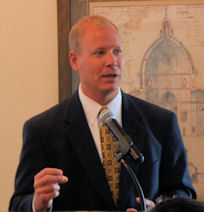
Latour “LT” Lafferty

What would you want to know about ethics from a white collar crime lawyer? I had the privilege of hearing Latour “LT” Lafferty who practices with Fowler White Boggs, give me an inside look at the downward slide away from integrity and some practical advice on how to avoid it, when he presented at the June 21, 2011 luncheon for Association of Fundraising Professionals (AFP) Suncoast chapter.

Most interesting was Lafferty’s perspective of the white collar criminal. He suggested that these are not bad people. In fact they are just like us and the people we work with. What has happened is that their unethical behavior has built up like a snowball rolling downhill in a snow storm.

The example that Lafferty gave us was simple. Say that a person submits travel or business expenses that fall slightly outside the parameters, and he is not corrected. Perhaps he is even informally rewarded. Maybe “everyone” in the organization pads expenses. He continues to submit expenses that are farther and farther out of bounds until – bam! – he is investigated for his fraud and labeled a criminal.

How do we counter this behavior? Lafferty tells us that according to John Maxwell who wrote the book, A Winning Environment, we can:

  • Hire people of good character
  • Train them
  • Inspire them with good leadership

Lafferty encouraged us to evaluate our organization’s culture and to lead in ethical behavior. He tells us that if we don’t expect, demand and reward ethical behavior, we are at risk of destroying our donor’s trust and our organization’s ability to thrive and achieve its mission. Yikes! I won’t name names, but we all know the organizations that have made the news headlines. The risk is real.

So what does that mean for the prospect researcher? While more and more researchers are finding their way to the management table many of us may feel we have little influence. I am a member of the PRSPCT-L community and the ethics issues raised online are very real and are likely to be just the tip of the iceberg. I believe anyone of any position in life can model ethics. Here’s how:

Care about ethics: Care that the donor prospects you research are treated with respect and dignity –by you!

Educate yourself: Maybe your organization won’t or can’t send to you APRA’s sensational conference, but you can participate in the list-serv discussions and read about issues of privacy and data generally –it’s everywhere! (Even Aspire Research Group has a fun 7-min. video on ethics)

Lead: Yes, I’m talking to you. All of us can lead. Open your mouth when talk of data and research arises. We can tell stories and introduce empathy with comments such as, “I read about that, but I didn’t put it in the profile because I would be so upset if someone treated me that way”.

We won’t always be heard. We won’t always be able to change the culture of our organizations. We will always be able to plant our ethical seeds and nurture them in ourselves and others. I can live with that. How about you?

Summer Reading from Helen Brown

It might not be “light” reading, but I still think you should go poolside with the suggestions from Helen Brown in her recent blog post Summer Reading: Wealth and Philanthropy.

All of the reports she mentions give great insight into donor motivations and capacity. But I can hear you moaning now: “I want to RELAX at the pool!”

All I can say to that is that I do my best philanthropy reading poolside. Sure beats being in my office. Get a blue or colored pen and circle the most important bits as you go along. When you are back at your computer, cut and paste the important bits into one document.

I went so far as to create a table with characteristics (inherited wealth, real estate wealth, etc.) in one column and the quote in the other. That way I have a quick reference guide when I’m doing my donor research profiles. Yes, it’s a little go-getter geeky, but it saves me a lot of time…

Happy reading!

Tips and Trends from Bob Carter

I am on an airplane trolling through the little notebook that I take everywhere and found my notes from Bob Carter’s talk at the APRA Florida conference. I’m realizing just how much of what he told us is showing up in the stories of the people I have been researching lately. I have to wonder if others of you are seeing these up close and personal too.

Bob Carter of previous Ketchum fame, has his own shop now, Of Philanthropy, and it is a fitting name for what he has to say. He is an engaging speaker with a global outlook. Best of all, he makes good practical sense.

The Best Solution
Carter mentioned that philanthropists are trending towards being married to the solution instead of the institution. I’ve heard this spoken of as a generational trend as well and it’s probably both, but I have written up a few donor profiles recently that demonstrate this emphatically. While the largest gifts go to the charity the donor is closest to and trusts the most to achieve the mission, giving is not guaranteed and is quickly shared with innovating organizations. Are you communicating your effectiveness at  implementing the solution?

Direct Involvement
Many speakers, not just Carter, have been talking about donors being more involved for a while now, but it has only been recently that I have seen it firsthand as so intrinsic to some donors’ giving. I heard Carla Harris speak at the AFP Florida Caucus’ Planet Philanthropy conference and she donates the proceeds of all of her gospel albums. Her occupation is Wall Street banker!

And more than usual I have been writing up donor profiles demonstrating this kind of it’s-a-way-of-life giving. I am also seeing more and more donors who don’t just give, they serve in four or five or even more volunteer capacities at the same organization!

Leveraging
Carter told the APRA Florida researchers that for every major gift there is no excuse for not getting three or four more from that donor’s network. Nothing new there, but it gave me a good kick-in-the-butt about priming my clients with possibilities when I send them a profile in preparation for solicitation. Depending on the client and the relationship I can do more than name-drop in my profiles, I can be part of the ongoing conversation and strategy.

Jennifer Kehoe of the University of Central Florida shared a great story at the APRA Florida conference about how her research department was able to add value to a major gift donor’s cultivation *throughout* and without which a gift would have been unlikely. Prospect researchers are fundraisers too – we want the big “YES” just as much as the fundraiser!

Collaborating
How do you get in with the philanthropic in-crowd in your community? Carter suggests a collaboration. The donors want it and I have watched one of my clients use a collaborative project to successfully promote the organization’s commitment and excellence to the in-crowd of philanthropists in her community. Leveraging the collaboration, donor research and excellent cultivation, she has brought her organization’s fundraising from barely there to million dollar gifts.

Provocative Ideas
But maybe the comment I liked most was when Carter talked about an organization that invited its best donors to a fundraising training. I am no longer surprised when board members show up for my Introduction to Prospect Research trainings. When board members and major donors become educated about fundraising it only makes them more effective givers. I have to wonder what other unusual cultivation activities fundraisers have begun using!

What have you been doing and seeing lately?