
Tag Archives: fundraising

Are you clinging to outdated myths about women’s giving?

Women with Spending Power = Rock Star Donors!

In just two decades there have been huge shifts in how women and men earn and give away their money. As responsible financial stewards, fundraisers need to be sure that their efforts reflect the needs of women as well as men. This post analyzes and highlights information primarily from a new study of high net worth women from The Center on Philanthropy at Indiana University. Heck, I might just convince you to make it easy for women to give to you by creating a women-only giving group!

I say that in *just* two decades there have been huge shifts, because twenty years is a relatively short period of time. From the time I started working in 1988 until now a tsunami of changes have transformed how women are treated at university and at work. My first boss, who had porn tapes delivered to the office and carried around a loaded gun, would be considered an anachronism today – and a dangerous one! And that was only twenty-three years ago.

Because such dramatic change has occurred in such a short amount of time, many of us fundraisers may still be clinging to outdated myths about women’s giving potential. These myths could cost your organization, but worse, they could cost the people who rely upon your organization to serve them.

*Women are Earning More Money*
You probably know this, but remember that women did not enter the workforce in significant numbers until about forty years ago in the 1970s. According to the Bureau of Labor Statistics (2011), women were 40% of the labor force in the 1970s and are now at about 60%. But how do those numbers translate into earning power?

The Pew Research Center published a study in 2010 that may surprise you. It demonstrated that the percentage of working women earning more than their working husbands has grown from 8% to 26% in the past two decades. A quarter of working women in a two income household are the primary breadwinner. Nice. And that is in the face of the fact that, according to the Bureau of Labor Statistics (2010), women earn about 80% of what men earn.

But the real eye-popping news is that in nearly 90% of high net worth individuals surveyed in a study by the Center on Philanthropy at Indiana University (2011), women are either the sole decision-maker or at least an equal partner in charitable decision-making. In non-research language that translates to: women decide how to give away the household dollars. How’s that for a myth-buster? Ignore women at your peril!

*Women are (Finally) Leveraging Networks*
When I was in Prague in 2009 I was invited to a lunch by another business woman. What I found was a long-standing network of women who encourage and help build each other’s success in what can still be a hostile environment for women. These women were the movers and shakers, creating new institutions and fantastic business success. It was women helping women. I have not found this kind of tight-knit camaraderie here in the U.S. But I know it exists as can be attested to by the rise of women’s giving networks.

The recently released study by The Center on Philanthropy added a layer of data to its 2010 Study of High Net Worth Philanthropy. They surveyed high net worth women from The Tiffany Circle of the American Red Cross who give $10,000 or more annually, added this data to their previous study, and published the 2011 Study of High Net Worth Women’s Philanthropy and the Impact of Women’s Giving Networks.

What I find so interesting about their choice to use The Tiffany Circle of the American Red Cross is that this giving network was created by the American Red Cross. In the past I have read numerous articles about women creating their own giving circles, but clearly some nonprofits have seen the “dollars written on the wall” and proactively created environments where women can thrive in philanthropy. Yes, you can do this too!

*What do Women in Giving Networks Expect Most?*
Before we go into what The Center on Philanthropy found out when questioning these high net worth networked givers (try saying that quickly!), I feel it is very important to note that in their 2010 study they discovered that 60.2% of women and 55.7% of men gave for general operating support. Really, really. In fact, only 15.9% of men and 10.8% of women were likely to donate for capital, construction or equipment. So it’s safe to say that at least HALF of high net worth donors will give general operating dollars. That’s HUGE! Living up to their expectations now takes on a whole new level of importance, doesn’t it?

The Center on Philanthropy found gender differences in these top indicators of donor expectations:

W=women  M=men  WIN=women in a network

  • Honor request for use of gift:  W-80.4%  M-68.4% WIN-89.3%
  • Send thank you note: W-60.4%   M-52.1%  WIN-66.1%
  • Communicate the impact of the gift: W-45.3  M-26.4% WIN-55.6%
  • Provide ongoing communication: W-45.1%  M-34.5%  WIN-49.6

Notice that men differ dramatically in two of these expectations (underlined for emphasis) and that women in a network have higher expectations for these items across the board. If you are going to create a woman’s giving network at your nonprofit, these are key items to take note of as you plan how to communicate with your new group.

*What Motivates Women in Giving Networks to Give*
We know from the Center on Philanthropy’s 2010 study that the more high net worth donors volunteered, the more they gave. However, personal experiences with an organization are more important to women. In the world of statistics this number is a big one: 90.8% of The Tiffany Circle women reported that they volunteered.

The study doesn’t attempt to find causes for this behavior, but it is reassuring to hear that women are more likely to have confidence in the ability of nonprofits to solve domestic or global problems (50.4% of women vs. 33.8% of men).

The Center on Philanthropy found gender differences in these top indicators of donor motivations:

W=women  M=men  WIN=women in a network

  • Moved at how gift can make a difference*: W-81.7%   M-70.9%   WIN-86.9%
  • Can give back to the community: W-78.2%  M-63.3%  WIN-87%
  • When a nonprofit is efficient in its use of donations: W-80.5%  M-69.2% WIN-86%
  • Volunteer at an organization: W-65.7  M-49.8%  WIN-73.1%

(*This was THE top motivator for men and women. Yes, we all know this, but validation from a study feels good too.)

Here we notice that men differ dramatically in one of these expectations (underlined for emphasis) and that again women in a network are more motivated by these items across the board. If you are going to create a woman’s giving network at your nonprofit, all of the above motivators should be emphasized.

Remember to bury those entrenched donor myths! Yes, these donors are motivated when you demonstrate efficient use of funds. And YES, they will give to general operating too. This study says at least half will. Make a strong case for general operating and they will give.

*Why do Women in Giving Networks STOP Giving?*
The top reason for women and men to stop giving is because they were solicited too frequently or were asked for an inappropriate amount. The big news? It’s not as important to women as it is to men. Only 49.3% of women cite this reason, but 61.2% of men do.

This is where I get to emphasize how important it is to methodically approach your annual fund appeals and test to discover the right message and the right number of appeals. And if you are going to ask one of your close donor friends to step up and make a stretch gift, it is only respectful to get an in-depth, researched donor profile. Nearly half of your women donors and more than half of your male donors are offended when you don’t care enough to do your homework before asking for a gift.

*Summing it All Up*
More women are working, more of these women are earning more, and women are organizing together to give. The big myth busters?

  • A quarter of working women in a two income household are the primary breadwinner.
  • Women are either the sole or equal decision maker on how to give away household dollars.
  • At least HALF of high net worth donors (female and male) will give general operating dollars.

Key takeaways from the Center on Philanthropy study:

  • Honoring your donor’s request for use of a gift is important for women and men, but much more important for women.
  • Women and men are most likely to be moved by how a gift can make a difference, but it is more important for women.
  • Volunteering and other personal experiences of a nonprofit are more important to women than men.
  • Nearly half of your women donors and more than half of your male donors are offended when you don’t care enough to do your homework before asking for a gift. Asking for an inappropriate size gift could cost you a donor.

Women are steadily becoming a financial force to be reckoned with and even more than men they like to be strategic and collaborative in their giving. Providing women with a way to organize their giving to you that recognizes their needs and preferences will help your organization gain access to this growing population of high net worth individuals. Don’t the people you serve deserve this?

*About Aspire Research Group*
Aspire Research Group was founded so that every development office could have the benefits of professional prospect research. We analyze donor databases to help fundraisers understand their donors better, create systems to help them reach major gift and campaign goals, and provide comprehensive profiles to empower fundraisers to qualify and ask donors for the “right” gift. We use our direct fundraising experience to craft research solutions that answer the questions that lead to more and higher gifts, guiding fundraisers comfortably every step of the way. Contact us for more information or visit us at www.AspireResearchGroup.com

*About the Study*
The 2011 Study of High Net Worth Women’s Philanthropy and the Impact of Women’s Giving Networks was written and researched by The Center on Philanthropy at Indiana University and sponsored by Bank of America Merrill Lynch. It can be accessed online here:
http://tinyurl.com/HNWwomen

Meg Whitman agrees to work for $1 – or does she?

by Kate Rapoport.

Compensation structures for highly paid executives in public companies are often a tangle of legalese, difficult to parse. The Security and Exchange Commission (SEC) requires that all public companies detail the compensation of their highest paid executives, but that doesn’t mean that what the companies report is straightforward. In recent years, many companies have gone from giving executives large sums of money each year, regardless of company performance, to trying to create a compensation structure that depends significantly upon the actual performance of the executive and the success of the company.

One example of this is the compensation package that Meg Whitman received when she joined Hewlett Packard in September 2011 as Chief Executive Officer. The former CEO of EBAY, Meg Whitman ran an unsuccessful campaign for California Governor in 2010. She was brought on as CEO at HP after a year on their board.

Ms. Whitman will receive $1 a year in salary. According to the Wall Street Journal, the $1-a-year CEO isn’t uncommon at tech companies. Eric Schmidt, Larry Page and Sergey Brin at Google and Apple CEO Steve Jobs have also worked for $1 a year.

However, one dollar is just the beginning of her potential compensation. She will also receive an annual bonus of at least $2.4 million with the possibility of increasing that bonus up to $6 million depending on the cash flow performance of the company.

The biggest percent of her compensation package involves stock options. Stock options have been around quite a while as an executive incentive tool. Options require the executive to purchase the stock with her own money at a predetermined “exercise price”. The options are only valuable if the market value of the stock she purchases is greater than her exercise price. If the market value of the stock has gone down from the exercise price, she earns nothing or could lose money by choosing to exercise the option.

Ms. Whitman received an option to purchase 1.9 million shares of HP. The exercise price will be equal to the market value of the shares on the date she received the options. The options will vest over an eight-year period; however, they will only be considered fully vested if HP’s share price rises by 40 percent or more. In September when she took the job, that number of shares was worth $45.2 million.

100,000 of those shares will vest on each of the first three anniversaries of her hire date if she stays with the company. 800,000 shares will vest after the first year, IF HP’s share price has risen 20 percent and stayed that high for at least 20 days. The final 800,000 shares will vest on the second anniversary of her hire, IF HP’s share price has risen 40 percent for more than 20 days. If she succeeds in raising HP’s share price 40 percent in the next eight years, she would make profit of $17 million.

This type of compensation package reflects companies’ desire in recent times to compensate executives based on what they can do for the company, not just because she is friends with the directors on her board. Ideally, this should save the company money in the short term and encourage high performance from the executive in question.

Hewlett Packard also included an incentive for Ms. Whitman to stay with the company for the long haul, making her severance benefit payment 1.5 times the sum of her annual base salary, or $1.50 plus the average of her bonuses paid in the last three years. If she left before the first year was out, she would receive less than $2 in compensation. That would certainly make me want to stay!

Here’s hoping the company has learned a lesson from its handling of Ms. Whitman’s sacked predecessor, Leo Apotheker, whose severance was $9.6 million and $3.5 million in stock even those his performance was dismal.

We're Writing a Book!

Helen Brown of The Helen Brown Group and I have just signed a deal with John Wiley & Sons to write Prospect Research for Fundraisers: The Essential Handbook.  We’re thrilled!

This book is going to be handy for every single front-line development officer, from the solo fundraiser in a one-person shop to the VP for Advancement overseeing a large university research department.

We’re going to highlight the successful partnerships, the innovative ground-breakers and the hair-tearing learning experiences, and our findings just may surprise you.

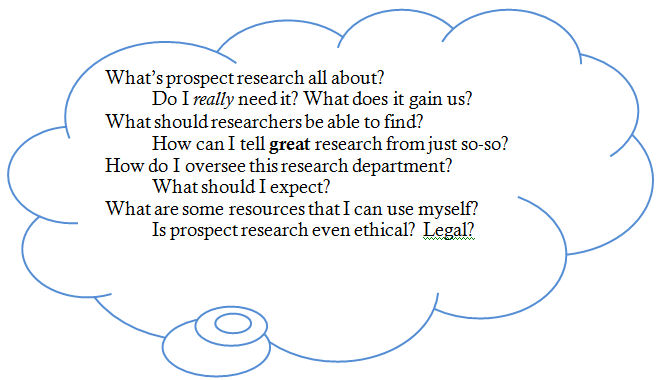
If you’ve ever wondered…

…then this book is for you!

We’re interviewing fundraisers and researchers to gain lots of perspectives, and the book will be chock-full of case studies and examples.  We still have some space, so if you’d like to be featured for your great front-line/research collaborations, let us know!

Visit www.Research4Fundraisers.com and sign-up to be included in book announcements, or email questions or comments to  me directly at: jen at aspireresearchgroup.com. I’m looking forward to hearing from you!

5 Steps to Fundraising Research Ethics

You wouldn’t slap your donor prospect in the face would you? Of course not!

Donor Trust: Don't Lose It!

Maintaining donor trust relies upon building professional and respectful relationships between your organization and the world. Without trust there would be no giving. Without giving, charitable missions would be unfulfilled. It’s that simple.

It’s also surprisingly easy to slip down the slippery ethical slope. And a donor could feel slapped in the face by some of the information you record. Why not use your personal email to request information? Does it really matter if you use those software subscriptions to look-up your annoying neighbor?

Here are 5 steps to keep you on the ethical track:

(1)  Always identify yourself
Whenever you are making requests for information you need to identify yourself. State your name, your role, and your organization. Like this: “Hello, my name is Jennifer Filla and I’m president of Aspire Research Group. I’d like to confirm the owner of a parcel of land in your county.” If this makes you uncomfortable, you probably shouldn’t be inquiring!

(2) Information recorded must deepen the donor prospect relationship
The whole point of researching donor prospects is to bring the organization and prospect closer together to further the mission – usually through a gift. So if the information found will not bring the two closer, don’t include it.That said, there are exceptions…

(3)  Discuss sensitive information verbally before documenting
When information about an arrest in the prospect’s family or some other sensitive information comes to light, it can be difficult to decide whether it is relevant to the relationship. Especially with naming rights, there is the possibility of a conflict of interest. Talking it over with leadership or the person building the donor relationship helps you confirm before documenting something embarrassing.

(4) Information must be exactly accurate
Be careful to use primary sources and to avoid using value-laden terms. For example, if a blog post says good or bad things about your prospect that you can not confirm elsewhere, don’t include it because it is an undocumented opinion. If a website claims it is a “leading” supplier or the “largest in the country”, either find the source to prove it or remove those words. If Wikipedia says it’s true, click through the footnotes at the bottom to read the original sources and be sure.

(5)  Treat researched information as confidential as donations
Just because you found all of this information in the public domain doesn’t mean it isn’t confidential in the form you have created. We don’t want our donors to feel creepy about the data we collect about them! That will not build trust. We want them to feel professionally handled, flattered and protected by us and our organizations.

Aspire Research Group is a member of the Association of Professional Researchers for Advancement (APRA), a member of the Association of Fundraising Professionals (AFP) and endorses the Code of Ethical Principles and Standards of both organizations.

If you would like to learn more, why not watch the fun 7-minute video on ethics and prospect research below?

Mission Brilliant Podcasts

Karen Eber Davis is a consultant on a mission to ensure fully resourced, creative and effective nonprofit organizations. On her website she features some free resources including her Mission Brilliant Podcasts. These podcasts are interviews with experts on topics such as events, tax, auctions, using video …and even prospect research.

Check out her podcasts and I bet you’ll find something relevant to your organization!

Will Your Donors Talk to You?

Your donors sound so good!

Lately I have been reading many a headline about how donors ask and respond to good stories told by nonprofits. In the video interview with Táňa Hlavatá of Nadace Via she tells a story about the Mayor of a small village in the Czech Republic who asks for a grant to beautify space in the village. Through the project residents are engaged and community spirit is ignited. It’s a quick story but shines a bright light on the work of Nadace Via.

But what about the stories of the donors who make nonprofit work possible? Planned giving and major gift initiatives know that spotlighting donor stories encourages others to give. In my blog post, 3 Steps to Major Gift Mojo, I talk about listening to your donors as a catalyst to reinvigorate your major gift initiative.

But there is another benefit to talking to your donors. When it is done methodically, you can learn a great deal about why donors give to your organization and how to strategically reach more donors based on that information. But let me tell you a story…

While I was visiting Prague this August and September I began asking local Rotary Club members and others how they felt about giving to local nonprofits. Almost every person I spoke to could tell a story about a charity in the early 1990’s that was corrupt and stole donor money. They would only give to a charity with people involved who they knew and trusted, or to an international charity with a strong reputation.

There is no electronic screening, no purchasing of lists that could have gleaned this critical information about Prague donors. It was only by asking them, talking with them, and listening to their stories that this information came to light. How to grow the donor base? I would begin with existing donors and leverage their peer networks to grow awareness and trust. For major gifts I would research affluent social networks connected to board members.Methodically listening to your donors, perhaps through surveys or random calls in each donor segment, is valuable prospect research that will allow you to intelligently grow your donor base – whether you are focused on major gifts or all gifts.

Do you need to breathe new life into your major gift efforts? Have you been asking the same donors to stretch year after year? Contact Aspire Research Group! We can help you understand your donors better and lay a clear path on which you can methodically move more donor prospects toward gifts. Call us today at 727-231-0516 or email jen at aspireresearchgroup.com.

Facial Recognition Software & Donors

Does facial recognition software violate our privacy? What if we want to use it on donor prospects? The Economist wrote an article, Anonymous No More, in its 7/30/11 issue. It describes how facial recognition software has improved to the point that in the best scenarios you can feed a picture into it and discover personal information on one-third of individuals. Now, obviously, that means that two-thirds remain “anonymous”, but it does demonstrate that picture-based research is viable and will improve.

As it stands now, I start with personal information (name and address or occupation) and find my way to a matching photo. In the not-to-distant future I can imagine subscribing to software that allows me to take fundraising event photos and identify the people in them – perhaps even automatically screening them for wealth.

Now try to guess who has developed a facial recognition search engine? You guessed it! Google. But they have decided not to release it. Why? Because of the sensitivity around the subject of… [drum roll]… privacy! Now try to guess who isn’t afraid to use facial recognition. Facebook. U.S. Government. Prospect researchers? Hmmm.

Is there privacy left to care about?

It is very clear that the media likes to wheeze on about privacy (even in light of the recent Murdoch news scandals) and equally clear that most of humanity really does not care about privacy. We are happy to trade our personal information for discounts, convenience and even fun. Or are we? Mostly we are okay giving away personal information when we are asked and get something we value in return. It’s when we get duped, fooled, or humiliated that our hair stands on end. And I am grateful to the journalists who report on those abuses.

When does privacy really matter?

If your donors feel that their privacy has been compromised by you they will stop giving. Worse, they might start saying bad things about your organization and get others to stop giving. Privacy matters.

Having a donor privacy policy will go a long way toward helping your organization communicate its actions with donors, but it is not enough to keep you out of trouble. Common sense, empathy and good recordkeeping are required.

For example, just because you found your donor’s unlisted telephone number on her voter’s registration record doesn’t mean she won’t be offended when your president calls her asking for a visit. Was it found in the public domain – yes. Was it in the donor record as a contact number – yes. Did the donor feel her privacy was violated – YES! There are no shortcuts to establishing meaningful relationships.

Facial recognition software is most likely going to do “quiet” tasks like match faces from our organization Facebook pages or constituent forums with photos in our donor database to create deeper relationship maps. That’s not nearly as scintillating as using event photos to identify wealthy prospects, is it? But it is more efficient and respectful.

More info on ethics and privacy:

Aspire Research Group’s Ethics Video
Letter to Board Members on Privacy and Prospect Research
APRA Statement of Ethics
AFP Code of Ethical Principles and Standards

3 Steps to Major Gift Mojo!

Not infrequently fundraisers want to talk to me about finding major gift prospects who are outside of the donor database. Often they have been asking the same group of donors and need to expand their reach.

Too frequently I find out that they have not screened or mined their own donor database for good prospects! Screenings come with a price tag that can be hefty for some and getting management to invest often requires some educated persuasion.

Consider the following plan for jump-starting your fundraising confidence and creating results you can demonstrate to management.

Phase One

  • Pull a list of your top lifetime donors and start calling and visiting to thank them
    • They will be mucho flattered because many will not be wealthy and the lifetime giving will be a significant number. They all make great planned giving prospects
  • Pull a list of your one or two-year lapsed donors by lifetime giving and largest gift
    • Schedule visits with any excuse: wanted to recognize your lifetime contributions with a chatke; wanted you to meet our new CEO; wanted to thank you and tell you about new initiatives you made possible.
  • Consider asking your gift entry/database administrator to make some thank you calls to top-end annual fund donors
    • Pick a list of people similar to your employee to make it easy to relate
    • Already too busy? Make one phone call a day
    • Success in a new task is invigorating! Expect your employee grow

Phase Two

Do not just pull lists…

Pick a concrete time-period – say three months – and blitz call and visit. Every. Single. Day. Especially if you haven’t done much visiting in the past! You will have friendly, feel-good visits that will build your confidence and reward your donors with the stewardship they so deserve. Any excuse for calling will do, but sincerely thanking, recognizing and telling them what their gifts have accomplished is numero uno.

Phase Three

After the designated time period, stop and evaluate. This is important. You will be amazed what your donors tell you and you will be better able to strategize your future efforts. This is where you begin rating which prospects are likely to make major gifts and you will now know how to better recognize them in your database. Check out the Aspire Research Group paper on creating a moves management system.

Looking for customized help with your donor lists? Contact Aspire Research Group today!

Work smarter, not harder. Because you’ll have your major gift mojo of course!

Millionaires use Social Media

In a Wall Street Journal blog post, Robert Frank reports that “According to a survey of millionaires from Fidelity Investments, 85% of respondents use text-messaging, smartphone applications and social media.  One third use social media professionally, with 28% using LinkedIn.”

Are Millionaires Talking to You?
Over the past couple of years I have been hearing prospect researchers talk about mining Facebook and alumni forums for phone numbers and emails. More recently I’ve been hearing that gift officers are communicating with their major gift prospects on LinkedIn, Facebook and, yes, even Twitter.

Sometimes it is obvious that the donor prospect is oblivious to how public these forums are or can be. But mostly I am hearing that the donor prospect initiates the contact through social media.

For Donors, Philanthropy is Personal, not Professional
If 85% of respondents are using social media, but only 33% of them use it “professionally”, it makes me speculate that donor prospects view their giving as “personal” not “professional” activities. Kind of obvious, huh?

So why should we care if millionaires are using social media? Well, for fundraising it’s a no-brainer. Our organizations need to be engaging and involving donors in social media as another cultivation tool in the toolbox. But what about prospect identification and qualification?

Social Media for Identification and Qualification
The murky issues of privacy and trust begin to swirl when we talk about mining data from social media – especially with privacy conscious millionaires! But I also think that using social media in fundraising serves to highlight how prospect researchers and fundraisers work best when working together. Here’s how:

(1) If a gift officer is invited to friend a donor prospect over a private network, it is the same as visiting the prospect in her/his home. You get to view the photographs on the mantel – so to speak – such as pages liked, friends, photos, videos and of course, posts. But that information can only be known and used by a researcher if it is communicated (yes, I’m talking about notes in the database as well as verbal conversations)

(2) A prospect researcher shouldn’t ignore relevant public information, even when it is left open on a social media network. Conversations with the gift officer might be necessary and wise before saving personal information gleaned from Twitter, blogs, Facebook etc., but key insights into giving motivations can be found and should be communicated. We never, ever want to record embarrassing things on a donor prospect record, but ignoring social media is not acceptable either.

More on Privacy and Prospect Research
If you want to learn more about privacy and prospect research, check out the video below by Aspire Research Group that puts a little fun into the subject. For comprehensively researched prospect profiles, click here.

How to get from $250k to $40m

You *want* to read this story about how the Wishard Foundation took a donor prospect from “If you’re coming to ask for money, I don’t even want to meet with you” to a $40 million naming gift. And when you’re done come back to this post and I’ll tell you what the prospect researchers were doing behind the scenes!

Where’s the Researcher?
Okay, if you look at the Wishard Foundation Staff page you won’t see a prospect researcher listed, but with that many gift officers and a manager of development services you’d at least expect a gift entry person, so let’s just speculate that there is someone with at least partial responsibility for research.

Getting the Edge with Donor Profiling
The president comes back from meeting a multi-millionaire who tells him to come back with a fundraising proposal and to make it “bold”. I betcha President Vargo was HOT for every scrap of information that could be found on Mr. and Mrs. Eskanazi. In my imagination I can see that prospect researcher sweating it out hour after hour, posting questions on PRSPCT-L, calling her APRA colleagues for tips and finally, hopefully, being a part of the conversation with the president about how much to ask for.

Identification – The First Step
But we all know prospect research happened MUCH earlier in the process, right? Somehow Mr. and Mrs. Eskanazi were identified and qualified for a $250,000 first gift. President Vargo’s amazing feat was to establish high affinity in one meeting. Granted, there was luck involved (they were looking for a legacy opportunity), but Vargo was ready. Mr. and Mrs. Eskanazi were identified and Vargo told a really powerful story. Pair that up with luck and presto! The Wishard Foundation received a $40 million gift. That is success!

Do you want a Professional Prospect Researcher?
If you don’t have a prospect researcher in-house, do not lament! Aspire Research Group can help you from identification all the way through to the ultimate solicitation. Check out our rating, profile and consulting services. Unfortunately, our magic wand is out for repair so we can’t manage the luck part right now, but we’re working on it.