Tag Archives: fundraising

Prospect Research Has Always been Mainstream

When asked by Blackbaud’s NonprofitTrends blog, Jay Frost tells it straight: prospect research has always been mainstream. And it feels so good to hear someone else saying it! Every time you find a quick company bio or a phone number on your prospect you are performing prospect research.

But Jay doesn’t stop there:

The danger in not making the distinction between the type of cursory review most offices do and the kind of work performed by a professional prospect research unit is that they miss opportunities, ask for too little and, because they are spending time looking things up rather than seeing donors, they ask less often than they could. All of these things put organizations without professional level prospect research at a significant short and long term fundraising disadvantage. [emphasis added]

So what does that mean to you as a fundraiser? You have to research stuff on your own because otherwise it wouldn’t happen, right? But Jay is not advocating all or nothing. I like to use the plumber analogy.

I am a do-it-yourselfer and I am not afraid to plunge a clogged drain or change the washer on a faucet. But if I told you that I was an expert plumber because I could plunge a drain or change a washer you would definitely have to stifle a giggle. And if I attempted to repair a leaking supply pipe I could end up wasting hours of time and end up in a pool of water.

So learn some basic search techniques and find what you need for that first donor prospect visit. But as cultivation deepens and you involve leadership or begin approaching the solicitation, don’t skimp on professional prospect research. If you need help identifying prospects for your campaign, don’t wait until you are struggling to reach your goal. Use professional prospect research before you risk thousands, perhaps millions, in gifts.

Aspire Research Group sells a fabulous how-to tool, Search Tips for Fundraisers, that has been helping fundraisers use their time effectively. At Aspire Research Group we recognize the fundraiser’s reality and craft solutions that empower you to effectively close on your major gifts. Check us out sometime at www.AspireResearchGroup.com.

How to Find Giving History

A great way to qualify a prospect and gain insight on a donor is to learn about the person’s giving history with other organizations. This demonstrates philanthropic inclination and aids in determining how much to ask for. But where do you find this lucrative information?

The Vendors
There are vendors who crawl through the web and/or scan and index printed donor recognition reports (NOZA, DonorSearch, iWave, WealthEngine). You type in the name and maybe some other criteria, and the software lists all the gifts found that match that name as a donor.

Do it Yourself
You can do the same thing using search engines, but it can be a bit hairy if your prospect has a very common name. And you won’t find old listings that have been removed from the internet. Using Google, click on the Advanced Search link found somewhere near the search box. This gives you a form to complete. Fill in the blanks under Find web pages that have… as needed. Try different combinations of the prospect name, including maiden and nicknames. But the real magic happens under the Need More Tools? options.

Search within a site or domain
You have a few ways to play with the Search within a site or domain option. You can choose just “.edu” or “.org” or you might choose the domain of an organization you know your prospect has an affinity with such as “afpsuncoast.org”. Once you start to fool around with these options you will find what you want much more quickly.

What if I don’t find any giving?
Just because a vendor or your own searches do not turn up any record of giving does NOT mean your prospect does not make gifts. Many organizations never publish the names of their donors. Does your organization publish donor lists? If you do not find any giving, and even if you do, you have a few options still available to you to determine philanthropic inclination.

  1. Does the person volunteer, serve as board member or is involved in some other way with charitable organizations? (Don’t forget church membership here.) People who are involved are more likely to give.
  2. Does the person attend lots of charity benefits and events? Sometimes an area has a culture of charity events and donors are not really asked for other gifts.
  3. Check for Federal Election Campaign Contributions (www.opensecrets.org) because these donations are correlated positively with charitable giving.
  4. If you know where she went to school, search that domain for your prospect’s name. Many schools publish every alumni donor, regardless of gift size.

Should I Do it Myself?
If you are a fundraiser, using these tools can give you a quick information edge as you qualify and cultivate your donor prospects. But you will find that if you get carried away trying to do all your own donor research two things are likely to happen:

  1. You will spend less time cultivating, asking and stewarding your gifts, which results in fewer gifts; and
  2. You will be much more likely to ask for smaller gifts than you might if you were better informed about your prospect.

Do I think you should know some basic prospect research techniques? You betcha! It’s a life skill these days. Just make sure you spend most of your time with your donors, not behind your computer screen.
(Re-printed from the July 2011 e-news: Information Seeking)

What is Really Blocking your Success?

Carla Harris

So many fundraisers work for organizations that do not value fundraising. Are you in one of them? Do you go to work, have your hands tied, get thrown into a padlocked trunk, tossed into a pool and then told to go raise millions? If this sounds like your fundraising experience, here is a hot tip from Carla Harris that might just help you begin to turn the situation around.

Why Fundraising?
There are many reasons why fundraising gets discounted. One situation might be that the dollars raised are a small percentage of overall revenue. Healthcare is an obvious example of this. If the organization’s balance sheet is the CEO’s number one indicator of success, fundraising as a source of revenue could be way down at the bottom, so why invest much in it?

We all know the answer to that question – mission! Fundraising makes our organization’s mission achievable by adding and expanding services to the community for which there is no other source of revenue. For example, the needs of cancer patients and their families dramatically increase as the disease progresses, which coincides with a decline in their ability to meet those needs emotionally, spiritually and financially. No insurance or government payment covers that!

Carla Harris was a keynote speaker at the 2011 Planet Philanthropy conference put on by the AFP Florida Caucus. A Wall Street banker, she overcame confidence squashing early in her career and has had tremendous success on many levels. She is a banker, gospel singer, mentor and volunteer.

When You are Not in the Room
One of the many fine points she made during her presentation and in her book, Expect to Win: Proven Strategies for Success from a Wall Street Vet, was that most of the decisions made about your career happen when you are not in the room. So true, right? Think how decisions are made about promotions, pay raises, and new hires. I bet that most decisions on fundraising budgets, staff size, office space and more are made when you, the development staff, are not in the room.

Three Adjectives
She advocates deciding on three adjectives that you wish other people used to describe you when you were not in the room. Once you have your adjectives start using them! Use those specific words in your own speech. You need to eat, breathe and sleep like those adjectives. Doing this trains others (and hey, maybe even yourself) to see you like those adjectives – because you *are* those adjectives.

Why not do the same thing for your fundraising department? The adjectives should be based on the skills required to fundraise with excellence. However, if fundraising is not being valued in your organization, first find out what *is* being valued and why. Listen for the words your own CEO uses frequently to define her and the organization’s success. Then you can use those words and demonstrated actions to begin positioning fundraising as the successful, revenue-generating, mission-achieving engine that it is!

Are you headed for handcuffs?

Latour “LT” Lafferty

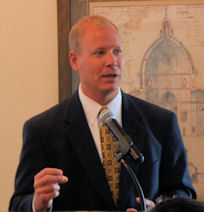
What would you want to know about ethics from a white collar crime lawyer? I had the privilege of hearing Latour “LT” Lafferty who practices with Fowler White Boggs, give me an inside look at the downward slide away from integrity and some practical advice on how to avoid it, when he presented at the June 21, 2011 luncheon for Association of Fundraising Professionals (AFP) Suncoast chapter.

Most interesting was Lafferty’s perspective of the white collar criminal. He suggested that these are not bad people. In fact they are just like us and the people we work with. What has happened is that their unethical behavior has built up like a snowball rolling downhill in a snow storm.

The example that Lafferty gave us was simple. Say that a person submits travel or business expenses that fall slightly outside the parameters, and he is not corrected. Perhaps he is even informally rewarded. Maybe “everyone” in the organization pads expenses. He continues to submit expenses that are farther and farther out of bounds until – bam! – he is investigated for his fraud and labeled a criminal.

How do we counter this behavior? Lafferty tells us that according to John Maxwell who wrote the book, A Winning Environment, we can:

  • Hire people of good character
  • Train them
  • Inspire them with good leadership

Lafferty encouraged us to evaluate our organization’s culture and to lead in ethical behavior. He tells us that if we don’t expect, demand and reward ethical behavior, we are at risk of destroying our donor’s trust and our organization’s ability to thrive and achieve its mission. Yikes! I won’t name names, but we all know the organizations that have made the news headlines. The risk is real.

So what does that mean for the prospect researcher? While more and more researchers are finding their way to the management table many of us may feel we have little influence. I am a member of the PRSPCT-L community and the ethics issues raised online are very real and are likely to be just the tip of the iceberg. I believe anyone of any position in life can model ethics. Here’s how:

Care about ethics: Care that the donor prospects you research are treated with respect and dignity –by you!

Educate yourself: Maybe your organization won’t or can’t send to you APRA’s sensational conference, but you can participate in the list-serv discussions and read about issues of privacy and data generally –it’s everywhere! (Even Aspire Research Group has a fun 7-min. video on ethics)

Lead: Yes, I’m talking to you. All of us can lead. Open your mouth when talk of data and research arises. We can tell stories and introduce empathy with comments such as, “I read about that, but I didn’t put it in the profile because I would be so upset if someone treated me that way”.

We won’t always be heard. We won’t always be able to change the culture of our organizations. We will always be able to plant our ethical seeds and nurture them in ourselves and others. I can live with that. How about you?

Tips and Trends from Bob Carter

I am on an airplane trolling through the little notebook that I take everywhere and found my notes from Bob Carter’s talk at the APRA Florida conference. I’m realizing just how much of what he told us is showing up in the stories of the people I have been researching lately. I have to wonder if others of you are seeing these up close and personal too.

Bob Carter of previous Ketchum fame, has his own shop now, Of Philanthropy, and it is a fitting name for what he has to say. He is an engaging speaker with a global outlook. Best of all, he makes good practical sense.

The Best Solution
Carter mentioned that philanthropists are trending towards being married to the solution instead of the institution. I’ve heard this spoken of as a generational trend as well and it’s probably both, but I have written up a few donor profiles recently that demonstrate this emphatically. While the largest gifts go to the charity the donor is closest to and trusts the most to achieve the mission, giving is not guaranteed and is quickly shared with innovating organizations. Are you communicating your effectiveness at  implementing the solution?

Direct Involvement
Many speakers, not just Carter, have been talking about donors being more involved for a while now, but it has only been recently that I have seen it firsthand as so intrinsic to some donors’ giving. I heard Carla Harris speak at the AFP Florida Caucus’ Planet Philanthropy conference and she donates the proceeds of all of her gospel albums. Her occupation is Wall Street banker!

And more than usual I have been writing up donor profiles demonstrating this kind of it’s-a-way-of-life giving. I am also seeing more and more donors who don’t just give, they serve in four or five or even more volunteer capacities at the same organization!

Leveraging
Carter told the APRA Florida researchers that for every major gift there is no excuse for not getting three or four more from that donor’s network. Nothing new there, but it gave me a good kick-in-the-butt about priming my clients with possibilities when I send them a profile in preparation for solicitation. Depending on the client and the relationship I can do more than name-drop in my profiles, I can be part of the ongoing conversation and strategy.

Jennifer Kehoe of the University of Central Florida shared a great story at the APRA Florida conference about how her research department was able to add value to a major gift donor’s cultivation *throughout* and without which a gift would have been unlikely. Prospect researchers are fundraisers too – we want the big “YES” just as much as the fundraiser!

Collaborating
How do you get in with the philanthropic in-crowd in your community? Carter suggests a collaboration. The donors want it and I have watched one of my clients use a collaborative project to successfully promote the organization’s commitment and excellence to the in-crowd of philanthropists in her community. Leveraging the collaboration, donor research and excellent cultivation, she has brought her organization’s fundraising from barely there to million dollar gifts.

Provocative Ideas
But maybe the comment I liked most was when Carter talked about an organization that invited its best donors to a fundraising training. I am no longer surprised when board members show up for my Introduction to Prospect Research trainings. When board members and major donors become educated about fundraising it only makes them more effective givers. I have to wonder what other unusual cultivation activities fundraisers have begun using!

What have you been doing and seeing lately?

Dating Donors, Data Mining & Donor Profiles -oh my!

Roxie Jerde, President & CEO, Community Foundation of Sarasota County

by Jen Filla.

I had the pleasure of hearing Roxie Jerde speak at the AFP SW FL luncheon on May 10, 2011. She is the new president and CEO of the Community Foundation of Sarasota County, having previously been with the Greater Kansas City Community Foundation. She packed a lot of information into her 20-minute slot. Thank you Roxie!

First, as the new person on the block, she made an interesting comment. She told us that she will not accept offers to meet for coffee or lunch. Instead she invited herself into our organizations. That really resonated with me. Since moving to Florida I have spent a lot of time getting to know the organizations operating in my area and that has meant of lot of driving and a lot of tours. For someone who works on billable hours this is an expensive investment! But I have never left a visit with an organization and felt it was a waste of time. There is so much culture, pride, and action packed into the buildings and places where fundraisers realize their missions.

Roxie also reviewed the Giving USA statistics, which reflected giving in 2009 (2010 is due out in June). Here’s a breakdown of giving in the U.S.

  • Individuals -75%
  • Foundations -13%
  • Bequests – 8%
  • Corporations -4%

Ho, hum, yawn, we’ve all seen this before. BUT have you actually gotten the statistics out of your own donor database? This kind of data mining yields key information you *must* know to create an intelligent fundraising strategy. Does somewhere around 75% of your funding come from individuals? If not, why? Every organization is different, so it might not make sense for your percentages to match the country’s giving overall, but if you differ significantly you’ll want to investigate whether you do indeed have the best strategy for your organization.

Roxie Jerde

Peppered throughout her presentation Roxie referred to the donor gift cycle as dating. Yes, most of us have heard this before too, but Roxie took it to a new level. In a previous position she and her staff used the dating terminology instead of the usual fundraising terms. It was endearing and funny to hear her talk about how blind dates can work too (prospecting), what it’s like to be newly married and still in the honeymoon stage (a major gift) and then, down the road, planning for your golden years (planned giving). Words are powerful tools and using dating words can create a much needed shift in how we interact with our donors.

Near the end of her presentation Roxie talked a little bit about asking for a major gift. She mentioned the uncertainty around how much to ask for and the drawbacks of asking for too much or too little. Being as passionate as I am about using prospect research to inform cultivation and solicitation it was all I could do to sit quietly. Profiles! DONOR PROFILES! I wanted to shout.

Donor profiles provide an awe inspiring amount of information to aid in determining an ask amount. Time and again fundraisers have told me how much more confidence they have asking for the gift when they can base it on known assets *and* their gut feelings. Development shops using prospect research, including donor profiles, ask for and receive larger gifts.

Too many human services and other similar organizations are not receiving their share of million dollar gifts and it is not because they don’t attract million dollar donors. It is because they don’t ask for million dollar gifts from their very own donors who are capable of giving them.

If you want to find out how Aspire Research Group can help you find your million dollar donors, just ask us! Call 727-231-0516, email jen at aspireresearchgroup.com or visit our website for more information, www.aspireresearchgroup.com

Cooking up Planned Giving with Julia Child

by Kate Rapoport.

I met Julia Child when I was a senior at Smith College. It was the first annual Julia Child Day at Smith, an event designed to honor Ms. Child and the revolution she had brought to the way Americans think about food. Julia Child was a Smithie herself, having graduated in 1934 with a degree in history. Even in her old age, she was a force to be reckoned with, her strong voice carrying as she talked to her many admirers. She had had an affection for Smith in the many years after graduation and had decided in her later years to include the college in her planned giving.

In Nonprofit Essentials: Major Gifts, Julia Ingraham Walker outlines the different types of planned gifts. These include gifts of marketable securities, donated art or other real property, charitable lead trusts which provide a stream of income over a period of years to the non-profit and then revert back to the donor at the end of the agreed upon time, and real estate that is gifted to the non-profit which the non-profit then sells.

Ms. Child chose the planned giving option of donating her house to Smith College. In 1990, she entered into an agreement with Smith, formally donating her house to the college, but keeping the right to live in it for her lifetime. She had lived in her home since 1956 and had filmed one of her famous cooking shows in the kitchen. The kitchen itself Child left to the Smithsonian, giving Smith the right to sell the house after her death.

In 2002, Ms. Child decided to move back to California, her childhood home. She accelerated her gift, giving her home in Massachusetts to Smith while she was still living. The proceeds of the sale of her home supported the construction of Smith’s Campus Center. Ms. Child died on August 12, 2004. An etching on a window of the Campus Center Café honors her generosity to Smith. Of the many ways to honor a donor, I think that that was a fitting tribute to Julia Child, who is rumored to have cooked for her friends and classmates while at Smith. There has also been a Julia Child Day every fall since 2003, continuing to honor the impact she made on Smith and the world.

The choice that Ms. Child made to give Smith College her house allowed her to make a significant gift to an institution that she strongly believed in supporting, while allowing her to live in her home until she made the choice to go home to California. That is the beauty of a planned gift. It gives a donor the chance to support a non-profit organization with a major gift, while still allowing her to use her resources during her lifetime.

Is Prospect Research Too Expensive?

Kevin O’Brien, Senior Vice President for Development at The Chester County Hospital and Health System, is in Pennsylvania and Aspire Research Group (ARG) is in Florida, but we had a great discussion over the phone about prospect research that I would like to share with you. Thanks Kevin!

ARG: What first got you thinking about prospect research?

Kevin:  My first development job was at Drexel University in 1993. Prospect research was a critical component of development at Drexel with two or three full-time prospect researchers at that time. With a tight budget we treated prospect research as a precious resource. As a result it was common practice to wait to request a profile until just prior to a solicitation.

ARG: Why is it important to you now to use donor prospect profiles?

Kevin: There are three reasons prospect research remains important to my work. First, as a professional fundraiser I think it is critical to “do your homework” before soliciting a prospect or donor for a significant gift. I want to make sure that the size of the gift I am soliciting is reasonable given the capacity and inclination of the donor. I feel that the best way to determine their capacity is to obtain an in-depth, thorough, research profile that is able to assess, as much as possible, that capacity in an objective manner.

Second, I consider fundraising to be both an “art” and a “science. A successful fundraiser has to have, among other things, good judgment, good instincts, good interpersonal skills, and good communication skills. Those are what I consider some of the “artistic” skills of fundraising. A successful fundraiser must also gather information, analyze that information, and make critical decisions based on that analysis. This is what I consider the “science” aspect of fundraising. I need the prospect research to help me apply that “science” to my work.

Third, I need to work efficiently and be sure I am focusing on our best prospects. A professional research profile provides me with an objective capacity rating that helps me prioritize that particular prospect among the many others.

ARG: What tips or advice do you have for other fundraisers?

Kevin: Prospect research can be an expensive resource if not used efficiently. By staying focused on major gift prospects nearing solicitation and outsourcing the profiles to Aspire Research Group I get a high rate of return on my investment. While not every prospect I have had profiled committed to a major gift, many of them did. In my opinion, if you want to make sure you secure the largest gift possible from each and every solicitation, you need prospect research to help you prepare for that solicitation.

About The Chester County Hospital and Health System

The Chester County Hospital and Health System is a leading provider of care to patients in Chester County, Pennsylvania and surrounding areas, and a national model for quality and service excellence. The Chester County Hospital is the only remaining nonprofit, independent community hospital in Chester County.

What I like about Google Searching

"Sherlock" Kate goes Google

As a new prospect researcher with Aspire Research Group I am constantly reading and learning new techniques. I recently came across a very helpful document on the internet: Google and Beyond: Making the Most of Search Engines for Prospect Research by Steven Hupp. He explains many useful search options within Google Search and expands upon the topic to speak about other search engine and meta search engine options. I thought I would share the search techniques that I found most useful while reading his presentation.

When using Google Search, you can use the ordinary Google search box or click the Advanced Search link near the box. I am describing how to use the everyday Google search box.

Using Quotes
The first advanced operator (otherwise known as useful thing to help make your searching more productive) is one that most people who have used Google already know about. When searching for a prospect (Jane Doe) put her name in quotes: “Jane Doe”. This weeds out all the search results that have Jane and Doe but not together. I use quotes for all the known combinations of the donor prospect’s name (e.g., Jane Doe, Jane E. Doe, Jane Evermand Doe)

The Asterisk
You can also use the asterisk with quotes. If you put “Jane Doe * Pennsylvania”, the * acts as a wild card and will produce search results that include all Jane Doe “any word at all” Pennsylvania. This can be helpful if you are not sure where in Pennsylvania a prospect lives or want to find all the places she might be involved within the state.

The Minus Sign
Another advanced operator that can be very time-saving is the minus sign (-). When you are searching a prospect’s name and it is relatively common or there is another specific person who is not your prospect who keeps showing up and taking over all the search results, simply put “Jane Doe” –ski ball and all the ski ball results will go away.

Domain Search
One can also use Google search to look specifically at a single website. Site searching looks like this: “Jane Doe” site: aspireresearchgroup.com. This will produce search results that only include Jane Doe’s name when it shows up on the website in question.

Type of File
The final search function that Mr. Hupp mentions that I think could be really helpful to people doing prospect research is the filetype search. In order to do this search type: “Jane Doe” filetype: pdf (or whatever file type you want) and the Google search results will only include documents of that particular file type where Jane Doe is mentioned. This would be particularly useful when used with PDF documents, as so often they include foundation reports and donor lists.

Happy Searching!
By using these tips on more productive Google searching, I hope that your searches will become less like searching for a needle in a haystack and more like searching for a colorful drinking straw in a haystack. 😀

Go Ask Aspire
And of course you can always ask Aspire Research Group to find your donor prospect in the haystack for you! We provide some of the most thorough donor prospect profiles in the business! Click here for more information.

Selling Anonymous Donor Info – for or against?

Today the U.S. Supreme Court is considering whether or not to uphold Vermont’s law against selling prescription info to data mining companies. It’s a privacy issue with parallels to nonprofit fundraising – or is it? SCOTUSblog has a wonderfully readable account of the case.

In Vermont, when drug stores fill a doctor’s prescription they are required to record the doctor’s name and address, the name, dosage and quantity of the drug, the date and place where the prescription was filled, and the patient’s age and gender — but not patient name and address. Drug stores are required to keep this digital information and they make money selling it to data mining companies who sell it to the pharmaceutical industry who use it for marketing drugs. But the information is also available to insurance companies, medical research institutions, and law enforcement authorities. Vermont law keeps the information from the data mining companies, but not others.

So once again we have personal data, which many in the public perceive as being ill-used or over-used by huge corporations like big pharma, but which is also being used for important public benefits like disease tracking, clinical trials and law enforcement. Can we say no to one user and not another? Do we give up the benefits to keep the info completely private?

Although this case might seem far removed from the world of not-for-profit fundraising, it isn’t. Blackbaud is a huge corporation with the dominant market share of donor database software – Raiser’s Edge. And they are moving their customers online, which means Blackbaud holds the keys to your donor data. They conduct lots of useful fundraising industry research including their Index of Charitable Giving. Where do they get the info?

“Each month, we draw actual giving statistics from the databases of thousands of participating organizations using a variety of fundraising systems to determine how much revenue was raised in the prior month.”

I’m not sure if that means that they use their clients’ data with permission or whether they collect data from clients and non-clients. Does it matter? Nonprofits are providing their donor information to Blackbaud for research – but stripped of identifying information. Is it restricted to freely available research studies or do they also use it for commercial purposes? Does that matter?

In March of 2010 I wrote about Google’s use of “data dust”. I suggested we should be able to use our own “donor dust” to help create a better experience for our donors. But it makes me uncomfortable to think of the possibility of Blackbaud sweeping up our collective donor dust and then reselling it for profit or using it for their own marketing.

The question shares many similarities with  the prescription drug case in Vermont. There will be good and meaningful uses for following fundraising trends gleaned from a corporation’s clients’ donor data, but is it legal and is it ethical?