Tag Archives: prospecting

Speedy Research Verification

1160561_45274657Looking back on 2014 I realize that I’ve done quite a few screenings and research verification projects. And that means I’ve had lots of conversations with fundraisers who ask a lot of the same questions. I thought you might like to eavesdrop on some of those Q&A’s!

Very soon after I get into a conversation with a fundraiser about prospect screenings, this question gets asked in some form or another:

Why should I get the results verified? Does that mean the results aren’t accurate?

Every organization has different needs, but generally speaking, verifying results is necessary for at least three reasons:

  • Lots of people have very common names – this can confound even the most talented prospect research professional and it certainly confuses computer algorithms!
  • Sometimes the data going in is less than perfect, so the data coming out is less than perfect too.
  • Prospect screenings were never intended to be accurate to the last detail. That would be nice, but the primary function is to prioritize a large list of names based on limited pieces of information. Some mismatches and omissions are a necessary result and that’s okay.

Once we start talking about where the data comes from and why there are bound to be some errors and omissions, the next question is this one:

What exactly does “verify” mean? What are you doing when you verify?

Verify means deciding which pieces of information are most important and then checking or verifying those pieces of information. It’s like a quality control check in manufacturing. Instead of each garment getting a sticker that says “Inspector #32”, each name gets a once-over by a prospect research professional.

Following are some illustrations of how this might differ from organization to organization:

  • In a small office with a total of three fundraising staff, the development director might eyeball the top-rated prospects, look up their company bio in Google, and make a phone call for a visit. Batta-Boom-Bang!
  • Another organization might hire an intern to check the top-rated prospects and leave it to the intern to figure out what that means.
  • A solo prospect research professional might select a portion of lesser-known prospects in each capacity or likelihood to give range, verify key items such as real estate, occupation, largest gifts, and volunteer leadership, and make recommendations for discovery call assignments.
  • A prospect research department supporting well-paid, highly-skilled major gift officers might take the top tier of top-rated prospects and go beyond verification to qualify that the prospect does indeed match the vendor’s capacity range and likelihood to give rating. They might then methodically verify and make recommendations, working their way through the tiers of prospects.

Why such variation in approach? Always look for the money! Spend the most time and resources where it will bring in the most gift dollars. Common sense tells us that there should be a different approach for verifying results where the highest gift capacity is $500,000 from verifying results where the highest gift capacity is $100 million.

And then people always want to know:

How long should it take to verify a name?

By now you will probably understand when I say, “It depends”. How long depends on how much you are verifying and at what capacity rating levels. Sometimes there are lots of assets and hundreds of possible gifts – that could take a while. On the other hand, prospects with less capacity can sometimes verify quite quickly.

Take a name or two in each category you plan to verify and time yourself. Now you have a good idea of timing.

Data >> Information >> Insight >> Action

Everyone in the fundraising office needs to know a few things about data these days. We need to turn data into information and information into actionable insight. That requires both fundraising and research knowledge. But you knew that, right? Because you are the future of fundraising!


More Articles You Might Like

Prioritizing Corp & Fdn Prospects

1334987_68502097Corporate and foundation research is different from individual research. Could it be so simple? About as simple as stating that boys are different from girls! They are different, but also the same in many ways. It’s complicated! Let’s take a quick peek at how corporate and foundation prospects differ when we need to identify new prospects or prioritize a long list.

Identifying Corporate and Foundation Prospects

There are some great tools out there for creating a good list of corporate and foundation prospects. Foundation Center Online and Foundation Search immediately come to mind. Pretty quickly you can create a long list of good prospects that fit some general criteria. Unlike individuals, many corporations and foundations don’t require a deep, personal connection to make a substantial gift.

And yet many times when you start digging deeper to craft your proposal, you realize that the prospects on your list aren’t as good a fit as you originally thought. For example, maybe they are listed as giving nationally but have only ever made gifts in Pennsylvania and Delaware. Or maybe they give to education, but only scholarships and not program.

Early on in my Aspire Research Group LLC career I was not interested in generating corporate and foundation prospects lists. There were plenty of grant writers around who could do that very well – and write the grants too!

But later on I started getting calls from people who had received a long and very broad list from a consultant or sourced the list themselves using products like Foundation Center Online. Now they were facing 100 or more prospects with no idea where to start and the pressure of meeting a fundraising goal.

When it comes to individuals, there are some great tools for narrowing a list like this. We have wealth screenings, predictive modeling scores and often, some giving history to our own organizations. As the Giving USA research has made quite clear, individuals provide the clear majority of overall fundraised dollars and it’s not surprising that the industry has invested in developing great tools for individual prospects.

Nevertheless, corporate and foundation partners are important players for many reasons, not the least of which because they help us engage with the individuals they employ and sell services to. And starting with the letter “A” and working through to “Z” is rarely ever the best use of time and resources.

I wanted to help people prioritize their corporate and foundation prospect lists, but in a way that would give them a good return on investment. In other words, I needed a way to prioritize that wouldn’t take much time so I could charge less. So I got creative. Maybe you have done this too?

Simple Scoring Scores!

Whenever I take on a prospect ID or prioritization project now, I create a simple worksheet based on my first interview with the client. Then we walk through the worksheet together answering the questions about what a really good prospect should look like. A fundraiser might want a prospect who will give to a certain project, but I make sure we get specific.

“Gives to after-school education” becomes “Has made a gift to a similar initiative of $5,000 or more”. I will probably try to define “after-school education” more specifically too. Are we talking science, computer literacy, reading or all of them?

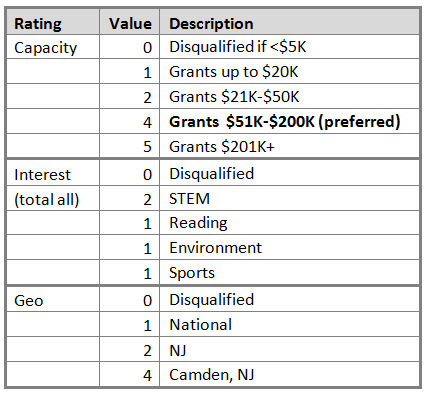
While we are going through the questions on the worksheet I might add or delete some of my questions as I learn more about the projects and needs. I also keep my ears open on which criteria are the most important. When we are finished with the questions I summarize and confirm which criteria are simply preferable and which ones will disqualify the prospect entirely.

An easy example is geography. If the foundation only makes gifts in New York City and the client organization is in New Jersey, the foundation is not a prospect.

The next step is to translate the worksheet answers into a rating legend. And by playing a little bit and giving some criteria extra weight – a higher rating value – I can get the prospects to sort out in a very obvious way based on the client’s funding needs.

By taking time up-front to determine what disqualifies the prospect and what is most important, I can zip right through the project. Doesn’t give where my client is located? Done with that one. Next!

CFRlegend

All’s Well that Ends Well

Some of my prospect ID projects have gone stunningly well and others not so much. The difference has usually been the quality of communication with the client and how early I discover that what the client wants just doesn’t exist. I’m careful now to do an initial search and communicate quickly if I am struggling to identify prospects that meet the agreed criteria.

Your organization might have a straightforward relationship with corporate and foundation funders such as asking for a grant and getting a grant, or you might have many layers to your corporate and foundation relationships such as providing the funder with volunteering, cause-marketing, or fulfilling other needs.

If you are tasked with corporate and foundation research you know you have just as much opportunity to help create wonderful and rewarding relationships as with individual prospects. Maybe you have helped the frontline fundraiser connect with your organization’s vendors, sourced donor relationships with corporate foundation executives or leveraged your organization’s constituency in other ways to identify prospects.

However you do it, identifying corporate and foundation prospects is different from individuals. And as is usual when working with together with other humans, success often requires good communication matched with the creative application of skills!

Do you have a prospect identification success story? Have you heard about new technology solutions for corporate and foundation prospecting? I hope you’ll share with us!

Other Articles You Might Like

Curious About Canada? A Primer for Prospect Researchers Who Don’t Own Hockey Sticks

Guest post by Preeti Gill

On this April morning, it’s -5 Celsius and the snow is blowing lightly.

I saunter in to my local Timmies, order a double double and a honey crueller, drop a few loonies on the counter and sit down for a while. It is tax time and I need to netfile before the CRA deadline. I look up from my keyboard and there’s Tony, the local hockey sensation, carrying his pet beaver on his shoulder…

Eh?

Oh, Canada, where donughts (not donuts), yoga pants and timed tweets were perfected. The land where conservative fiscal policy helped our big five banks cushion Canadians (somewhat) from the economic downtown of 2007/08.

I find that where we’re from makes us exotic, especially for other Prospect Research professionals who are always on the lookout for new resources.  When Jen and I brainstormed around blog ideas, she seemed intrigued by my Canadianness.

“How far is Ottawa from Toronto?” she asked this Vancouverite who is ill-equipped to comment on any Ontario-related matters.

What I can offer is a quick primer on today’s Canada for Prospect Researchers outside my homeland, strong and free.  Here you’ll find some interesting “Timbits” about what’s new and where to access information about your friendly Canuck prospects and donors.

We are accomplished

Our Government hands out accolades to everyday and high-profile brave and successful Canadians.

Our peers also honour each other.

We are diverse

Immigration is primarily driving population growth. Environics intelligence notes that in our major urban centres, Toronto and Vancouver, nearly half of the population identify as members of a visible minority group. So the minorities are fast becoming the majority.

Canadian Immigrant magazine profiles successful new Canadians in business and other areas.

We are rich

  • Well, they are (not me) –> Canadian Business Rich 100 2014 [List]
  • The left-leaning Canadian Centre for Policy Alternatives studied the wealth gap in Canada and discovered that the wealthiest 86 Canadians could purchase an entire province today. [News release]
  • How much did Canada’s top 100 CEOs get paid last year? The Globe & Mail is due to update this list with 2013 figures soon. [List]

We give back in a big way

  • The late Doc Seaman left $117 million from his estate to the Calgary Foundation last year. It’s the largest ever gift to a Canadian community foundation.  (Did I mention we’re getting older, as well?)
  • The Slaight family gave $50 million to a consortium of five hospitals in Toronto.
  • An impressive 13.3 million Canadians volunteer 2.1 billion hours, according to Volunteer Canada.
  • KCI provides an addictive scroll of recent Canadian giving by individuals, corporations and foundations.
  • Blackbaud’s new Giving Index provides a monthly snapshot of our generosity. (Things are looking up.)

We are social

…but slightly more conservative in our approach to shameless self-promotion!

  • There are 8 million+ LinkedIn users, as of 2013. [Infographic]
  • Twitter opened a Canadian branch in Toronto primarily to drive advertising and sales.
  • Planning timed tweets? You may be using HootSuite which was born in Vancouver and is rapidly expanding, thanks to securing $165 million in financing.
  • Can’t get enough of Canada? Consider attending the upcoming APRA-Canada conference in Toronto this fall. This is a highly-anticipated and well-organized biennial conference with a focus on Canadian-based research resources, issues and trends.

About Preeti Gill

Preeti-2Preeti Gill is passionate about all things prospect research, pipeline management and charity capacity-building. She works at Canada’s largest community foundation in Vancouver and blogs at Sole Searcher [preetigillyvr.blogspot.ca]. With true patriot love, she welcomes social contact here and there:

Top Secret! How to Bulk up your Prospect Pool

HappyKeySMIn this article I’m going to share the secrets of finding great prospects. Maybe you’re one of those fundraisers who is always reading the Business Journal scouting for a lead, but they don’t pan out. Do you wonder how those other organizations pull in the big gifts? Or maybe you’re new and all the best prospects are assigned to senior fundraisers. You can get great prospects too!

If you read a lot of blogs (like I do) now is where you get skeptical. Is she just going to give me theory I already know (and hasn’t yet helped me find good prospects) or will I get at least a couple of nuggets I can actually use? I’m aiming for the latter. The “trick” is that you still have to work hard!

Fundraising research theory tells us that you need to know who you are looking for so you can spot them. We use jargon like linkage, ability and affinity. And there are tools that give you a competitive edge with that. But you can do it even without bright, shiny tools.

The First Thing…

The first thing any good fundraiser (and prospect researcher) needs to do is learn what it looks like to be wealthy. Watching soap operas may seem like a good education here, but much better is reading through some of the wealth reports like the Knight Frank Wealth Report 2014. You’ll find links for other reports in the sidebar on your right.

And the second first-thing-any-good-fundraiser-needs -to-do is get in front of people, especially donors. You should read and get in front of donors at the same time. Start with known donors because they are the most likely to give (again) and it’s always better to get a gift, right?

Call, visit, and read.

When you are reading about the wealthy at the same time as you visit prospects you’ll start making the connections. When the prospect talks about how he and his wife are taking classes in gemology and he has a watch collection, you’ll remember what you read about this being an investment hobby for the very wealthy. And when a different prospect brags about taking regular trips to Europe on mileage points you’ll recognize that what you thought were luxury vacations probably aren’t.

You can do that without any tools except your eyes and ears. Well, I guess you need to use your mouth to place the phone call…and, okay, guide the conversation. But you get it, right? Recognizing the wealthy – the truly wealthy – takes an education.

Get Your Toolbox Dirty

Getting an education on spotting the wealthy still isn’t likely to fill your prospect pool with GREAT donors – those with linkage, ability and affinity. If you have tools that assign ratings to the prospects in your database, use them! Don’t be discouraged if it doesn’t work out perfectly the first few times.

For example, you might pull a report of people who rate high for ability and likelihood to make a gift, but find most won’t take your phone call. You may need to add additional criteria depending on your organization. Maybe it’s “donor within the past two years” or “attended an event in the past two years” or some other criteria that makes it more likely they will let you visit with them.

Keep track of your efforts so you can repeat what works best. And, yes, this does mean you will have to make a lot of phone calls that end in “no thank you I don’t want a visit”.

It’s the same even if you don’t have tools that provide ratings. Without tools you have to get more of an education. You might use a free tool like the Washington Post’s interactive map** of the nation’s super zips to identify wealthy zip codes to search for in your donor database and combine that with “donor within the past two years” or other criteria that suggest a “warmness” toward your organization.

The Secret Weapon

If you are really lucky, you have a trained prospect researcher on staff. Use all your fundraising powers of relationship building to get this prospect research wizard on your side!

HOT TIP: your researcher is likely to get the most excited about searching out top prospects if you reward her with feedback from your calls and face-to-face visits.

With a prospect researcher on your team you are more likely to out-produce even seasoned professionals in the race for fundraised dollars. Really, really!

…and if you can’t support a trained prospect researcher full-time, you can always outsource. Just sayin’!

**Julie, Prospect Research Analyst in Pennsylvania and Groundbreaking Student at the Prospect Research Institute, shared this fantastic resource with the class!

Did you get a nugget or two?

I hope you found a useful tip you can apply in your office. Maybe you have great suggestions you’d like to share with others. Please comment and share!

Jenz Favorite Wealth Reports

When Should You Look for Cold Prospects?

It's COLD out there!

It’s easy to tell fundraisers to look at their donors first, but are there times when it makes sense to look outside the donor pool? If so, when and how should you do it?

This may sound obvious, but usually the best time to go after cold prospects is after you have looked in your donor pool and need more. Apart from general donor acquisition, this might happen for a few reasons including:

(1) You need more major gifts than your current donor pool can support

(2) You need qualified prospects to fill board member positions

(3) You are strategically reaching out to a new constituency

Branching Out

When you are looking for more major gifts or new board members, a great technique is Branching. This technique is described in Prospect Research for Fundraisers: The Essential Handbook (p.26) and you might also hear it described as Relationship Mapping (p.175). The idea is that you take your high-powered, well-connected donors and trustees and put them at the center, branching their connections outward.

A simple, but great example, of this technique is demonstrated by Dan Blakemore in his blog post, “How One Web Search Led to a $20,000 Gift”. When the board chairman passed away and he needed to find donors for a named fund in his memory, Dan branched out from the board chairman’s connections to identify a donor who made a first gift of $20,000. Dan started with his existing donors, but he took an extra step outward and was successful. You don’t have to start with a huge project to get results.

Strategic New Direction

Branching exercises sometimes result in more of the same prospects because you are working within a network of connections. There are organizations that do not want more of the same. They make a deliberate decision to reach out to new and different constituencies. This might take the form of populating the board of directors with people who are more similar to the people they serve. It might also be a concerted effort to engage an entirely new group with the organization in a meaningful way.

In the book, Prospect Research for Fundraisers, we tell the story of Jeff Lee at Wycliffe Bible Translators (p.164). He was hired to build stronger fundraising efforts in Asian countries where Wycliffe operates, but also to build engagement with the U.S. Asian-American community, hopefully at some point in the future linking that engagement back to the home countries. Some institutes of higher education and other organizations are strategically building engagement with countries where new wealth is emerging, such as China and India. When you are starting out new there are usually few existing donors and relationships, so how do you go about it?

Building Up and In

In the U.S. there are many sources of information specific to industries, ethnic communities and more. For example, local Business Journals usually publish a “Book of Lists” each year. You can build a list of the top philanthropists in your community, the top business leaders and more. You can ask a researcher to build you a specific list, or as a frontline fundraiser you might start by, for example, joining a local association of Chinese business owners and using a researcher to help you get more information after you have identified specific individuals.

First you build up your list of cold prospects (some people call them targets, but that often sounds harsh to a fundraiser’s friendly ears) and then you make the inside, face to face connections, getting prospect profiles on individuals once you have made a connection.

Cold Prospecting Takes Effort

No matter how you go about it, cold prospecting consumes a lot of time and resources. Make sure you set yourself up for success. Following are some tips:

Plan & Track:
Make sure you have a plan in place. You wouldn’t just show up on a plot of land and build a house willy-nilly. Draw up a plan and track your progress periodically.

Polish Skills:
You may find it takes a different set of skills to engage a new group of people. Be sure to get any training you need. Network with colleagues who have done similar work successfully.

Educate Yourself:
You may need to broaden your knowledge of the culture and history, inside or outside of the U.S. Researchers can help you gather this information as well.

There are good reasons to do cold prospecting, but it needs to be treated with careful respect because of its expense. Just as you nurture donors acquired through direct mail to ensure you raise much more money in the long-term than the initial cost of acquisition, likewise you need to plan your major gift prospecting projects to ensure that they lead to large gifts and deep relationships.

About the Author

Jen Filla is president of Aspire Research Group LLC where she works with organizations worried about finding their next big donor, concerned about what size gift to ask for, or frustrated that they aren’t meeting their major gift goals. She is also co-author of Prospect Research for Fundraisers: The Essential Handbook.

Yes! You Can Still Raise Major Gifts Without a Wealth Screening

I sat next to Heidi Shimberg, VP of Development and Marketing for the Glazer Children’s Museum, at the Suncoast Chapter meeting of the Association of Fundraising Professionals in March. She told me an amazing story. In September of last year the Glazer Children’s Museum held its grand opening. Only six months later, they have a whopping 6,000 members!

Her fundraising dilemma? To do a wealth screening on 6,000 people would put an unhealthy bulge in the budget. “So why not filter your list and send a smaller number of records to be screened?” I suggested to Heidi. She had thought of that, but when you are brand spanking new, what do you filter by? She felt that if she filtered by wealthy zip codes or addresses, she might miss some “hidden” prospects. It troubled her.

As I was driving my cat to the veterinarian the next morning, my conversation with Heidi was on my mind. Then the light bulb went off. Heidi might not need a prospect researcher on staff, but she sure needed a prospect research strategy. She was averaging 1,000 members a month!

When there are no big dollars in your budget how do you get smart – and still get big dollars in gifts?

Depending on the amount of pressure to raise funds, Heidi has some fun choices.  She could go for the wealth screening and decide on a fundraising strategy for cultivating people with known wealth – maybe joining a special society as a first step and/or one-on-one meetings. Armed with the wealth screening she knows exactly who can give and won’t waste any time approaching members who can’t give.

Or she could swing wider and filter her list by addresses, making a first contact without any real wealth information. Cultivating more people in small groups instead of one-on-one would allow her to find “hidden” donors in her community. Ask the Benevon people about that one. It works.

I can hear you calling me to account. “But Jen, you have not addressed Heidi’s concern about missing the hidden prospects in her member list!” Well here’s the answer. Without a giving history to the Glazer Children’s Museum or any other history (like event attendance etc), Heidi cannot know a crucial piece of information – affinity, or how close someone feels to the museum. It’s just too new. You can’t screen for that on a newborn list. What she can do is methodically approach prospects while developing her entire member list.

Going from “A” to “Z” contacting 6,000 members is foolish. Heidi knows this. Picking 1,000 and working them in small groups will have Heidi training another gift officer next year when her well-stewarded member list, which has also been solicited for unrestricted operating dollars, gets filtered again for the next 1,000. And since she started with her best prospects, she can now feel better about having a trainee cultivating the “B” list. By year five there isn’t likely to be a “hidden” prospect, especially because now there will be money in the budget for a wealth screening on a well-kept donor/member database!

If we could all start out with the very best prospect research tools, so much more could happen. But that’s not reality and it doesn’t have to stop a fundraiser like Heidi from exceeding her major gift fundraising goals.

Aspire Research Group wants to see you succeed. If that means a one or two-hour consult to brainstorm for a mean-and-lean strategy, we’re all about it. Call us today! (727) 231-0516 or email jen at aspireresearchgroup.com.

Solicitation Approach for Distressed Donors

[Jan 2011 E-Newsletter Article]
I recently had the opportunity to meet up with Suzanne Nixon, State Director of Development for Devereux in Florida. We had such an interesting conversation that I asked her if I could share some of it with Aspire Research Group readers. Wouldn’t you know it, she said yes. Thanks Suzanne!

ARG: You have a lot of small and family business owners and other donors who have suffered with shrinking income and assets. Have you changed your solicitation approach with these donors?

Nixon: Yes, and I can give you an example. Some of Devereux Florida’s best and most passionate donors have found themselves struggling to meet their own and their peers’ expectations of giving. Thankfully, fundraising is not accounting so I have been able to help some of our donors reach a desired giving level by “stacking” their gift. One donor was able to make a gift by adding together several resources. She included a smaller than typical personal gift, adding that to one from her business and a third one from her family foundation. I was able to recognize her gift under the combined amount, which put her in a much higher giving level than any one of those gifts alone.

ARG: When do you use prospect research? 

Nixon: We are in a campaign to build a gymnasium and after my campaign cabinet has a brainstorming session I request a solicitation profile on the top four or five prospects that have surfaced. These are prospects my cabinet members already know, or know someone who knows them. Getting a solicitation profile at the identification stage makes sense for me because I have so little time. I need to know right away whether the prospect is philanthropic and what size gift might be possible. The solicitation profile gives me all the information I need to plan a strategy for cultivation or to disqualify early. When I’m ready to solicit for a gift I just ask for a profile update.

About Devereux:

The Devereux Foundation helps empower children and adults with intellectual, emotional, developmental, and behavioral challenges to lead fulfilling and rewarding lives. Devereux is a nationwide organization, headquartered in southeast Pennsylvania, positively impacting the lives of tens of thousands of individuals and families each year.

Devereux Florida operates nearly 50 programs in 38 counties statewide and is the largest non-profit provider of these services in the state of Florida. In 2012, we will celebrate 100 successful years nationally and 25 years of service in Florida.

You've got a million-dollar prospect! Now what?

$binocularI was having lunch with a client and when we had finished eating she pulled out a copy of the short profile I had completed for her. She wanted to know what the capacity rating “really” meant. Briefly here is how we dissected the information:

  • Her business is in a profitable industry and appears to be successful
  • Might have income around $1 million or more
  • Has numerous other small business ventures that could be bringing in money or losing money
  • Paid $8 million+ cash for a Manhattan, New York condo two years ago, intending to do renovations
  • Seems unaffected by the recession given her real estate purchases
  • Owns a large yacht, but has it for sale at $500,000+
  • May be tired of owning a boat or maybe she is beginning to feel pinched after splashing cash on real estate and renovations
  • Maintenance costs for her yacht could be $20,000 or more a year
  • No giving to other organizations was found, but she gave $40,000 to the first phase of the campaign and is very engaged

Once you have a million-dollar prospect – qualify her! My friend did a great job of cultivating and qualifying for inclination to give. If you suspect your prospect can give $10,000 or more and is willing to give, get a profile to qualify for wealth. After reviewing the profile and what she knows about the prospect, my friend can now ask for the right size gift for the prospect and for the campaign.

Qualifying prospects narrows our list to those that have wealth AND the desire to make a gift to our organization.