Tag Archives: Ultra HNWIs

Top 5 Capacity Rating Insights for Research Professionals

We’ve all been there. The gift officer needs a capacity rating “super quick” before meeting with someone. The electronic screening shows a low number, but the prospect’s occupation suggests there’s more. Sound familiar?

After years of calculating ratings, fielding anxious questions from researchers and fundraisers, and watching the gap between promise and reality, following are the top 5 capacity rating insights for research and prospect management.

1.No Matter What Rating You Choose – You Will be Wrong! (And That’s OK)

Surrender your anxiety! Capacity ratings can never be 100% accurate because too much of the information is private. Capacity ratings are directional, not definitive.

Your job is to provide the best assessment possible with available data. But if you want to feel anxious, get worried about under-rating the prospect not over-rating them. You want build your development officer’s confidence to ask boldly.

 2. HNWIs Are Your Blind Spot

The wealthier the prospect, the more likely their wealth is hidden. Private equity, angel investments, Delaware LLCs, family offices – none of this shows up cleanly in databases. Machine-generated ratings consistently undervalue HNWIs because the data needed to identify “whales” isn’t available for algorithms to process.

Accept that spotting transformative wealth still requires human intelligence and industry knowledge.

 3.  Estimated Net Worth vs. Gift Capacity: Know When Each Matters

Gift capacity ratings provide an assessment of a stretch gift amount from the prospect and the approach to calculating depends on the prospect. At Aspire, if someone appears to be below $1M in estimated net worth, we use the old-fashioned general calculations based on visible assets.

But if they are $1M or above, we place them in a net worth tier based on quantitative and qualitative data points and then take a percentage (typically 5%) of estimated net worth to create the capacity range.

 4. Data Isn’t the Strategy

Technology keeps promising instant major gift identification, but it’s not delivering for everyone, especially wealthy minorities such as women, people of color, and others. And we know that the best data is locked inside the donor’s head and heart.

As a researcher, you can go beyond gathering information and become the fundraising partner who translates pages of information into ways the development officer might take action with the prospect.

 5. Inclusive Research Pays Off

Traditional approaches miss wealthy minorities. But identifying prospects by demographic characteristics such as ethnicity can be ineffective and uncomfortable.

Instead, research with inclusive assumptions. Question your own biases when two similar prospects get different ratings. Check if you’re undervaluing first-generation wealth creators or making assumptions about giving patterns.

Moving Forward

Capacity ratings aren’t perfect, but they probably are not going anywhere. As A.I. creeps into our tools and makes all of our scores and ratings even better, we might find them eventually replaced or perhaps renamed and improved. But for now, you can make them as useful as possible while managing expectations about their limitations.

We all struggle with the same capacity rating anxieties. The most successful researchers combine data analysis with relationship intelligence, inclusive practices, and clear communication about what they know and don’t know.

Engage gift officers in conversations about how you arrive at ratings. Some of your best collaborations will come from fundraisers who want to understand your methodology. Join professional forums, attend APRA sessions, and don’t be afraid to ask for input from colleagues. Capacity rating is as much art as science.

And of course, the Prospect Research Institute has lots of resources to help you with capacity ratings!

  • Connect with other prospect research professionals tackling these same challenges in the FREE Forums at the Prospect Research Institute.
  • Invest in your education and buy the Capacity Ratings book or the course.
  • Check out the Institute’s Capacity Rating Section in our Free Library, which includes a capacity rating calculator download.


Public Company Insider. So What?

Maybe no-one in your fundraising office would say “So What?” but that does not mean they are not thinking it. What is the big deal about public company insiders and how can you succinctly convey that relevance in conversation – or even profiles? I have three things to say about that!

1. Years of Growth (or not)

Especially during economic volatility, a 5-year or 10-year chart of stock performance can visually demonstrate whether your insider is experiencing heady wealth accumulation – or not.

Because your insider is likely getting paid a cash salary and a cash incentive/bonus, those stockholdings represent long-term incentive and they grow at rates your savings account can merely fantasize about.

That means that if the stock price chart is moving up significantly in value, your insider’s stockholdings are highly appreciated assets that are untouched by living expenses.

What is that stock price chart? Oh that. That is your insider with “excess” assets making great rate returns.

2. Gifts of Stock

I do not know what percentage of insiders make gifts of stock, but at Aspire, we find a good portion of the insiders we research make gifts of stock. However, it is not always to an operating nonprofit.

But many times the stock is gifted to a family foundation, which is significant, or to a family trust, which is, again, excess assets making great returns.

Regardless of who the stock is being gifted to, the key point here is that the insider has the knowledge and maybe even has the habit of gifting stock.

When you reach a deeper relationship and the insider is keen to make a significant investment in your organization’s work, gifting stock may be an option your prospect already uses – no education required.

3. Counting Cashed Out Stock

It is possible to skim through the insider’s Form 4 filings for specific file types that indicate which sales of stock resulted in cash in the insider’s pocket. But you have your work cut out for you untangling them from all the sales of stock used to exercise stock options, pay taxes, or other sale types.

Aspire recently subscribed to Kaleidoscope’s Insider Focus research tool and it is the perfect use for A.I. The software has no problem making the calculations to tell me exactly how much stock was cashed out during a specified time-period.

This is an amazing number! Did your prospect cash out stock to the tune of millions of dollars in the past year or two? Now you can know with a click!

Knowing that this cash is above and beyond salary and bonus gives you a snapshot of what kind of money is “psychologically” available. In other words, it is money that the insider is already comfortable cashing out of stockholdings.

Even if this cash is being invested elsewhere, it gives you a sense of how much money could be available if the insider is deeply motivated.

When someone is an insider it is a good bet there’s significant wealth

For at least the three reasons above, if you are trying to identify $1 million+ potential donors for your campaign, or otherwise trying to spot the most capable prospects in your donor base, do not underestimate the insiders!

Money is never enough, of course. Prospects need to have an interest, be philanthropic, and be reachable, but there is no doubt that big visions need big money.

Do you need to learn to read SEC filings?

If you are looking for training on how to assess public company insider wealth from Securities and Exchange Commission (SEC) filings, check out the training offered at the Prospect Research Institute!

Curious about compensation and beneficial ownership, but also how to incorporate into capacity and the profile? This 3-workshop bundle has you covered! Enroll Now

Additional Resources

Insiders and the Paycheck that Keeps Paying

Most of us are familiar with getting a paycheck as well as the practice of receiving a bonus incentive for achieving top performance. And many people are familiar with investing in mutual funds to benefit from the stock market without having to manage a personal portfolio. But exactly how is it that public company insiders can accumulate such tremendous wealth? Is it just because the total numbers are bigger?

I have always thought of stock options and stock grants as the “paycheck that keeps paying.” If the company’s stock price continues to rise – and perhaps rise dramatically – the original option or stock value also increases.

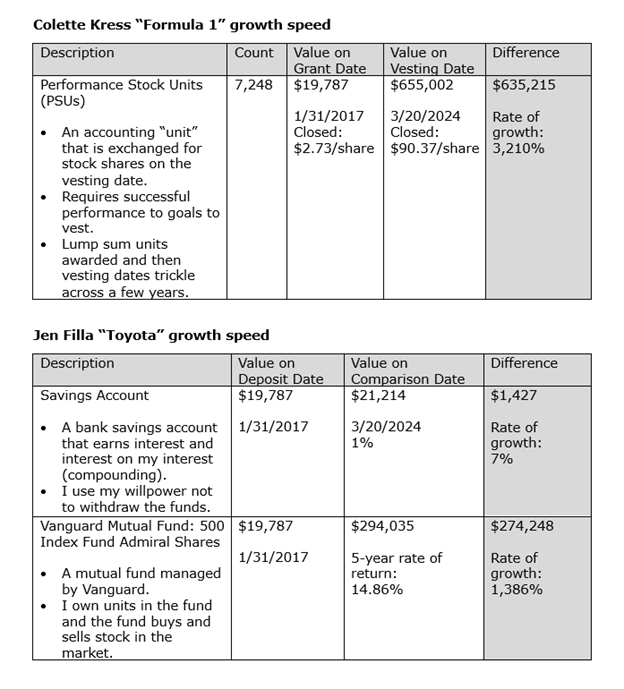
In my head I imagine I have my Toyota at the starting line with the insider’s Formula 1 race car next to me. Sure my “Toyota” mutual fund rate of return is awesome, but the insider’s “Formula 1” performance stock units can go so much faster!

But how does the insider make incredible gains on their incentive awards in real life?

NVIDIA Corp. (NASDAQ: NVDA) chief financial officer Colette Kress is our obliging volunteer with a demonstration below.

The savings account is not even a real comparison is it? In that scenario, my Toyota is more like a beat-up, barely moving, 20-year-old Toyota compared to the insider’s Formula 1 – and that is with what has been a generous, harder to get 1% rate!

But when we get to a double-digit rate of return on the mutual fund – which is invested in the stock market – we see something close to a comparison to the NVIDIA stock rise — but not really. Why? Because NVIDIA stock rose in value faster and I had to make the initial investment. Ms. Kress was given the stock for her performance. Yup. The paycheck that keeps paying!

At this point someone usually reminds me that stock prices can go down, too.

This is true. But for a public company executive insider like Colette Kress, she earns a cash salary and bonus every year too, which has been around $897,000 from 2022 through 2024.

Her Performance Stock Units are a long-term incentive (i.e., long-term bonus). She receives her annual salary and short-term bonus in cash and her long-term incentive in performance stock units (PSUs), which vest into stock a little bit each year — adding a very generous layer of stock value.

This is Why I Say That Long-Term Incentives are Like the Paycheck that Keeps Paying

Hopefully, this example gives you a better perspective of how stock is an outsized addition to salary and cash incentives in the compensation package. And it is not just the executives who receive stock as part of their compensation package.

Top executives are considered insiders and must publicly report their compensation, but management and other employees likely receive stock awards, too. Just not quite so many!

When your prospect is a public company insider this automatically indicates the potential for significant wealth.

To know how much – or how little – requires some knowledge and skill. This is where the prospect research professional steps in to clearly present the full wealth picture of a prospect.

If you are looking for training on how to assess public company insider wealth from Securities and Exchange Commission (SEC) filings, check out the training offered at the Prospect Research Institute!

Curious about compensation and beneficial ownership, but also how to incorporate into capacity and the profile? This 3-workshop bundle has you covered! Enroll Now

Want to know more about insiders? Check out “Why Insiders” by Elisa Shoenberger.