Back to the Future with #ResearchPride

Are you familiar with the imagery of a devil on one shoulder and an angel on the other, both whispering in your ear, trying to influence your behavior? In the information services field it sometimes feels likes we have artificial intelligence on one shoulder and humanity on the other, each trying to get us to follow the path on the right or left.

Does it have to be one or the other? Good versus evil? Artificial intelligence versus humanity?

I had the privilege of interviewing prospect research thinker Valerie Anastasio recently for the Prospect Research #ChatBytes podcast. Years ago when the Apra Talks first debuted at Apra’s annual international conference, she was one of the first presenters. She talked about profiles and the future. Would artificial intelligence take over our profession? Her message: the march is on …but we are just as important as before!

If you haven’t listened to Valerie’s 20 minute podcast yet, I give you permission to go ahead and take a tea or coffee break right now.

Valerie walks us through the dawn of the internet right up to the data aggregators and social media firehose of information available to us now. She talks about what our profession has lost sight of and the opportunities it is gaining as it moves into the future. It’s good stuff.

Advances in information technology have transformed the prospect research profession. Even so, our primary role remains the same. As prospect research professionals we provide the information necessary to guide and support the fundraising effort – the relationship donors have with the organization.

How and what kind of information we provide has changed and will continue to change.

I won’t spoil the podcast for you and share Valerie’s vision for what that change might look like in the future, but I will share with you how you can change your mindset in a way that prepares you for the future of our profession.

  1. Don’t sell products; sell service partnerships. So often we refer to our work as a “product.” We can give you a profile, a wealth screening, or data analysis. The future is in partnerships. We can listen and understand what you need to move fundraising forward, and translate the information to get you there.
  2. Be a sales person. That means communicating in the way your end-user prefers, which could be on the phone or in-person. It also means actively marketing your services. Why should anyone care about the all-in-one rating you created to prioritize the prospect pipeline? Listen to their “pain” and “speak” the solution.
  3. Omit the details. Prospect research must still understand and be accurate in the details, but don’t torture your end-user with them. Big picture thinkers often make good leaders, but they won’t listen to you drone on about all of the options. Listen to them, decide what you think will work best, present the solution confidently, and then you can keep tweaking until it works.

Back to our devil vs. angel imagery, if the march of artificial intelligence is already on, which shoulder should you be listening to – artificial intelligence or humanity? Both! Valerie listens carefully to the voice of artificial intelligence, the advances in information technology, but also to the voice of humanity, the way in which humans behave and relate to one another. She combines them both to create a central path for her organization. This is the path that leads to the deepest connections with the most capable donors.

As you listen to the prophets and skeptics of artificial intelligence, remember your history, and consider Valerie’s description of her experience with the internet revolution. Change doesn’t happen overnight. It will happen, but probably not quite the way we all expect it to.

One thing I am certain about: prospect research professionals will continue to provide invaluable support to their organization’s fundraising programs. So go on, indulge yourself in a little #ResearchPride!

Additional Resources


How about a fun way to show your #ResearchPride at the office?

Click here for #ResearchPride Swag

Women’s Hack Guide to Prospect Research

Did you know that International Women’s Day is March 8, 2018? Get ready! In honor of women, the Day, and with some recent inspiration from a #FemaleFund Tweet-up hosted by Preeti Gill (@SoleSearcherPR) and Vanessa Chase (@vanessaechase), I thought I’d depart from the usual and have a little bit of tongue-in-cheek fun!
You see, during the Tweet-up I mentioned that my biggest challenge in researching women is that the traditional public sources are weak on information about them. Sarah Bernstein (@srbernstein) mused that since prospect research, like other fundraising careers, is still mostly done by women, are we creating many of our own biased tools?

And the seed to the Women’s Hack Guide to Prospect Research was planted!

(Don’t worry, men, you can read this, too, and still get some great search ideas.)

Preparing for Your Day

  1. Make some coffee.
  2. Review/write your task list for the day, incorporating meetings on your calendar and when you’ll accomplish household errands in between everything else (because you pass the dry cleaning on your way to the library where the book you requested is waiting, and you can finally return your child’s overdue library book, which you found when you were cleaning this weekend).
  3. Mentally separate tasks that require deep focus and those that you can do while chatting with someone who stops by your desk (including updating the database record while the gift officer tells you about her visit with the prospect you just researched).
  4. Sip your coffee and start your research!

Shifting to Inclusive Research

  1. Using the “inside-out” approach, efficiently work through the usual tools, collecting information, but then, regardless of the level of profile, stop and shift to one or two alternative or less traditional search approaches.
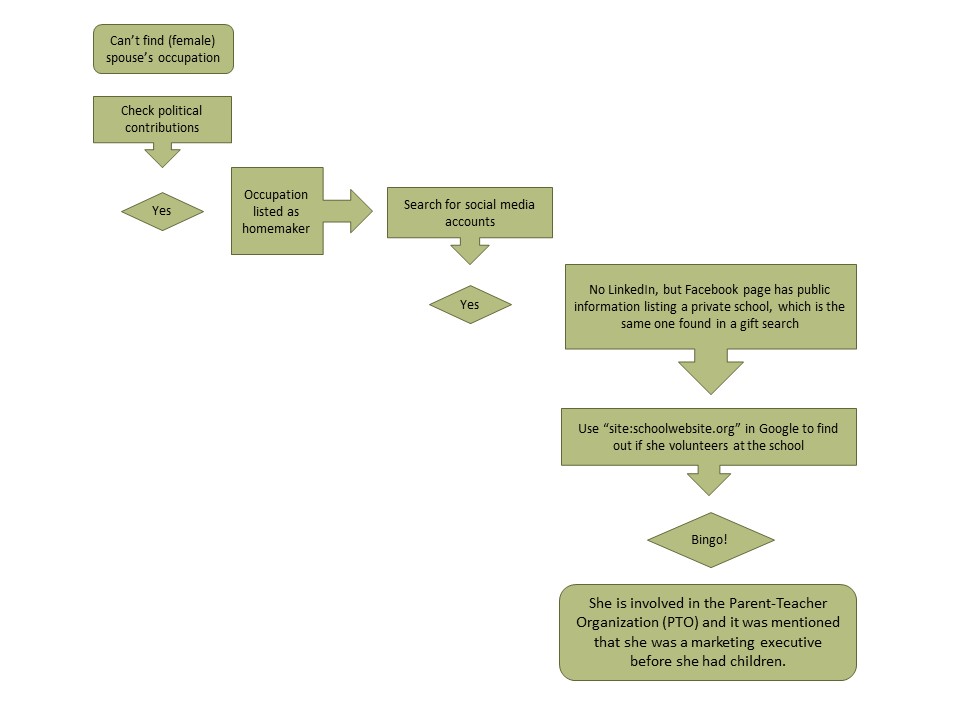
  2. Document your alternative search strategies to keep track of what works as you proceed with your research, such as the following:

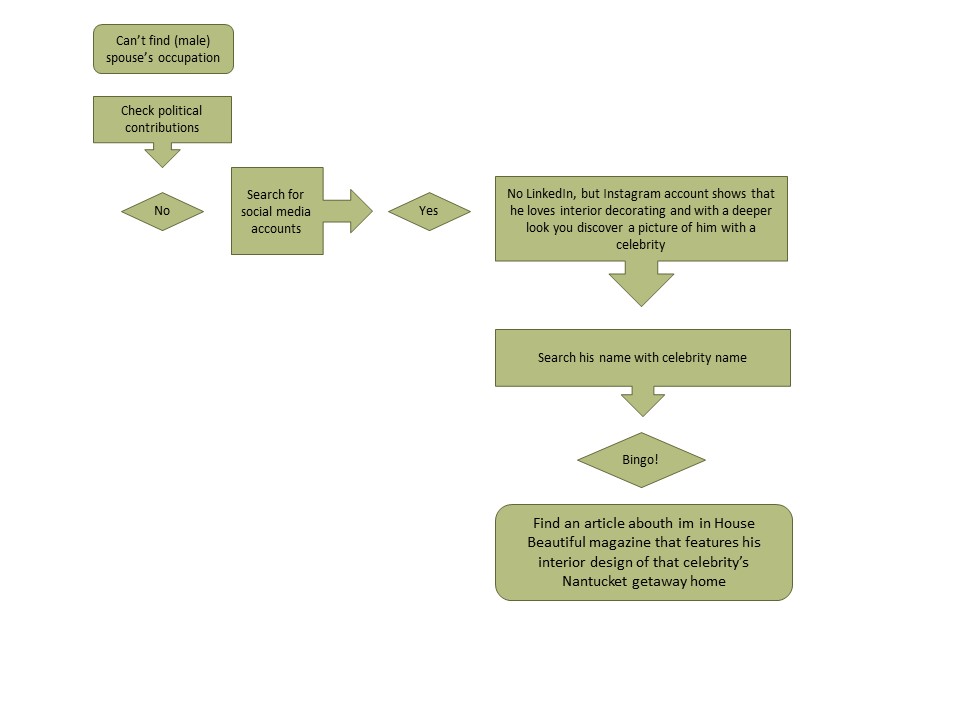
Female Spouse

Male Spouse

  1. Social media is sizzling for you today! Add the social media sites to your bookmarks, especially if there is a separate search page.
  2. Download a few articles and blog posts about Instagram and Pinterest onto your tablet because you don’t have your own account on them – yet! (and you know you’ll have at least a 30-minute wait when you take your teenager to the doctor’s office later this week – they are never on time.)
  3. Make more coffee! (or switch to tea)

Winding Up Your Day

  1. Hand-deliver the prospect profile to the gift officer because you know he’s excited about his upcoming meeting in the couple’s home. When you mention that the woman was a marketing executive and he dismisses it, listen as you weave the story about why it’s important (The giving is either in her name individually or as a couple, suggesting she is the philanthropic driver in the household. She held a top position at the marketing firm and would probably be a great fit for and open to serving on our development board, while her husband appears overstretched serving on multiple company boards building his career. The children are teenagers and she might be thinking about what she wants to do next – it’s good timing!)
  2. Make a mental note to add information like that to the profile next time!
  3. Pat your back because you just advocated for a woman AND put your organization in a better position to deepen its relationship with a donor.
  4. Finish your last cup of coffee before the commute (race) home begins.


Additional Resources

Get Ready to (Prospect Research) Work in 2018!

Back in 2016 when Mark Noll posted “When Technology Killed the Fundraising Star” I wasn’t wholly convinced that Skype was about to replace face-to-face major gift visits. Then, only a little over a year later in August 2017, The Chronicle of Philanthropy wrote “15 New Fundraising Ideas That Worked: Part III” and included one about digital-gift officers. Could it be?

When I look back over the PRSPCT-L list-serv posts in 2017, the eye-popping number of prospect research job openings really gets me thinking about more than the research we perform. It has me wondering about the conditions under which we do it. The nonprofit world is not particularly known as cutting-edge leadership when it comes to managing its workforce, but I muse about whether fundraising could lead the way in helping to redefine the workplace.

Development officers must travel and nonprofits and institutions have been right there with for-profit sales offices in establishing “field offices” where fundraisers work out of the home office in the geographic location where their prospects live. As digital-gift officers emerge, why do they need to be located in a specific place? And with nonprofit leadership skills in hot demand, more leadership candidates are using that leverage to demand to work remotely, too.

And then there’s fundraising research – interacting intimately with development officers and headquarters. Prospect research is also in a great position to work from home!

But you don’t have to listen to me speculate. You can listen to three real prospect research professionals tell you about their experiences working remotely. Warning: it isn’t all sugar and spice.

I was inspired by how candid the panelists were. Pioneers all three! And it felt so good to be among fellow prospect research professionals who share so many of the same experiences working remotely that I experience. It can feel isolating to be the only prospect research professional in a fundraising office, but that gets compounded when you work remotely!

If you work remotely you will love to hear the stories of these three women and if you don’t work remotely, but want to, you will gain a lot of practical and tactical advice. Developing rapport and maintaining presence in the virtual world requires a new skill set. Thankfully, whether you are a development officer or researcher, fundraisers happen to be well placed to learn the ropes!

More Resources

Can You Spot the HNWIs in Your Database?

So much of what we do in prospect research revolves around finding wealth. Sometimes it sounds like the only thing we talk about is money! As I finish facilitating another Capacity Ratings Workshop at the Prospect Research Institute I am heartened to reflect that in every discussion we had about the money, we were irresistibly drawn to another rating – affinity or engagement.

I’m not trying to suggest that we don’t need to be really good at spotting high net worth individuals (HNWIs) in our database. We do! When we segment our database by wealth we are better able to focus on finding what really qualifies someone as a major gift prospect – how engaged or aligned they are with our organization.

Following are some tips for finding HNWIs who also demonstrate affinity for your organization:

  • Go Beyond the Screening: Yes, verify the information in your top-rated segment, but don’t assume no-one else in your file has wealth. Professional researchers know how to identify the hidden HNW gems such as private company owners, women volunteers, and wealthy families.
  • Prioritize Giving: Don’t get blinded by bling! High lifetime giving and monthly giving are great indicators for planned gifts. The savvy researcher might look for things like long-term home-ownership, too. It’s all about knowing your unique constituency.
  • Leverage All of Your Data: When the gift officer and researcher work as a team, you can test out what pieces of information best prioritize your top prospects. Is it attendance at multiple events? Donors who have multiple points of communication or participation? Donors invited by other top donors to participate and give? Create a feedback loop!
  • Research Wisely: Profile research isn’t about completing a form anymore. The software tools do most of that groundwork for you. When you know what wealth looks like and you know what a top donor to your organization looks like, you can research wisely. Spend more time on the most relevant information – connections to and interests in your organization.
  • Prospect Smartly: Truth is that even if you are at a college or university, at some point most organizations will need to reach out to people who are not part of our existing constituency. Getting good at finding connections and having a researcher-gift officer team to better clarify what a top donor looks like to your organization (wealth + affinity) will position your organization to seize external opportunities for major gifts.

Knowing what a HNWI looks like takes practice. Read the wealth and philanthropy reports published by places such as Indiana University and Capgemini. Once you learn to distinguish between someone living comfortably and someone who has significant wealth, the next step is to understand how HNW donors give differently from others. Cultivation and messaging for this group is distinct.

And the next time you are talking about wealth or estimated net worth and someone asks, “Isn’t it more important to know if they are philanthropic?” – you now know the answer! There has to be both wealth and philanthropy to raise major gifts.

More Resources

Pictures and Patterns: Decision-making with Fundraising Insights

Imagine you emerge from a strategic planning session and your task is to raise more money from corporations. Your organization wants to expand its reach and you need to take the thousands of corporate donors in the database and transform them into a fundraising program. Why? Because everyone “feels” like there is a lot of opportunity there. Where do you start?

One of the most common mistakes in fundraising is to make decisions and invest money and resources in strategies that are based on intuition and anecdotal evidence alone. Let’s face it, sometimes it works, and maybe that’s why the behavior is so persistent. But much of the time data-weak decisions fail miserably, often slowly and painfully with lots of fingers pointed. There is a better way.

Leverage the talents of prospect research to paint pictures and identify patterns!

Well-trained prospect research professionals are methodical and analytical. That means that we enjoy solving problems, untangling messy information, and putting order to chaos. Share with us your dilemmas, your problems …your fundraising hopes and dreams. We can help you succeed!

In the new corporate fundraising program example, it means painting a picture of our corporate donors:

  • Where are they located?
  • How many of them are there and at what giving levels?
  • How long have they been donors?
  • Are they small, closely held companies, or large corporations?

And then identifying clusters and patterns:

  • Are there groups of donors in particular industries, geographic locations, or company size?
  • Do the donors that give the most and most frequently have anything in common?
  • Is there anything about the data that can help us understand the giving behaviors? Can we see any correlations between data points?

There is no standard checklist for exploring this kind of information. It requires a keen understanding of the fundraising being undertaken matched with an analytical mind trained in using data to solve problems.

When a prospect research professional works with you to explore your data and make an initial assessment, you can decide on strategies and tactics that will raise the most money now and in the future.

For example, you might discover some companies are more “ripe” for a new approach than others. If they have been giving frequently and increasing their giving, visiting them and discovering their philanthropic needs might uncover a unique corporate approach for your organization that you hadn’t thought of!

Knowing that your best donors are dominated by small, closely held companies gives you the opportunity to find out why. What makes your organization so attractive to them? Are they really individual donors in disguise or do they have company objectives for their philanthropy?

Uncovering an unusual pattern, such as expressions of faith on the company website, might give you an insight that challenges the way you perceived your donors and that opens the door to much deeper relationships.

Fundraising success through insights is not so much about the tools – data mining, statistical analysis, profile research – it’s about giving the donor story inside your data a voice.

When you hire a prospect research professional to help you understand your data, you are hiring someone with a unique skill set – someone who can uncover and communicate the “story” inside your data.

More Resources

Can you Achieve Faster-Better-Cheaper Profiles?

“I need a profile on this person today…can’t you just Google it?” It’s the kind of question that makes prospect research professionals cringe. But why shouldn’t a development officer want it faster, better, and cheaper? Why is your organization paying thousands of dollars a year for research tools if it still takes forever to get the information needed?

So what’s happening to cause this disconnect between development officer and prospect researcher? I suspect there a few causes, but first, let me tell you a story…

As a consultant I charge a flat fee for projects. I want my clients to be able to budget, and as a professional I should have a fair idea of how long it will take to do the research. Profile-type research falls into this category. And it’s this kind of pressure that keeps us razor sharp. It’s me and the team against the clock!

That’s how I “rediscovered” one of my favorite tools the other day – DonorSearch.net.

Faster-Better-Cheaper with DonorSearch.net

At Aspire Research Group we’ve taken on a few new clients that, in addition to standard profile research, needed some “situational” research done. Things like prioritizing, quick checks to be sure assigning for a visit is appropriate, or key items researched to prepare the president. So I asked myself, “How could we manage our time researching, keep up the high quality of information, and make it the right price?”

In my quest, I took a fresh look at our tools and settled on DonorSearch to start our projects. Of course, being able to upload a small batch of names for a prospect screening is a time-saver, but even when we entered only one name into the Integrated Search, suddenly everything was at our fingertips. DonorSearch had made so many updates to their product – the combined result meant we could be very competitive.

For example:

  • Time Management: The big name family business was clearly the source of wealth, but why was the prospect not listed on the website? Open Corporates in the Integrated Search demonstrated a long list of companies where he was a director – many with the same word in the name. From there a quick Google search revealed his specialty in the family business. Faster.
  • High Quality: There was a large, outlier gift to an organization with a strange name. I didn’t want to put it in the list without checking, but didn’t want to have to do a distracting search. A click on the source link gave me a searchable PDF – and lo and behold – it was an organization with a mission similar to the client! Better.
  • The Right Price: By letting the tool do all of the upfront “grunt” work finding relevant information we spent less time gathering and more time thinking, and that meant we could charge the right price. Cheaper.

Ask the Librarian: Can’t you just Google that?

But if you really want your research to achieve the business mantra of better-faster-cheaper, you need more than a great tool like DonorSearch. You need to start with a really good understanding of the need and continue with really good communication throughout.

So why do researchers get asked to Google it in seconds flat? Let’s go ask the librarians! Librarians are trained to interview the customer. When you go to the reference desk, the librarian has to figure out what you are trying to accomplish and then help you navigate your way to success.

While we don’t view the reference librarian as an expert on the subject matter that brings us to the library, we do view the librarian as someone who has received training in library science and is an expert on helping us find information. The librarian is a professional.

The “just Google it” request suggests that any amateur without training can perform quality prospect research, which can be insulting … but it also happens to be a great opening for a really good conversation to clarify the  problem to be solved.

Professionals are Always in Demand

The more that software tools are able to do, the more important prospect research professionals become. Librarians don’t worry that books will put them out of business!

And on the flip side, the more that software tools are able to do, the more we must use our communication and problem-solving skills to provide flexible, custom solutions.

If you manage a prospect researcher, if you are a prospect researcher, or if you want to be a prospect researcher, you can arrive at better-faster-cheaper profile research if you recognize the importance of great training (including communication skills) and tools. It’s what qualifies us as prospect research professionals!

More Resources

Cure Analysis Paralysis with this Visual

In this wonderful era of exciting, off-the-shelf prospect research tools and one-click-away data analysis, how is it that we still struggle to prioritize our donors and prospects? But we do. The results come in, the scores are assigned and yet there are still way more highly-rated prospects than our staff could possibly contact. Which names do we call on first?
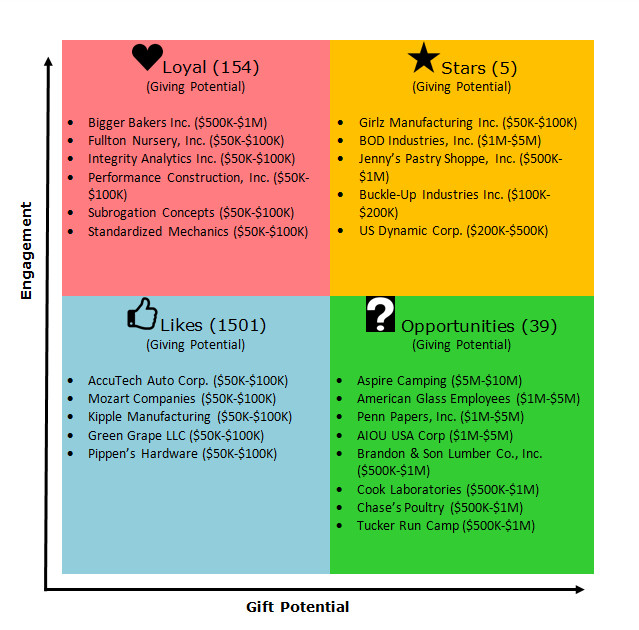

Human brains are not wired to interpret and act upon long lists of names with appended information, such as those found in our databases and Excel spreadsheets. And when you need 50 names, but there are 300 that all have the same top score, it can be paralyzing!

Whenever I hear about data visualizations I always see pictures of charts and graphs in my mind’s eye. But when I was grappling with how to deliver a prioritized prospect list to a client recently I decided against charts and graphs. I wanted something that would give them a colorful visual with graphics, but also actual donor prospect names with dollar signs.

The organization had decided to create a more formal corporate giving program. It had been happening accidentally and now they wanted to get serious. So she sent me a list of over a thousand of their best donors based on giving history. My job was to sort it out and send it back.

We decided to focus on two variables that we labeled engagement and gift potential. Engagement was based on RFM scoring, which stands for recency, frequency, and monetary and represents a giving history analysis. We also appended some estimated sales and other data to determine gift potential.

As you can see from the picture below, the key to the data visualization was limiting the presentation two only two, easily understood and highly relevant variables. (The information in the grid is fictional.)

Click to enlarge

Following is how you “read” the picture for this donor list:

  • Stars = high engagement, high gift potential
  • Loyal = high engagement, low gift potential
  • Opportunities = low engagement, high gift potential
  • Likes = low engagement, low gift potential

I knew that my client, a talented fundraising professional, really wanted to begin her efforts with a fighting chance of receiving major gifts in the first year. Who wouldn’t want that? It was up to me as a researcher to understand how to translate the organization’s fundraising program intentions into data points, create or get those data points, and then translate it back into fundraising actions.

My client didn’t need to understand exactly how I sorted and filtered to assign donor prospects into each of these categories. She needed to be able to recognize some names, be pleased and surprised to see some names she didn’t recognize, and be able to quickly make decisions about which ones she will call tomorrow.

No matter what kind of fundraising professional you are – front-line, prospect research, or something in between – you now have a simple way to visualize two variables that you can ask for or apply to the data yourself.

If you have a data visualization triumph I’d love to hear about it! Reply to this email or better yet, comment on the blog post.

More Resources

Fake News, Research, and Fundraising

In prospect research, the rule-of-thumb has always been to find at least one, and preferably two, corroborating sources for information found on a prospect. With the onrush of data, technology, and some of humanity’s evil proclivities, could that rule-of-thumb all too easily turn into a sore thumb?

The idea that completely fake stories circulate on the internet in pursuit of clicks and the resulting ad revenue – and that these stories are obscenely successful – makes me feel like I’ve reached for my wallet to pay for a meal only to discover my purse was stolen. At some point in our lives, most of us have done a quick Google search to answer a question and have taken the results at face value without clicking through to more carefully verify. I’ve certainly done it.

As the prospect profile shapeshifts in response to really good aggregators and an on-demand, as-needed approach to fundraising, could we be duped by perniciously false or even simply erroneous information?

I’d like to believe that prospect research professionals already go beyond the corroborating source rule-of-thumb and consider the quality and reputation of the source, the date, and the sensitivity of the information, especially when there appears to be a lot of value-laden words or outright bias.

A simple example of this is a Wikipedia article. While Wikipedia provides a nice summary, clicking through the article’s sources and reading the original cite is critical. Another example that came up recently on the Apra PRSPCT-L list-serv was evidence of a criminal record.

Sources such as Lexis Nexis for Development Professionals allow us to see certain criminal records. Sometimes we find news articles, court documents published on attorney websites, and other sources, too. We worry about the risk to our organization’s reputation and whether the information will impact a prospect’s ability and interest in making a gift. But understanding the process for convicting someone and finding all the information can be a time-consuming, complex task.

In addition to complex information such as a criminal offense, we now face completely false information in our quest to better understand our prospects. Right now I can feel a whole day slip away trying to research a false news story… can we efficiently and deliberately navigate this mine field?

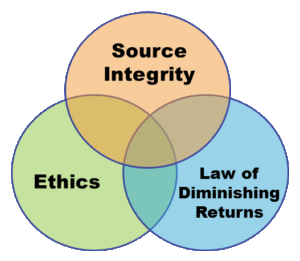
Yes we can…but only if we have a Venn diagram!

There are three key competing demands as we evaluate the information we find:

  1. Source Integrity: Most of us are pretty good at this. We know that the government is likely to be a more credible source than an industry blog. We also look for corroborating sources, dates, and even the language used.
  2. Ethics: Apra (the Association of Prospect Researchers for Advancement) as well as AFP (Association of Fundraising Professionals) both have guidance on ethics. Your organization probably has policies and documentation on gift acceptance, prospect management, and more that can help you make decisions.
  3. Law of Diminishing Returns: As we chase the details of any piece of information there comes a point where further research is without value. You might not need to know all the exact details about a criminal offense to make a decision about a prospect. Knowing when to stop is tricky. Ask for help!

All of these three items overlap to find the sweet spot for dealing with prospect information. It doesn’t matter if you are finding quick information before a visit, verifying a prospect screening, or digging deeper during cultivation and solicitation. Questioning sources is just as important as it ever was.

Consider this: voice recognition is getting so good that with enough recorded voice to learn from, machines can fabricate new audio recordings that sound exactly the real person. Next up? Completely fabricated videos.

The rapid pace of technology is enough to cause alarm! It’s comforting to remember that we have the fundamentals, such as the three elements of the Venn diagram above. All we need to do is stay aware and apply them to the ever-changing online world.

More Resources

How do I make prospect profiles work for me?

I work with quite a few fundraising professionals who are taking a leadership role for the first time or are heading into their first ever serious fundraising campaign. Suddenly you have to figure out how to make the leap into managing significant gifts and create a major gift program that delivers. That’s a lot of pressure!
.
So, of course, you demand – and get – a budget for prospect research. Way to go! Now what?

What is prospect research exactly and how does one USE profiles?

As I mentioned in Re-Wiring the Trusty Profile, it helps when you and your team discuss and recognize how and where traditional prospect research, such as profiles, fundraising analytics, and relationship or prospect management intersect at your organization. Even in a small team, you’re no doubt running a full development program. Research will likely touch many parts of that program.
.
For example, I had a researcher describe to me how her initial snapshot profile went directly into the donor database for prospects that were assigned for a first visit. It was up to the gift officer to print the snapshot report and make the visit. Is that traditional prospect research (e.g., snapshot profile) or prospect management (e.g., proactive prospect assignment)? Well, it’s both, isn’t it?

But to know what you can get out of a profile, you need to know what goes into it.

In 3 Strategies to Choose a Research Tool I show you a graphic and describe the five building blocks of the profile. This structure identifies what information is relevant for fundraising, but your profile format could be any kind of mix-and-match from these building blocks.
.
In Can You Really Trust Prospect Research? I talk about some of the commonly held misunderstandings about the voo-doo we researchers do. There’s a lot of confusion about what information we can find and how accurate or complete it can be.
.
As a fundraiser meeting with donors, you are performing primary research. You find out all of the information we researchers usually can’t. In your face-to-face meetings you discover people’s philanthropic passions, family and health situations, and their interests and personal connections to your organization. What information do you need to perform those visits and ultimately ask for a major gift? Once you understand the five profile building blocks, you will be much better placed to answer that question well.

But the very best move you can make to use PROFILES WITH POWER is to communicate with your researcher!

With the five building blocks of the profile as your conversational guide, examine what you need to know at each stage of your interactions with donor prospects. What does your researcher recommend in terms of software subscription tools versus manual research?
.
In some situations you might do well with a quick look-up in a tool on your own and a first visit before asking for a researched profile. And sometimes getting a researcher’s edge from out of the starting gate will deliver better results in a shorter period of time.
.
Once you understand what you need and when, can you break it down into two or three types of standard profile requests? Of course you can always make exceptions – you’re the boss! But standardizing your practices will make it easier to manage expectations and easier to onboard new staff as you continue to grow.

Prospect Research is good and exciting work!

Discovering people’s paths to wealth and their expressions of philanthropy is sheer pleasure. As a prospect research professional I love being part of the team that connects people to the joys of giving. When I can work closely with a front-line fundraiser to cultivate and solicit a transformative gift it’s a breath-taking experience!
.
The power of profiles can be yours – especially if you treat your researcher as one of the fundraising team. Who knows? Your prospect research professional might just turn out to be your secret weapon!
.

More Resources

Learn to perform basic prospect research and find information on your prospects – fast!

Get your free Knowledge Seekers membership and gain access to profile templates, commentary, and more. Click here to discover Prospect Research Institute’s learning community.

Researcher, are you cheating your organization out of money?

As a prospect research professional, do you routinely underestimate the giving potential of your organization’s prospects? Take the quiz below to find out!

  1. Have you ever taken the gift capacity amount and reduced it because the prospect had never made large gifts to your organization?
  2. Have you ever used a gift capacity rating calculator and lowered the result manually because you just couldn’t believe the prospect could give that much money?
  3. Have you ever calculated a gift capacity rating based only on assets you could get numbers for, even though the prospect was in a top wealthy list or had a lucrative occupation?

If you answered “yes” to any of the questions above, you might be suffering from Concrete Moneyitis.

Concrete Moneyitis is a syndrome characterized by the following symptoms:

  • Belief that visible philanthropy and visible assets are the only evidence on which we can rely
  • Belief that capacity ratings are straightforward mathematical calculations
  • Belief that donor prospects are just like you and me
  • Fear of being “caught out” for erroneous assumptions or inaccurate information

Okay. Concrete Moneyitis is not a real syndrome. I made that up. But it is a real “thing”. It’s about our own personal money issues interfering with our work to connect people interested and capable of giving with our organization and mission.

I am a prime example of this! When I graduated high school I was 16 years old. Nice head start on the adult life, right? That summer I gave birth to a baby girl. The following 13 years I worked and scraped up enough time and money to earn my bachelor’s degree. I counted every penny and spent lots of creative energy figuring out ways to provide for my family and my education.

As a result, when Bill Gates made his first big splash in philanthropy I was very judging. How could he have been so ruthless, squashing competitors on the fine line (or over the line) of legal business practices, and now be “saved” by giving it away? Was it fair for him to get super rich on the “backs of others” and then get lauded and praised for doling out cash where and how it suited him?

I consoled myself that at least he was giving it away. I knew of too many of the very wealthy who didn’t make any philanthropic gifts.

And then I jumped into the business of performing prospect research as a consultant. Working for all shapes and sizes of organizations, having to price my services, and becoming savvy in the ways and means of the ultra-wealthy brought me in direct conflict with my judging money beliefs.

As a person, I still have a set of money beliefs that guide my behavior. As a prospect research professional I do my absolute best to set those beliefs aside when I do my work. I know and stay fully conscious of the fact that the people I research are NOT like me. Their giving is different from mine – and not just in size!

I work for amazing organizations whose missions make a tremendous impact on lives and on our environment. I don’t need to decide on the big philosophical questions about wealth and philanthropy. I want and need to be a part of the fundraising team, helping donor prospects connect with organizations in ways that meet both parties right where they are, in the present.

I challenge you to consider how your beliefs about money and philanthropy might be affecting your work as a fundraising researcher. I challenge you to worry more about under-rating prospects and less about being “right”. How many times has a gift officer asked for thousands – perhaps millions – too little because you wanted to provide a “conservative” estimate of wealth?

Your organization is worth overcoming a little bit of fear, isn’t it?

More Resources You Might Like